A sudden hiss from your rear wheel can end a good ride fast. Glass in a city bike lane, thorns on a country road, or sharp rocks in the Southwest can all cause a flat. Yet a heavy, armored tire can feel slow on every climb.
US riders face more than flats. Poor cornering grip, wrong pressure, and early tread wear are just as common. Each one comes back to how you choose and set up your tires.
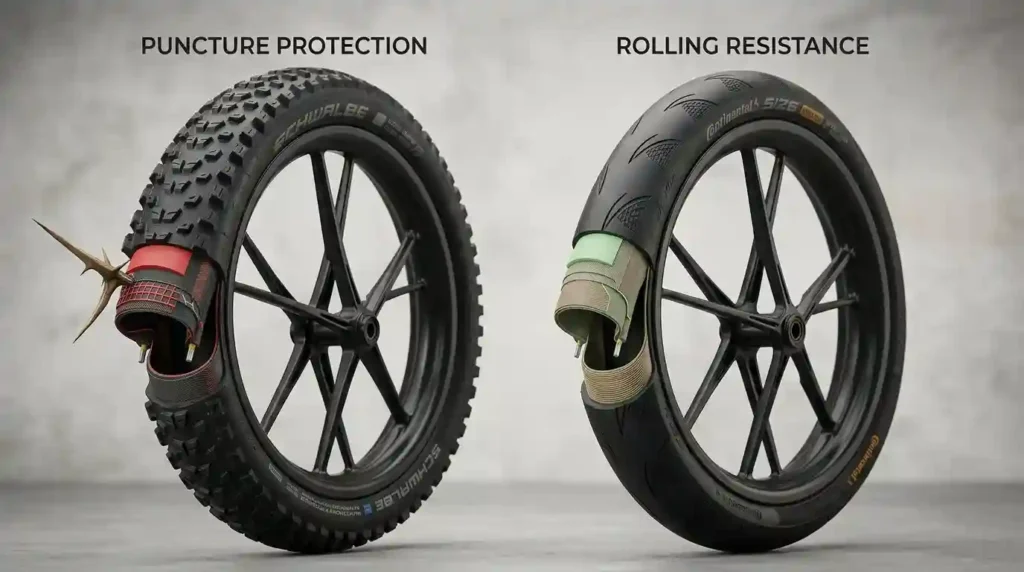
That is the heart of bike tyres for puncture protection vs rolling resistance. More protection often adds weight and stiffness. Less resistance often means a lighter, suppler tire that may be easier to cut.
You do not have to choose one side. Casing design, rubber compound, tread, and tire pressure (PSI) all shape the result. The right setup also improves safety, cornering traction, and comfort.
This guide gives you plain definitions, tables, and PSI steps. New to tire basics? Start with what makes a good bike tire and how bike tires work.
What Are Puncture Protection and Rolling Resistance?
New to tire tech? These two terms explain most of the trade-off.
Quick answer: Bike tyres for puncture protection vs rolling resistance is a choice between tires built to stop flats and tires built to waste less energy. Protective tires use belts and thicker layers. Fast tires use flexible casings and efficient rubber. Many modern tires blend both.
Tire design shapes four things you feel on every ride:
- Speed: supple casings waste less energy.
- Flat protection: belts and thick rubber resist cuts.
- Comfort: flexible casings soften rough pavement.
- Handling: tread and compound set cornering grip.
Defining Puncture Protection in Bike Tires
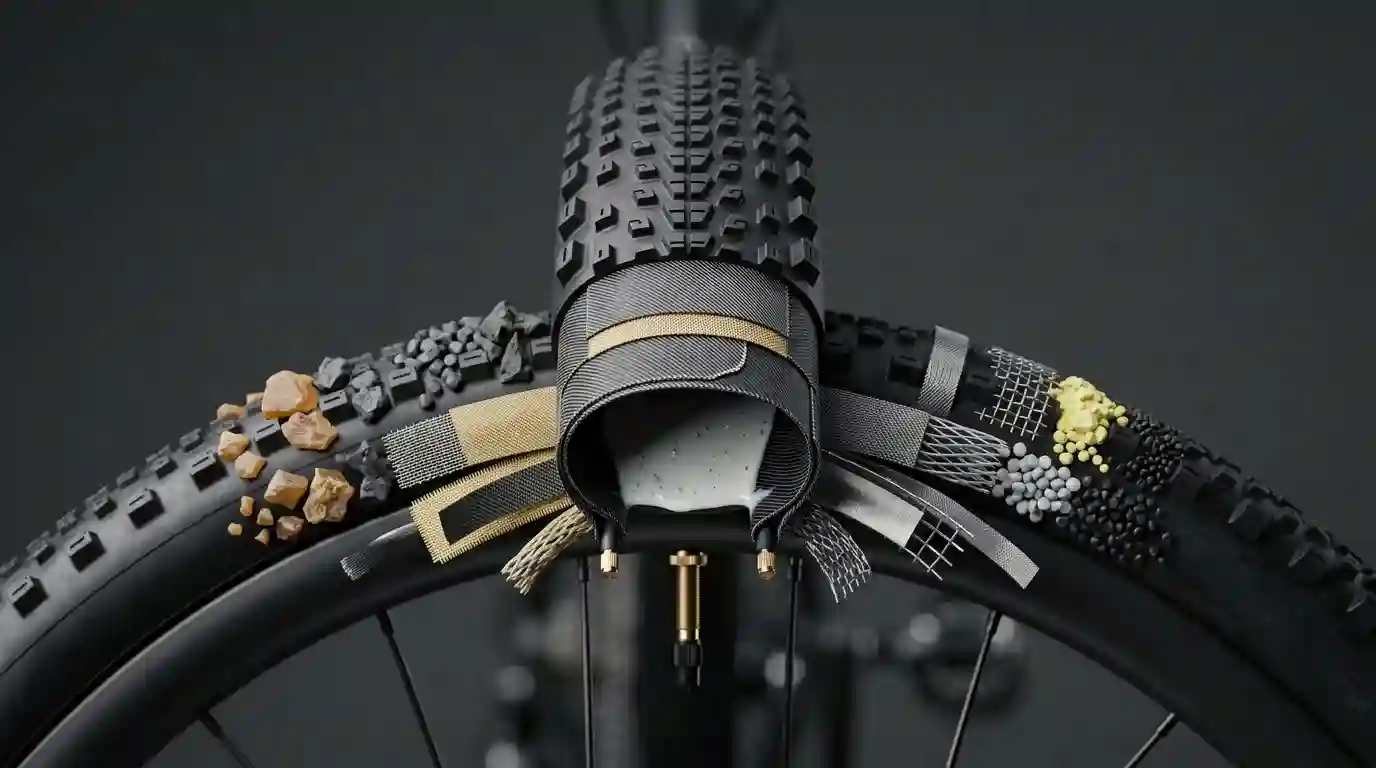
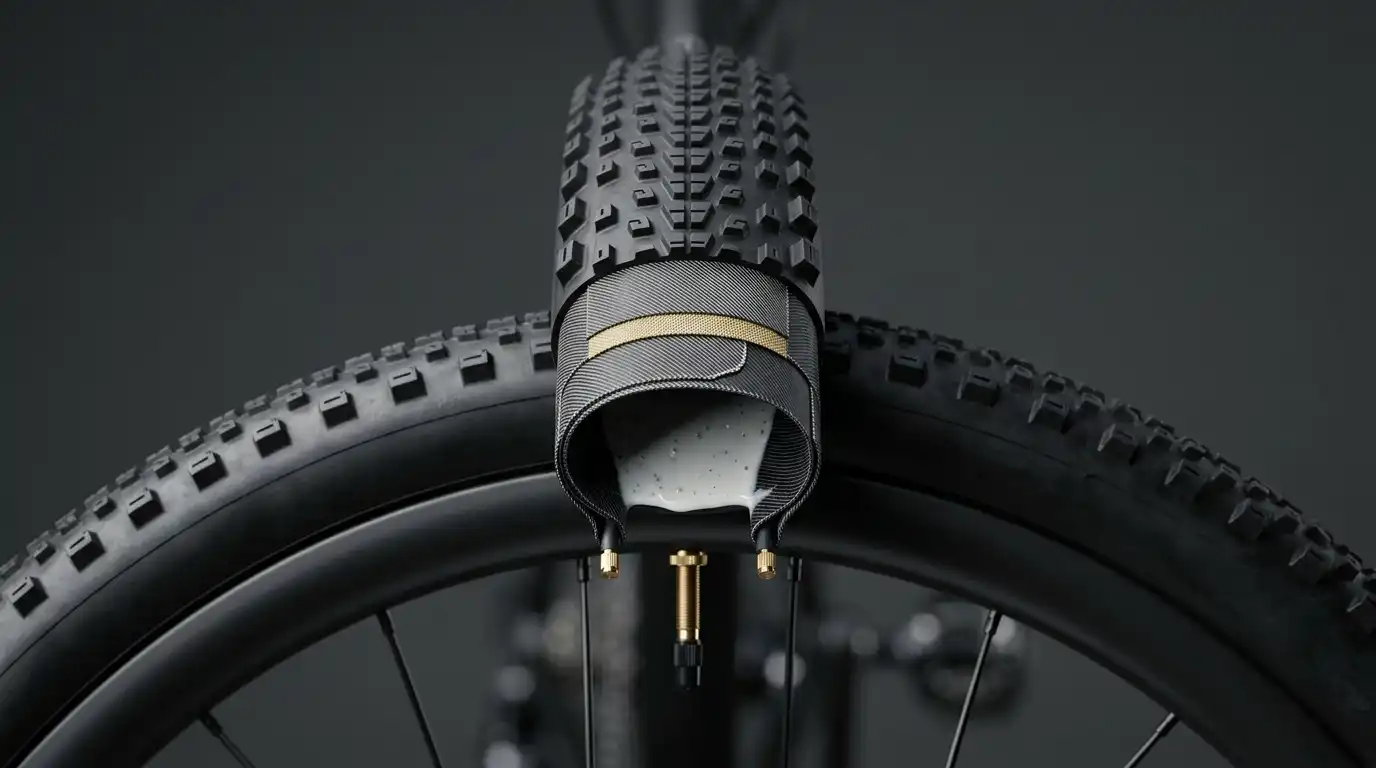
A puncture belt is a tough layer under the tread, often made from nylon or aramid fibers. It slows or stops sharp objects before they reach the tube or tire cavity.
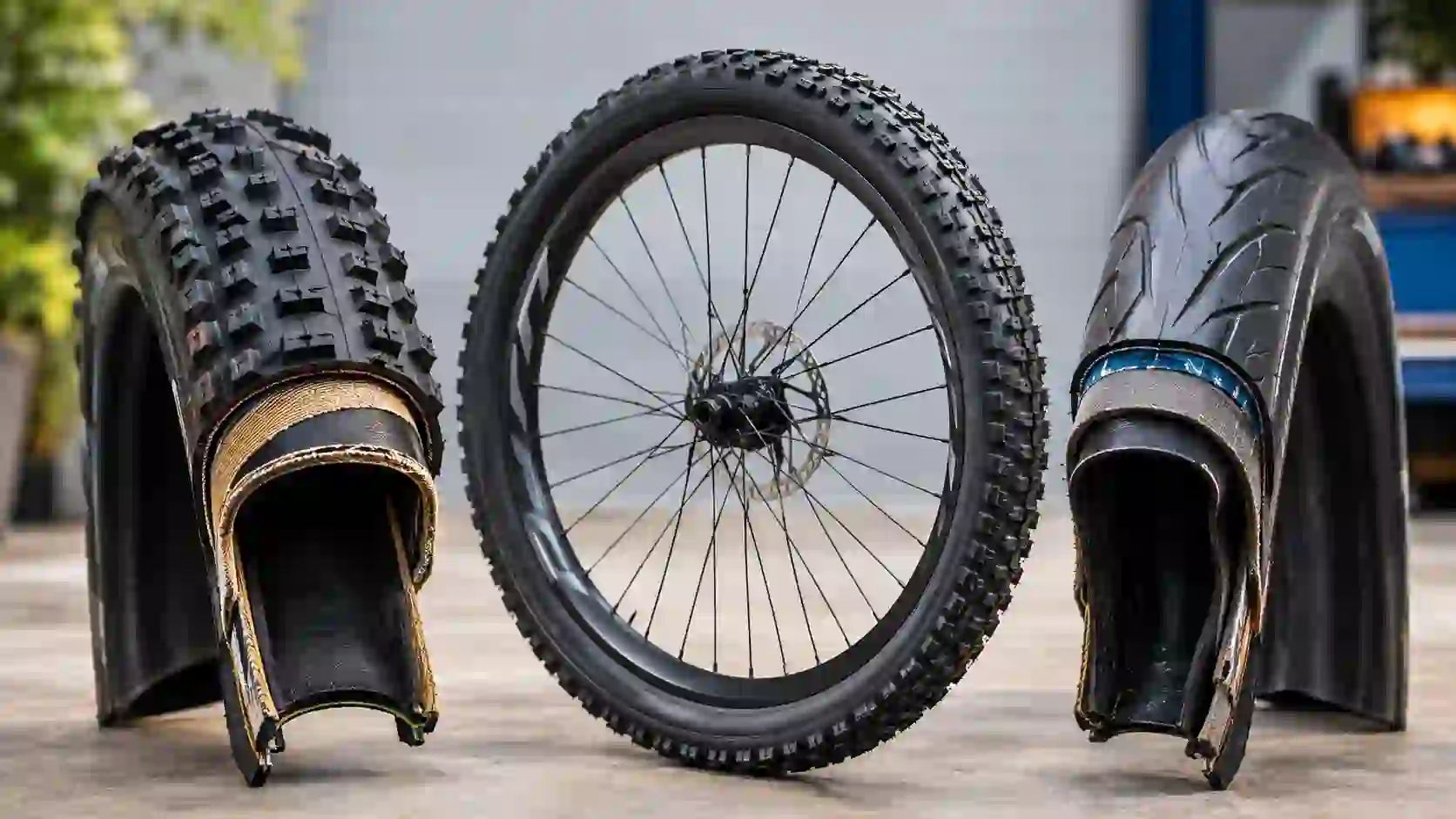
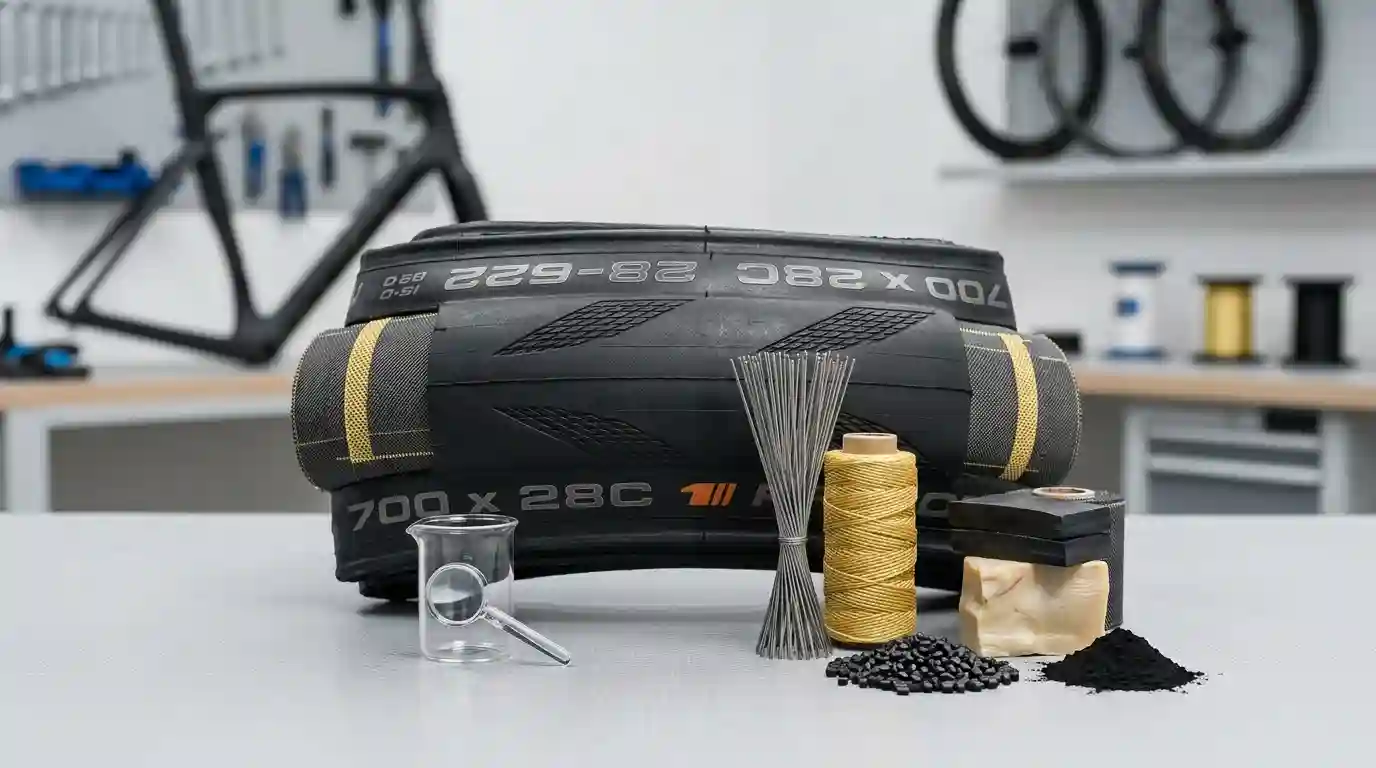
Thicker tread rubber, a reinforced casing, and sidewall panels add more defense. Together they help resist glass, thorns, sharp stones, and road debris. See what bike tires are made of for the materials.
No tire is flat-proof. Protection lowers your risk. It does not remove it.
Rolling Resistance in Plain English
Each turn of the wheel flexes the rubber and casing, then lets them spring back. That flex wastes energy as heat. This lost energy is rolling resistance.
Pressure, rubber compound, tread pattern, and casing flexibility all change it. Surface matters too. On rough pavement, a supple tire can roll faster because it absorbs bumps instead of bouncing you up.
Why These Two Factors Matter
Flats cost time, money, and safety on a busy road. Rolling resistance costs energy on every mile. Commuters often value durability. Racers often value efficiency.
A rider on smooth Florida bike paths needs a different tire than a rider on rocky Colorado trails. The best tire depends on terrain, rider weight, and riding goals. Our guide on how to choose bike tyres covers the wider picture.
How Does Puncture Protection Affect Rolling Resistance?
Extra material adds weight and can reduce casing flexibility. But protection does not always mean slow. Modern designs balance both, so compare measured results instead of judging tires by thickness.
Reinforced Casings and Belts: How They Work
A belt under the tread blocks sharp objects from reaching the tube or tire cavity. Light belts cover only the center of the tread. Thicker, full-width reinforcement protects more area but adds weight.
Casing TPI means threads per inch in the casing fabric. Higher TPI often feels more supple, yet it is only one factor. Material, ply count, and rubber coating matter too. Learn to read the numbers on bike tires before you compare.
Do Thicker Bike Tires Roll Slower?
Not because of thickness alone. Rubber compound, casing build, tread design, and inflation pressure all play a role.
A supple, well-designed tire with a light belt can roll efficiently. A stiff, cheap tire may roll worse with no extra protection. That is why a thick tread alone tells you little. Look at how the whole tire is built. Width matters too, as bike tire width explained shows.
Can a Fast Tire Also Resist Punctures?
Yes. Many modern road and gravel tires pair protective belts with flexible casings. All-round tires sit between race-focused models and heavy-duty commuter tires.
Check independent tests for both puncture and rolling resistance results. A tire that scores well on both is often the smartest buy for riders who want speed without constant worry. For mixed riding, see how to choose bike tyres for road and off-road.
Puncture-Resistant Tires vs Low-Rolling-Resistance Tires
Each type has clear strengths and trade-offs. The best pick shifts between smooth pavement, rough roads, gravel, and trails. The table below makes the differences easy to scan.
Key Differences at a Glance
Use this table as a starting point, then check your own routes.
| Feature | Puncture-resistant tires | Low-rolling-resistance tires |
|---|---|---|
| Main goal | Reduce flats | Reduce energy loss |
| Construction | Often reinforced | Often flexible and optimized |
| Weight | May be higher | Often lower, but not always |
| Ride feel | Can feel firmer | Can feel more supple |
| Best use | Commuting and debris-heavy roads | Speed-focused road riding |
| Main trade-off | May add weight or stiffness | May offer less protection, depending on design |
Commuting: Which Tire Wins?
Puncture protection usually wins for commuting. City routes bring glass, debris, and rough pavement.
Look for an efficient tread, durable sidewalls, and a practical balance of weight and comfort. Reflective sidewalls add visibility on urban rides. See best bike tyre size for commuting and how to choose tyres for a commuter bike.
Road Racing: Which Tire Wins?
Low rolling resistance usually wins for racing. Favor predictable cornering grip and a suitable weight.
Check whether the tire’s protection matches the road and event distance. Do not pick a tire only on advertised speed or minimum weight. A fast tire that flats in the final miles costs more time than it saves. For sizing, see best tyre width for road and city riding.
Gravel and Mountain Biking Choices
Gravel tires need a casing and tread suited to mixed surfaces. Mountain bike tires must balance protection with traction, sidewall strength, and cornering grip.
Southwestern loose rocks cause sidewall cuts and pinch flats. Pacific Northwest mud needs open tread that sheds dirt. A tough sidewall and the right pressure often matter more than tread depth alone. Get more help with how to choose bike tires for gravel roads.
Which Tire Features Matter Most for Speed and Flat Protection?
Tire performance comes from the full design, not one spec. These features help you compare models before you buy.
Rubber Compound and Tread Pattern
Durometer measures rubber hardness. Lower numbers feel softer. Softer compounds can grip better but may wear faster or waste more energy.
Hard compounds usually last longer, which helps with early tread wear on daily commutes. Smooth tread suits pavement. Gravel and mountain bike knobs add traction on loose ground but can add resistance on smooth roads. See how much tread a bike tire should have.
Casing TPI and Sidewall Construction
Thread density tells you how fine the casing fabric is. Supple casings feel smooth and fast. Reinforced casings handle rough use.
Compare TPI only within context: material, ply count, and overall tire design. Our bike tire casing guide goes deeper.
Belts and Sidewall Protection
Tread protection and sidewall reinforcement do different jobs. Belts guard the tread. Sidewall layers resist cuts and pinch flats.
Common risks include glass cuts, thorns, sharp stones, and pinch flats. Match protection to your route, not to the heaviest tire. For tough routes, read how to choose bike tires for rough roads.
Tire Weight and Width
Tire mass affects acceleration and climbing, especially with repeated speed changes. Wider tires can add comfort and grip with the right rim and pressure.
Width alone does not set rolling resistance. Use what tyre width should I choose to narrow your range.
How Tire Pressure (PSI) Changes Speed and Puncture Risk
Low pressure lets the casing move more. That can raise the risk of pinch flats with inner tubes. Very high pressure can cut grip and comfort on rough surfaces.
Ideal PSI depends on rider weight, tire width, rim width, tire build, and terrain.
What PSI should my bike tires be? Start with a trusted calculator or the maker’s chart, using total system weight and tire width. Stay inside the tire and rim limits. Then adjust in small steps for surface and feel.
Tires also lose air over time. See why bike tyres lose air and how often to check bike tyres.
Finding the Right Tire Pressure Step by Step
- Check the tire’s minimum and maximum pressure, then the rim maker’s limit.
- Estimate a starting PSI from system weight, tire width, and surface.
- Test the setup. Adjust by 2 to 3 PSI while watching grip, comfort, and rim-strike risk.
Wet roads often call for a small drop of 2 to 5 PSI for traction, as long as you stay within limits. Rain also hides glass and debris, so slow down and scan the road ahead.
Rider Weight and PSI
Heavier loads need more pressure, within approved limits. Count the rider, bike, clothing, water, and gear.
Front and rear wheels carry different loads, so do not assume identical pressures. A rough split is 45% front and 55% rear. Weigh yourself in riding kit with a full bottle for the best estimate.
| System weight | Road 700×28 (1.1 in) | Gravel 700×40 (1.6 in) | Mountain bike 2.4 in |
|---|---|---|---|
| 150 lb (68 kg) | 56 / 46 | 29 / 24 | 18 / 14 |
| 175 lb (79 kg) | 65 / 53 | 34 / 28 | 21 / 17 |
| 200 lb (91 kg) | 75 / 61 | 39 / 32 | 23 / 19 |
| 225 lb (102 kg) | 84 / 69 | 43 / 35 | 26 / 22 |
| 250 lb (113 kg) | 93 / 76 | 48 / 39 | 29 / 24 |
Values are starting PSI, shown as rear / front, for tubeless setups. With inner tubes, add about 10 percent. Always follow the lowest limit printed on your tire or rim.
Calculating a Starting PSI
No single formula fits every tire and wheel. Use a reputable calculator or maker chart first. Then use this rough check, which approximates typical calculator output.
Rear PSI = (system weight in lb x 0.55 / tire width in mm) x K
Front PSI = (system weight in lb x 0.45 / tire width in mm) x K
Use K = 19 for smooth pavement, 14 for gravel or rough roads, and 13 for mountain bike trails.
Example: A 200 lb rider and bike on 700×28 tires, smooth road. Rear: 200 x 0.55 = 110, divided by 28 = 3.93, times 19 = 75 PSI. Front: 200 x 0.45 = 90, divided by 28 = 3.21, times 19 = 61 PSI.
Then adjust for tubeless, surface, and handling feedback.
Tubeless Tires vs Inner Tubes for Puncture Protection
Tubeless setups use sealant to close some small punctures without an inner tube. Tubes cost less and stay simple. Neither setup is immune to large cuts, damaged sidewalls, or sudden air loss.
Tubeless Sealant: What It Does
Tubeless sealant is a liquid that plugs small holes as air tries to escape. It needs checks and top-ups every few months. It dries faster in hot, dry places like the Southwest.
Sealant compatibility, tire build, and puncture size all affect results.
If a tubeless tire leaks on the road, spin the wheel so the hole sits at the bottom. Give the sealant a moment to plug it. If air keeps escaping, add a tubeless plug and recheck your pressure. Carry a spare tube as backup.
Could Tubeless Tires Reduce Rolling Resistance?
Possibly. Removing the tube removes tube-to-tire friction, which may cut energy loss. The result depends on tire design, pressure, rim fit, and test conditions.
Do not expect a universal speed gain over inner tubes. Tubeless also needs rim tape, valves, and sealant, so weigh setup time and cost against the benefits.
When Are Inner Tubes the Better Choice?
Tubes are simple to fit, affordable, and sold everywhere. Puncture-resistant tubes and tire liners add protection without a tubeless conversion.
To fix a tube flat, find the cause first. Run your fingers carefully inside the tire to feel for glass or thorns. Then patch or replace the tube and reinflate to your target PSI.
Match tube size and valve type to your wheel and tire. Our ETRTO bike tire sizes guide helps you decode sizes.
Choosing the Best Bike Tires for Your Riding Style
Match tire construction to your route, speed goals, maintenance habits, and budget. Weigh tread performance and puncture protection together. New riders can start with best bike tyres for beginners.
Daily Commuting Tire Picks
Put protection first, then predictable wet grip and long tread life. Durable urban tires with reflective sidewalls and decent efficiency work well.
Pick a width that fits your frame, fork, rim, and target pressure. Browse best bike tyres for everyday riding, what bike tyre to buy for commuting, choosing tires for daily cycling, and bike tires for wet weather.
Road Cycling and Speed Picks
Look for efficient casing construction, a suitable compound, and reliable cornering grip. Choose protection that fits your road surface and ride distance.
Compare independent rolling-resistance data with puncture tests. For big miles, see how to choose tyres for long distance and best 700c bike tyres for comfort.
Gravel and Mixed Surface Picks
Match tread depth and spacing to your mix of pavement and loose ground. Midwest gravel can chew sidewalls, so consider reinforcement where sharp rock is common.
Balance grip, durability, and efficiency instead of choosing the most aggressive tread. See how to choose tires for mixed surfaces.
E-Bike Tire Picks
Look for the right load rating, casing durability, and maker approval for e-bike use. E-bike torque, extra system weight, and frequent acceleration raise wear and demands.
Verify any speed rating that applies. E-bikes also stop with more force, so look for good wet grip and strong sidewalls that stay stable under braking. Learn to read sidewall labels in bike tyre markings explained for beginners.
Checking Tire and Rim Compatibility Before Buying
Tire width, rim dimensions, frame clearance, and pressure limits must work together. A printed size alone does not guarantee a safe fit. Confirm with your rim and bike makers. Our bike tire size compatibility guide walks through it.
Rim Width and Tire Choice
Inner rim width shapes the mounted tire profile and measured width. Check the rim maker’s approved range.
Hooked rims have a lip that holds the tire bead. Hookless rims have straight walls and often set lower pressure limits, commonly near 72.5 PSI (5 bar).
| Inner rim width | Typical tire width range |
|---|---|
| 17 mm (0.67 in) | 25 to 32 mm (1.0 to 1.3 in) |
| 19 mm (0.75 in) | 25 to 35 mm (1.0 to 1.4 in) |
| 21 mm (0.83 in) | 28 to 42 mm (1.1 to 1.7 in) |
| 25 mm (1.0 in) | 32 to 50 mm (1.3 to 2.0 in) |
| 30 mm (1.2 in) | 40 to 61 mm (1.6 to 2.4 in) |
These are typical ranges. Your rim maker’s chart always wins. Check frame, fork, brake, and mudguard clearance before going wider. See bike wheel size vs tire size.
Tire Size and Clearance Steps
- Read the size printed on the sidewall. Our guide on how to read bike tire size helps.
- Confirm the rim diameter and approved tire width. Labels confusing? See what 700c, 650b, and 26×2.1 mean.
- Check clearance at the frame, fork, brakes, and nearby parts. Try will this bike tire fit my wheel and how to measure bike tire size.
Can You Use a Different Tire Width?
A modest change often works when the rim and frame allow it. Check the actual mounted width, since it can differ from the label. Never exceed the maker’s compatibility or pressure limits.
Read more on changing bike tire width, using wider tires, using narrower tires, and how much wider a tire can fit. Unsure of your size? See what bike tire size you need, how to find bike tyre size, and fitting a different size tire.
Testing Puncture Protection and Rolling Resistance
Fair comparisons need repeatable conditions and clear measures. Look for independent tests, not only maker claims. Keep rolling resistance, puncture resistance, grip, durability, and weight as separate measures. See our testing process for how we evaluate tires.
Measuring Rolling Resistance
Labs use a drum and measure energy loss under controlled conditions. Pressure, load, speed, temperature, and test surface must stay consistent.
Lab results may not fully predict performance on rough roads or trails.
Tread Puncture Tests Explained
Controlled tests measure the force needed to push a defined object through the tread. They do not fully capture sidewall cuts or pinch-flat resistance.
Compare results only when the test method and conditions match. A score from one lab cannot be compared directly with a score from another.
What Should a Reliable Tire Review Include?
- Tire size, measured width, weight, pressure, wheel setup, and test conditions.
- Both puncture-resistance and rolling-resistance results where available.
- Clear limits, with no single test presented as proof of total performance.
Our editorial policy explains the standards we follow.
Common Mistakes When Choosing Puncture-Resistant Bike Tires
The heaviest tire or the highest PSI does not automatically perform best. Compatibility, maintenance, and surface conditions matter most. Use these simple checks to avoid flats and poor handling.
Choosing Protection Without Considering Riding Conditions
Skip heavy-duty tires if your routes do not need them. Do not run fragile race tires on debris-heavy commutes without weighing the risk.
Balance speed, reliability, and replacement cost. A slightly slower tire that never strands you may be the better value.
Using the Wrong Tire Pressure
Do not copy another rider’s PSI without considering weight and tire width. Check pressure regularly, because tires naturally lose air.
Stay within tire and rim limits, even when testing lower pressure. Use a quality gauge, since built-in pump gauges can be off by several PSI.
Ignoring Tire Wear and Maintenance
Inspect for tread cuts, exposed casing, bulges, and sidewall damage. Replace tires when wear or damage makes them unsafe.
Check tubeless sealant levels and valve condition during routine care. See how often bike tyres should be replaced.
Frequently Asked Questions
Quick answers to common tire questions. Find more on our FAQs page.
Do puncture-resistant bike tires roll slower?
Not always. Some reinforced tires have higher rolling resistance, but casing design and rubber compound matter too. Compare independent test results for the tire size you plan to use.
Are tubeless tires better than inner tubes for puncture protection?
Tubeless sealant can close many small holes. Larger cuts may still need a plug, boot, or new tire. Inner tubes are simple to repair or replace but can suffer pinch flats.
Which PSI fits my weight?
Start with a calculator or maker chart based on total system weight and tire width. Adjust for front and rear loads, surface, and tire build while respecting all limits. In wet weather, many riders drop 2 to 5 PSI for grip.
Is a wider tire always faster?
Not in every situation. Width, casing, pressure, tread, and road surface all affect energy loss. Wider tires can improve comfort and grip when matched to the rim and bike.
When should I replace puncture-resistant tires?
There is no universal mileage limit. Lifespan depends on tire quality, riding conditions, and care. Replace tires when the tread is worn or the casing is damaged, bulging, or exposed.
Will puncture-resistant tires fit any rim?
No. The tire must match the rim diameter, inner width, and intended pressure. Check the bike and rim makers’ specifications before buying.
Are tire liners a full fix for flats?
No. Liners can block some tread punctures but may not protect sidewalls or stop every flat. Confirm the liner fits your tire and does not cause tube problems.
Is puncture protection worth it on an e-bike?
It can be, for riders who want fewer interruptions and dependable daily use. Check load and speed ratings, casing durability, and the effect of added tire weight.
Conclusion: Find Your Best Balance of Speed and Protection
Puncture protection improves reliability. Low rolling resistance helps you save energy. The best tire sits between the two for your routes.
Remember these key points:
- Casing, compound, tread, and pressure all shape real-world performance.
- Rim compatibility and riding conditions matter as much as any spec.
- Measured results beat thickness, weight, or marketing claims.
Run Your Numbers Before Your Next Ride
Ready to dial in your setup? Use the Free Bike Tire Pressure Calculator / Tire Finder Tool at TheBikeTires.com. Enter your weight, tire size, and riding surface to get a clear starting point.
Test it on your own routes, then fine-tune your PSI. Learn more about the team behind these guides on our about page.

Mohidul Islam is a leading cycling technology specialist and bike tire consultant with over 15 years of hands-on experience in the bicycle industry. He holds a Bachelor of Science in Mechanical Engineering from Penn State University, where he focused heavily on material science, tread mechanics, and rubber compound performance. Over the past decade and a half, Alex has conducted extensive field testing, tubeless setup evaluations, and tire pressure modeling for road, mountain, and e-bikes. His practical insights and data-driven approach help cyclists of all levels optimize grip, speed, and durability on every ride.