
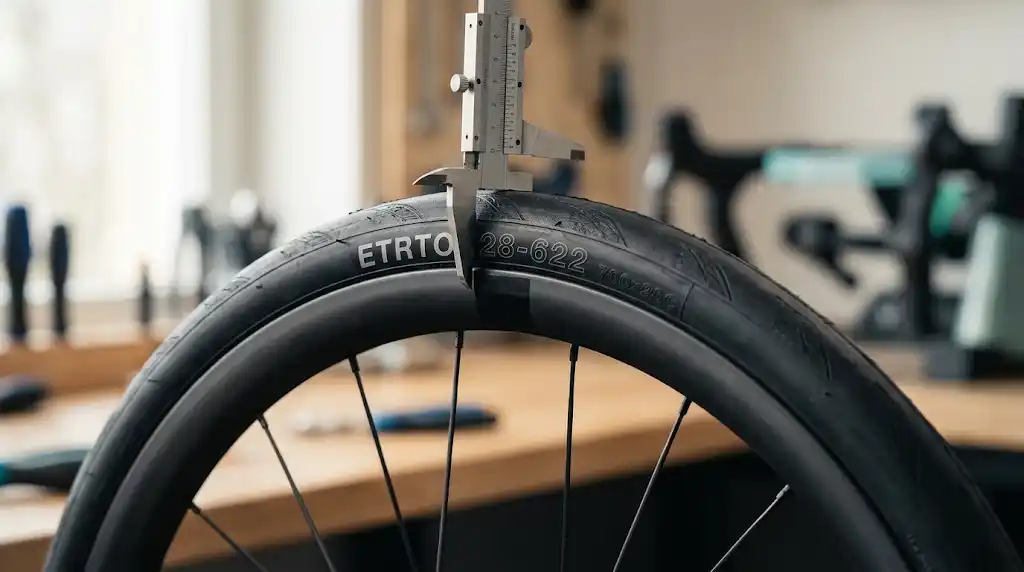
Every year, thousands of US cyclists face the same head-scratching moment at their local bike shop or online checkout: you need a replacement tire, but your current sidewall lists 700x40c, 40-622, and 28 x 1.50 all on the exact same piece of rubber. Are these three totally different sizes, or are they different languages describing the exact same tire?
Understanding bicycle tire sizing is more than just an exercise in decoding numbers. Choosing the wrong tire size can lead to dangerous rim blowouts, severe frame rubbing, poor cornering grip, or sudden pinch flats on your daily commute.
That is where the ETRTO (European Tyre and Rim Technical Organisation) standard comes in. This standardized system cuts through decades of confusing imperial and French marketing labels by providing precise millimeter measurements for tire width and rim fit. In this guide, we will break down ETRTO sizing for US road riders, gravel grinders, mountain bikers, daily commuters, and e-bike owners, helping you pick the perfect tire and dial in your ideal tire pressure (PSI) for maximum comfort, speed, and safety.
What Does ETRTO Mean on a Bike Tire?
ETRTO Definition: ETRTO stands for the European Tyre and Rim Technical Organisation. In bicycle applications, an ETRTO marking (such as 40-622) uses two precise millimeter measurements: the first number represents the inflated tire width, and the second represents the bead-seat diameter (BSD) of the rim.
                   ETRTO MARKING: 40 - 622

   [ 40 mm ]  ----------------------------> Inflated Tire Width
   [ 622 mm ] ----------------------------> Bead-Seat Diameter (BSD)
Historically, bike tires were labeled using regional marketing systems. The US and UK relied on traditional inch sizes based on the estimated outer diameter of an inflated tire (e.g., 28 x 1 1/2″ or 29 x 2.1″), while France developed metric labels based on outer diameter and rim width classes (e.g., 700c). Because these traditional systems measured the outside of the tire rather than where the tire actually attaches to the wheel, they were notoriously imprecise.
By standardizing tire measurements under ISO 5775 (which adopts ETRTO guidelines), tire and rim manufacturers created a universal standard. If two tires share the same ETRTO bead-seat diameter, they will fit on the same wheel—regardless of whether the packaging says 700c, 28-inch, or 29-inch.
How to Read an ETRTO Tire Size
Reading an ETRTO size is straightforward once you know where to look:
- First Number (Width): Expressed in millimeters (e.g., 40 in 40-622), this is the nominal inflated width of the tire casing.
- Second Number (Bead-Seat Diameter): Expressed in millimeters (e.g., 622 in 40-622), this measures the precise rim shoulder diameter where the tire bead sits.
The second number is the critical fitting dimension. While you can change your tire width to suit different terrain, your bead-seat diameter must match your rim exactly.
- 28-622: 28 mm wide tire fitting a standard 622 mm BSD rim (Modern road setup).
- 32-622: 32 mm wide tire fitting a standard 622 mm BSD rim (Endurance road or light commuter).
- 40-622: 40 mm wide tire fitting a standard 622 mm BSD rim (Gravel or adventure bike).
- 50-622: 50 mm (approx. 2.0″) wide tire fitting a standard 622 mm BSD rim (Monster-gravel or 29er MTB).
What Is Bead-Seat Diameter?
The bead-seat diameter (BSD) is the diameter of the internal rim ledge where the tire’s wire or aramid (Kevlar) bead firmly seats when inflated.
   Cross-Section of Bicycle Rim & Tire Bead:

           /  (Tire Casing)  \
          |                   |
          |   +-----------+   |
          |   |  Air Gap  |   |
          \___|           |___/
             (  Tire Bead  )  <--- Sits directly on the Rim Seat
         ======================= <--- Bead-Seat Diameter (BSD)
             | Internal Rim |
             |    Width     |
Without a standardized BSD, tires would blow off the rim under pressure or prove impossible to mount by hand. Marketing terms like 700c and 29-inch both share an identical 622 mm BSD. This means a 29-inch mountain bike tire and a 700c road tire use the exact same wheel seat diameter, despite being marketed to entirely different cycling disciplines.
However, sharing a BSD does not guarantee interchangability. Two tires with an identical 622 mm BSD can range in width from a narrow 25 mm road slick to a massive 2.5-inch (63 mm) downhill mountain bike tire.
ETRTO vs ISO Tire Sizing
You may see cycling components labeled as ISO (International Organization for Standardization) rather than ETRTO. In the cycling industry, ETRTO and ISO bike tire measurements are identical. The ISO standard 5775 adopted the ETRTO width-BSD format (Width – BSD) to form an international baseline.
While tire sidewalls carry these markings, always check both your tire and rim specifications. Modern rim manufacturers frequently list their own ETRTO rim sizes (e.g., 622 x 21c), where the first number is the BSD and the second represents the internal rim width.
ETRTO vs 700c, 26-Inch, 27.5-Inch, and 29-Inch Sizes
Traditional tire sizing can be extremely confusing for US cyclists because imperial and French measurements were derived from the outside diameter of an inflated tire, not the wheel itself.
+-------------------+----------------+---------------------+-------------------------------+
| Marketing Size    | ETRTO BSD (mm) | Traditional System  | Common Primary Applications   |
+-------------------+----------------+---------------------+-------------------------------+
| 700c              | 622 mm         | French Metric       | Road, Gravel, Cyclocross      |
| 29-Inch           | 622 mm         | US Imperial         | XC, Trail, Enduro MTB         |
| 27.5-Inch / 650b  | 584 mm         | US Imperial / French| Gravel, Trail MTB, E-Bikes    |
| 26-Inch           | 559 mm         | Traditional US      | Vintage MTB, Dirt Jump, Urban |
+-------------------+----------------+---------------------+-------------------------------+
Is 700c the Same as 622 ETRTO?
Yes. The traditional French 700c designation originally meant a tire with a total outside diameter of roughly 700 mm when paired with a specific high-profile tire (the “c” referred to a specific rim width class). Today, “700c” simply serves as shorthand for any tire built for a 622 mm BSD wheel.
Even though a 32-622 and a 45-622 tire both feature the same 622 mm bead-seat diameter, they differ significantly in air volume, overall height, and required frame clearance.
Is 29-Inch the Same as 700c?
From a bead-seat diameter perspective, 29-inch and 700c are identical—both use a 622 mm BSD.
When mountain bike pioneers introduced “29-inch” wheels, they mounted high-volume 2.1-inch (54 mm) knobby tires onto standard 622 mm BSD rims. The extra tire thickness increased the outer rolling diameter to roughly 29 inches.
Warning: Never buy a tire based solely on the “29-inch” or “700c” label. Mounting a 2.3-inch (58-622) “29er” mountain bike tire onto a narrow 700c road bike rim will cause severe frame rubbing, dangerous handling, or rim failure.
Why Inch Sizes Can Be Confusing
Inch sizing is notoriously unreliable because the nominal diameter does not match the bead diameter. For example, there are at least six different “26-inch” tire sizes in cycling history, ranging from standard mountain bike rims (559 mm BSD) to vintage utility and juvenile rims (571 mm, 583 mm, or 590 mm BSD). A 26 x 1.75 tire (559 mm BSD) will never fit on a 26 x 1 3/8 rim (590 mm BSD). Checking the sidewall for the two-digit ETRTO BSD number completely eliminates this confusion.
ETRTO Tire Size Chart for Common Bicycle Tires
Use this quick-reference table to map ETRTO sizes to their traditional marketing names and common cycling uses across the US:
| ETRTO Size | Nominal Width | Imperial / French Equivalent | Primary Cycling Application |
| 25-622 | 25 mm | 700 x 25c | Performance Road / Criterium Racing |
| 28-622 | 28 mm | 700 x 28c | Modern Endurance Road / All-Road |
| 32-622 | 32 mm | 700 x 32c | Paved Commuting / Rough Road |
| 40-622 | 40 mm | 700 x 40c / 28 x 1.50″ | Gravel / Adventure Touring |
| 45-622 | 45 mm | 700 x 45c / 28 x 1.75″ | Off-Road Gravel / Singletrack |
| 50-622 | 50 mm | 29 x 2.00″ / 700 x 50c | Bikepacking / Cross-Country MTB |
| 57-622 | 57 mm | 29 x 2.25″ | XC / Trail Mountain Biking |
| 60-622 | 60 mm | 29 x 2.35″ – 2.40″ | Enduro MTB / Heavy Duty E-Bike |
Note: The actual mounted width of any tire will vary depending on your wheel’s internal rim width and inflation pressure.
How ETRTO Tire Width Changes Riding Performance
Tire width dictates how your bike interacts with the road or trail surface:
- Narrow Tires (25–28 mm): Offer lower aerodynamic drag and reduced wheel weight. They require higher inflation pressures to avoid pinch flats.
- Wide Tires (38–50 mm+): Provide significantly higher air volume. This allows you to run lower operating pressures, dramatically improving rider comfort, bump absorption, and off-road traction.
Does a Wider Tire Always Mean More Grip?
Not necessarily. While wider tires create a shorter, wider contact patch that improves cornering traction, overall grip is determined by a combination of factors:
- Rubber Compound: Measured in shore durometer (softer rubber clings better to wet roots and asphalt; harder rubber lasts longer).
- Casing Flexibility: High-thread-count casings conform to road surface imperfections instead of bouncing over them.
- Tread Pattern: Knobs penetrate loose dirt, whereas slick treads maximize rubber contact on dry pavement.
- Inflation Pressure: Running an overly wide tire at max PSI reduces its contact patch and decreases available grip.
How ETRTO Size Affects Rim Compatibility
For optimal safety and handling, your tire width must be properly matched to your wheel’s internal rim width.
                  TIRE TO RIM PROFILE MATCHING

     TOO NARROW ON WIDE RIM         IDEAL MATCH          TOO WIDE ON NARROW RIM

         /-----------\             /-----------\             /-----------\
        |             |           /             \           (             )
        |_____________|          |_______________|           \___________/
        |             |          |               |            |         |
        [   Rim Wall  ]          [    Rim Wall   ]            [Rim Wall ]

      Flat, exposed rim         Rounded sidewall,          Lightbulb shape,
      Square profile,           Optimal support,           Squirmy cornering,
      Rim strike risk           Predictable grip           Blowout risk
Quick Compatibility Checklist
Before buying a new tire, run through this step-by-step checklist:
- Verify BSD: Match the wheel’s ETRTO diameter (e.g., 622) exactly.
- Check Rim Width: Measure or check your rim’s internal width (e.g., 21 mm).
- Consult Rim Charts: Ensure your desired tire width falls within the rim manufacturer’s safe operating envelope.
- Measure Frame Clearance: Confirm your frame, fork, and fenders have at least 4–6 mm of surrounding clearance.
How to Match Tire Width to Rim Width
Rim manufacturers publish recommended tire width ranges based on internal rim channel width:
- 19 mm Internal Width: Best paired with 25 mm to 38 mm tires.
- 21 mm Internal Width: Best paired with 28 mm to 45 mm tires.
- 25 mm Internal Width: Best paired with 35 mm to 54 mm (2.1″) tires.
- 30 mm Internal Width: Best paired with 2.25″ to 2.6″ mountain bike tires.
What Happens When a Tire Is Too Wide for the Rim?
When a wide tire (e.g., 50-622) is mounted to an overly narrow rim (e.g., 15 mm internal), the tire assumes a “lightbulb” profile. Under hard cornering, the sidewalls flex excessively over the rim walls, creating a squirmy, unpredictable ride feel. In tubeless applications, this mis-match increases the risk of “burping” air during hard cornering.
What Happens When a Tire Is Too Narrow for the Rim?
Mounting a narrow tire (e.g., 25-622) on a very wide rim (e.g., 25 mm internal) flattens the tread profile and exposes the delicate rim beads to direct impacts from pothole edges, increasing the risk of rim damage and sidewall slashes.
How to Check Your Bike’s ETRTO Tire Size
Finding your precise size requires checking three key areas on your bike:
                          1. CHECK TIRE SIDEWALL
                             Look for: "40-622" or "700x40c"
                                       /
                                      /
             +-----------------------+-----------------------+
             |                                               |
             |                                               |
             v                                               v
   2. CHECK RIM MARKINGS                           3. MEASURE CLEARANCES
   Look for: "622 x 21c"                           Ensure 4–6 mm gap at:
   (BSD x Internal Width)                          - Fork Crown
                                                   - Chainstays
                                                   - Brake Calipers
Where to Find the ETRTO Number
- Inspect the Sidewall: Rotate your wheel under bright light and look for raised or printed lettering along the tire edge.
- Locate the Two-Digit Format: Look specifically for the hyphenated millimetric standard (e.g., 28-622, 40-622, or 57-584).
- Snap a Photo: Take a quick picture with your smartphone to reference when shopping for replacement inner tubes or tubeless tires.
How to Measure Rim Internal Width
If your rim markings are worn off or missing, you can measure internal rim width manually:
- Deflate the tire and pop one side of the tire bead off the rim.
- Using a vernier caliper, measure the internal distance between the inner rim walls.
- Do not measure the outside edge-to-edge width of the rim, as rim wall thickness varies across wheel designs.
How Much Frame Clearance Should You Leave?
Always maintain a minimum physical gap between your tire and your bike frame:
- Road / Paved Cycling: Leave at least 4 mm of clearance around the fork crown, seatstays, and chainstays.
- Gravel / Off-Road Cycling: Leave at least 6 mm of clearance to account for mud accumulation, wheel flex, and minor rim wobbles.
- E-Bikes & MTBs: High-torque e-bikes and heavy trail bikes flex under load; leave at least 6–8 mm of frame clearance.
ETRTO Tire Size and Tire Pressure
Selecting the correct ETRTO tire size is only half the battle—setting the proper tire pressure (PSI) dictates your ride quality, rolling efficiency, and puncture resistance.
+------------------+---------------------+-------------------+-------------------------------+
| Discipline       | ETRTO Size          | Typical PSI Range | Key Benefit                   |
+------------------+---------------------+-------------------+-------------------------------+
| Performance Road | 25-622 to 28-622    | 65 – 90 PSI       | Aerodynamic, fast acceleration|
| All-Road / Gravel| 38-622 to 45-622    | 30 – 45 PSI       | Smooth ride over rough gravel |
| Trail / XC MTB   | 57-622 to 60-622    | 18 – 28 PSI       | Maximum traction on dirt/roots|
| Urban Commuter   | 32-622 to 40-622    | 45 – 65 PSI       | Pinch-flat protection, comfort|
+------------------+---------------------+-------------------+-------------------------------+
Why Wider Tires Usually Allow Lower PSI
Air volume scales non-linearly with tire width. A wider 40-622 tire holds substantially more air volume than a 28-622 tire. Because air volume supports system weight, wider tires safely operate at significantly lower pressures without bottoming out against the rim.
       28 mm Tire Volume               40 mm Tire Volume
       (Requires 75 PSI)               (Requires 35 PSI)
          [  Low  ]                      [   HIGH   ]
          [Volume ]                      [  Volume  ]
Running lower pressure decreases high-frequency vibration, reduces rider fatigue, and allows the tire tread to mold around road debris, actually reducing rolling resistance on rough real-world surfaces like chip-seal asphalt or rocky gravel roads.
How Rider Weight Changes Recommended PSI
Tire pressure must scale directly with total system weight:
$$\text{Total System Weight} = \text{Rider Weight} + \text{Bike Weight} + \text{Gear/Cargo}$$
A 210 lb rider on a 30 lb commuter bike requires higher inflation pressures than a 130 lb rider on a 16 lb carbon road bike using identical 32-622 tires. Under-inflating tires for heavier loads leads to squirmy handling and pinch flats, while over-inflating reduces traction and creates a harsh ride.
A Practical Bike Tire PSI Formula
While exact pressure depends on tire casing construction and rim width, you can estimate front and rear PSI using weight distribution formulas:
- Calculate your total system weight in pounds.
- Apply a 40/60 weight distribution split (40% of system weight rests on the front tire, 60% on the rear tire).
- Adjust base pressure upward for narrower tires and downward for higher volume tires.
Simplify Your Setup: Skip the manual calculations! Stop guessing your inflation setup and use the Free Bike Tire Pressure Calculator / Tire Finder Tool at TheBikeTires.com to get instant, mathematically precise PSI recommendations tailored specifically to your weight, ETRTO tire size, rim width, and riding conditions.
ETRTO Sizes for Tubeless Bike Tires
Upgrading to a tubeless setup eliminates inner tubes entirely, replacing them with a liquid tubeless sealant that instantly plugs small punctures from thorns, glass, or wire.
                        TUBELESS TIRE CROSS-SECTION

                            /-----------------\
                           /   Tread Layer     \
                          |                     |
                          |   [Air & Sealant]   |  <--- Liquid Sealant Pools at Bottom
                          \                     /
                           \   (Aramid Bead)   /   <--- Locked tightly into Rim Hook
                           =====================
                           | Tape |  Valve Stem |
                           +------|-------------+
How to Install an ETRTO-Compatible Tubeless Tire
Setting up tubeless tires requires precise component matching:
- Verify Tubeless Compatibility: Confirm both your tire (marked TLR, Tubeless Ready, or UST) and your rim feature matching ETRTO dimensions and tubeless bead hooks.
- Install Tubeless Rim Tape: Wrap the inner rim bed with air-tight tubeless rim tape that is 2–3 mm wider than your internal rim width.
- Insert Tubeless Valve: Push a tubeless valve stem through the valve hole and secure the locking nut finger-tight.
- Mount Tire Beads: Push the first tire bead into the deep center channel of the rim, followed by the second bead.
- Add Tubeless Sealant: Inject 2–4 oz of quality liquid sealant (such as Stan’s NoTubes or Orange Seal) through the valve core using an injector.
- Seat the Bead: Use a high-volume floor pump or air compressor to seat the tire beads onto the rim shelf until you hear distinct popping sounds.
Why Tire and Rim Compatibility Matters More With Tubeless
Tubeless setups rely entirely on a tight mechanical interlock between the tire bead and the rim shelf to hold air pressure. Selecting an incorrect ETRTO diameter or pairing a tubeless tire with an unapproved hookless rim can cause catastrophic tire blowouts under high cornering loads.
Why a Tubeless Tire May Not Seat
- Poor Rim Tape Job: Air is escaping into the spoke holes through torn or offset tape.
- Bead Resting in the Center Channel: Pull the tire beads outward toward the rim walls before pumping.
- Insufficient Air Volume: Standard floor pumps may not release air fast enough; use a tubeless booster tank or air compressor.
How Tire Construction Changes Performance Beyond ETRTO Size
Two tires with identical 40-622 ETRTO markings can perform completely differently based on their internal construction specs.
+--------------------+------------------------------------+----------------------------------------+
| Construction Spec  | Low-End / Commuter Specification  | High-End / Performance Specification   |
+--------------------+------------------------------------+----------------------------------------+
| Casing TPI         | 30 – 60 TPI (Heavy, thick nylon)   | 120 – 320 TPI (Supple, fast rolling)   |
| Rubber Compound    | Single hard compound (Durable)     | Dual/Triple compound (Grippy shoulders)|
| Puncture Belt      | Thick rubber breaker (Thorn-proof) | High-tenacity aramid/Kevlar layer      |
| Bead Type          | Rigid Steel Wire (Heavy, rigid)    | Foldable Aramid/Kevlar (Lightweight)   |
+--------------------+------------------------------------+----------------------------------------+
Casing TPI and Ride Feel
TPI (Threads Per Inch) measures the density of nylon or cotton threads woven into the tire casing:
- Low TPI (30–60 TPI): Uses thick threads coated in heavy rubber. Highly durable and resistant to cuts, but stiff and heavy.
- High TPI (120–320 TPI): Uses fine, tightly woven threads. Creates a supple casing that deforms smoothly over road imperfections, significantly reducing rolling resistance and improving grip.
Rubber Compound and Rolling Resistance
Manufacturers formulate specialized rubber compounds to balance grip, durability, and rolling speed. Softer compounds (lower durometer) conform to wet rocks and smooth pavement for maximum traction, but wear out quickly. Premium tires use multi-compound treads—harder rubber along the center tread for fast rolling speed and longer wear life, paired with softer rubber along the shoulders for cornering confidence.
Tread Pattern and Cornering Grip
Tread design should always match your riding surface:
- Slick Treads: Ideal for smooth pavement; maximizes rubber contact patch and cornering grip.
- Semi-Slick / File Tread: Features a smooth center tread for pavement efficiency, flanked by raised shoulder knobs for cornering support on loose dirt.
- Full Knobby Treads: Uses tall, widely spaced lugs to bite into soft dirt, deep mud, or loose gravel.
Puncture Belts and Casing Protection
Underneath the tread rubber, manufacturers place protective puncture breakers made from woven Kevlar, aramid fiber, or dense nylon strips. While sub-tread belts protect against glass and thorns, gravel and mountain bike tires also feature sidewall protection grids to prevent slashes from sharp rocks.
Choosing ETRTO Tire Sizes for Different Types of Cycling
Road Bike Tire Sizes
RECOMMENDED ROAD SIZES:
- 25-622 (Classic Racing / Tight Frame Clearance)
- 28-622 (Modern Standard / Optimal Speed & Comfort)
- 32-622 (Endurance Road / Rough Pavement / Chip-Seal)
Modern road cycling has completely shifted away from rock-hard, narrow 23 mm tires inflated to 110+ PSI. Today’s professional and recreational riders prefer 28-622 and 32-622 tires inflated between 55 and 75 PSI. These wider tire setups roll faster on real-world roads because they absorb surface vibrations instead of transferring micro-impacts upward into the frame and rider.
Gravel Bike Tire Sizes
RECOMMENDED GRAVEL SIZES:
- 38-622 (Light Gravel / Hardpack / Commuter Hybrid)
- 40-622 to 45-622 (Sweet Spot for All-Around Gravel)
- 50-622 / 29x2.0" (Adventure Gravel / Heavy Singletrack)
Gravel riding demands a balance of pavement speed, dirt traction, and flat protection. A 40-622 tubeless tire set between 30 and 40 PSI serves as the ideal all-around setup for American gravel events like Unbound Gravel or Midwestern fire roads.
Mountain Bike Tire Sizes
RECOMMENDED MTB SIZES:
- 57-622 (29 x 2.25" - Cross-Country Racing)
- 60-622 (29 x 2.40" - Modern Trail / All-Mountain)
- 63-622 (29 x 2.50" - Enduro / Downhill / Loose Terrain)
Mountain bike sizes prioritize high air volume and aggressive tread lugs. Note that modern 29er trail bikes use wide 30 mm internal rims, which work best with 60-622 (2.4″) or wider tires to ensure proper sidewall support when railing hard corners at 20 PSI.
Commuter Bike Tire Sizes
RECOMMENDED COMMUTER SIZES:
- 32-622 to 38-622 (Urban Pavement / Pothole Protection)
- 40-622 to 47-584 (Heavy Commuting / Cargo Bikes)
Commuters should prioritize thick puncture belts (like Schwalbe’s SmartGuard casing) and reflective sidewall strips. Choose a width that leaves ample space for full-coverage fenders during wet weather.
E-Bike Tire Sizes
RECOMMENDED E-BIKE SIZES:
- Look for ECE-R75 Certification (Rated for speeds up to 30 mph / 50 km/h)
- 40-622 to 60-622 (Thick casing to handle motor torque and heavy system weight)
E-bikes feature electric motor assistance that places high torque through the rear wheel, while their heavier overall bike weight increases tread wear and braking forces. Always select tires with reinforced casings explicitly rated for e-bike speeds.
How to Choose the Right ETRTO Tire Size
Follow this step-by-step decision framework when buying your next tire:
                  TIRE SELECTION FLOWCHART

            [ Read Current ETRTO Marking ]
                         |
                         v
            [ Check Internal Rim Width ]
                         |
                         v
          [ Measure Frame/Fork Clearances ]
                         |
                         v
            [ Select Target Tire Width ]
                         |
                         v
     +-------------------+-------------------+
     |                   |                   |
     v                   v                   v
Narrower (Speed)   Wider (Comfort)   Match Surface
(e.g., 28-622)     (e.g., 40-622)    (Slick vs Knobby)
Should You Go Wider or Narrower?
- Go Wider If: You ride on rough asphalt, loose dirt, or gravel, want to reduce body fatigue, experience lower back pain from road harshness, or want improved wet cornering grip.
- Go Narrower If: Your frame clearance is limited (under 4 mm gap), you ride exclusively on glass-smooth pavement, or you are competing in time trials where aerodynamic marginal gains outweigh comfort.
How to Choose Tires for Wet Roads
When riding on rain-slicked asphalt:
- Choose Soft Rubber Compounds: Look for tires explicitly designed with silica-infused wet-grip rubber compounds.
- Lower Your Pressure: Drop your front and rear tire pressure by 5–8 PSI to increase your contact patch size.
- Ignore Tread Grooves on Road Slicks: Bicycle tires are far too narrow to hydroplane at normal cycling speeds; wet grip comes down entirely to rubber compound softness and inflation pressure.
How to Choose Tires for Long-Distance Riding
For long-distance touring, randonneuring, or long bikepacking trips across the US:
- Select supple 120 TPI casing tires to reduce muscle fatigue over 6+ hours in the saddle.
- Run a robust tubeless setup with fresh sealant to auto-repair punctures on remote rural roads.
- Choose a tire size with sufficient volume (35-622 or larger) to carry your bike, packs, and gear safely.
Common ETRTO Bike Tire Sizing Mistakes
- Choosing a Tire by “700c” or “29er” Label Alone: Assuming all 700c or 29-inch tires fit on your bike will eventually lead to frame rubbing or tire mounting failure. Always check the two-digit ETRTO width first.
- Ignoring Internal Rim Width: Mounting a wide 2.4-inch tire on a narrow 17 mm rim creates dangerous sidewall squirm and cornering instability.
- Assuming Listed Width Equals Mounted Width: A tire labeled 40-622 may measure 38 mm on a narrow 19 mm rim, but inflate to 42 mm on a wide 25 mm internal rim. Always leave extra frame clearance for tire growth.
- Inflating to the “MAX PSI” Printed on the Sidewall: The pressure listed on the tire sidewall is the maximum safe limit, not the recommended riding pressure. Inflating to maximum PSI results in poor grip, harsh handling, and high rolling resistance on real roads.
- Confusing Tire Size with Tire Performance: Expecting a cheap 30 TPI 28-622 commuter tire to perform like a handmade 320 TPI 28-622 race casing will lead to disappointment. Construction quality matters just as much as size.
How to Tell When a Bike Tire Needs Replacing
                      SIGNS OF TIRE WEAR

   +-------------------------------------------------------+
   | 1. FLATTENED CENTER TREAD (Squaring off in middle)    |
   | 2. VISIBLE CASING THREADS (Rubber worn through)       |
   | 3. SIDEWALL DRY ROT (Cracking from UV/age)            |
   | 4. BULGES OR DEFORMATIONS (Broken casing threads)     |
   | 5. FREQUENT PUNCTURES (Tread is thin and compromised) |
   +-------------------------------------------------------+
Inspect your tires every month for these critical failure signs:
- Square Profile: The rounded center tread has worn down into a flat plane, resulting in clumsy handling when leaning into turns.
- Exposed Threads: Fabric casing threads are visible through the center rubber or along the sidewalls. Replace the tire immediately!
- Sidewall Dry Rot: Fine hairline cracks appearing along the sidewall rubber, usually caused by age, sunlight exposure, or storing tires under-inflated.
- Casing Bulges: Distinct bumps or wobbles along the tire shape when inflated, signaling torn structural casing threads inside the tire.
- Frequent Flats: A tire that suddenly suffers repeated punctures is telling you its protective sub-tread rubber has worn dangerously thin.
ETRTO Tire Testing and Real-World Performance
What Laboratory Testing Can Tell You
Independent drum-testing laboratories evaluate bicycle tires under controlled conditions to measure:
- Rolling Resistance (Watts Lost): Measures energy lost to hysteresis as the tire casing flexes against a smooth steel drum.
- Puncture Penetration Force: Measures the exact force (in Newtons) required for a sharp pin to pierce the tread and casing.
- Tire Weight and Dimensional Accuracy: Verifies manufacturing tolerances and exact bead dimensions.
Laboratory drum tests provide an excellent baseline for comparing raw casing efficiency and rubber compound speed between tire brands.
What Real-World Field Testing Adds
While laboratory tests provide valuable benchmark data, steel drum testing cannot replicate real-world outdoor conditions. Drum tests favor stiff, heavily inflated tires because a smooth drum never hits potholes, gravel, or chip-seal pavement.
In real-world field testing, flexible, supple casings combined with optimized lower pressures consistently outpace stiff tires because they absorb road irregularities instead of bouncing the rider upward.
Frequently Asked Questions About ETRTO Bike Tire Sizes
What does 40-622 mean on a bike tire?
An ETRTO marking of 40-622 means the tire has an inflated width of approximately 40 millimeters and a bead-seat diameter of 622 millimeters. It is commonly sold under marketing labels like 700x40c or 28 x 1.50″.
Is 700c the same as 622 ETRTO?
Yes. Both labels describe wheels designed with a 622 mm bead-seat diameter. “700c” is the traditional French marketing term, while “622” is the exact ETRTO/ISO measurement.
Can I put any 622 tire on a 622 rim?
No. While any 622 tire will fit the wheel diameter, you must ensure the tire width is safe for your wheel’s internal rim width and that your bike frame and fork have sufficient physical clearance.
How do I know what tire width my rim can take?
Check your wheel manufacturer’s specification sheet for approved tire widths based on your wheel’s internal rim width. As a general rule, your tire width should be between 1.4 and 2.2 times the internal rim width.
What PSI should I use for my bike tires?
Ideal PSI depends on total system weight (rider + bike), tire volume, rim width, terrain, and tubeless vs tube setup. Rather than guessing, use the Free Bike Tire Pressure Calculator at TheBikeTires.com to calculate your personalized pressure.
Are wider bike tires better?
For most cyclists, yes. Wider tires allow for lower inflation pressures, which dramatically increases comfort, improves traction, and reduces rolling resistance over rough surfaces without sacrificing rolling speed.
Are tubeless tires better than tires with inner tubes?
Tubeless setups are superior for gravel, mountain biking, and endurance road riding because they automatically seal small punctures and permit lower operating pressures without risk of pinch flats. However, inner tubes remain popular for low-maintenance urban commuters due to their simple installation.
How do I know when my bike tire is worn out?
Replace your tire if the tread profile is noticeably flattened along the center line, if you can see fabric casing threads through the rubber, if the sidewalls are dry-rotted or cracking, or if you experience a sudden increase in flat tires.
Final Takeaways on ETRTO Bike Tire Sizes
- ETRTO is the Ultimate Reference: Ignore confusing French (700c) and imperial (29″) marketing labels. Always verify the two-digit millimeter ETRTO code (Width – BSD) printed on your tire sidewall.
- Check Three Compatibility Factors: Ensure your replacement tire matches your rim’s bead-seat diameter, fits within your wheel’s internal rim width profile, and leaves at least 4–6 mm of frame clearance.
- Pressure Dictates Performance: Pairing the right ETRTO tire size with properly calculated inflation pressure gives you the ultimate balance of speed, comfort, and flat protection.
Find Your Ideal Tire Pressure and Tire Match
Stop guessing your tire pressure or risking unnecessary flats on your next ride!
Head over to TheBikeTires.com to use our Free Bike Tire Pressure Calculator / Tire Finder Tool. Enter your exact rider weight, bike type, and ETRTO tire dimensions to calculate your ideal front and rear PSI in seconds!

Mohidul Islam is a leading cycling technology specialist and bike tire consultant with over 15 years of hands-on experience in the bicycle industry. He holds a Bachelor of Science in Mechanical Engineering from Penn State University, where he focused heavily on material science, tread mechanics, and rubber compound performance. Over the past decade and a half, Alex has conducted extensive field testing, tubeless setup evaluations, and tire pressure modeling for road, mountain, and e-bikes. His practical insights and data-driven approach help cyclists of all levels optimize grip, speed, and durability on every ride.



