
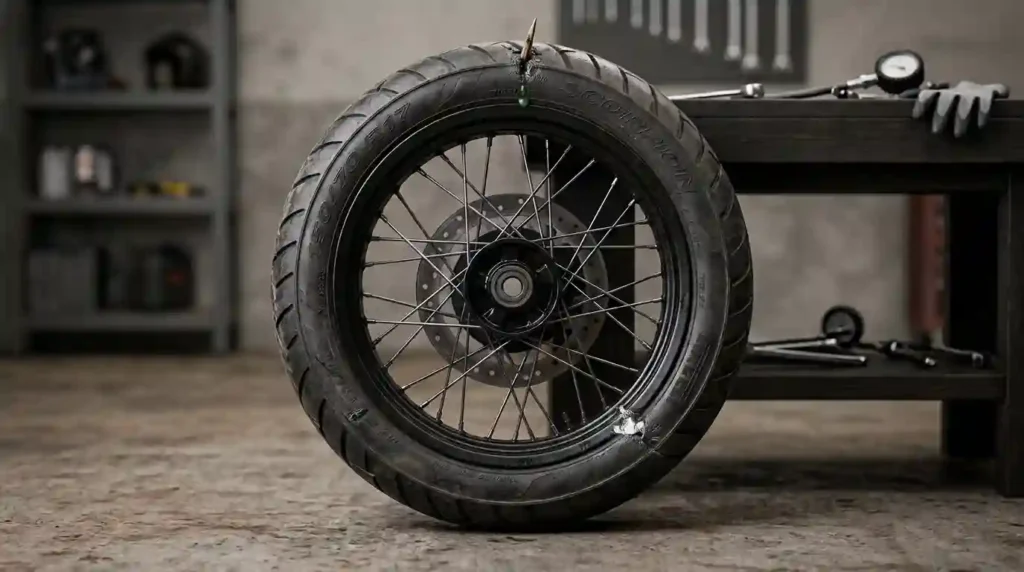
You roll out on a dry desert trail or a quiet bike path. A few miles later, the rear tire feels soft. You stop, and there it is: a tiny thorn stuck in the rubber. A bike tyre puncture from a thorn is small, but it can ruin a ride.
US cyclists face many tire problems. Flats, poor cornering grip, wrong tire pressure (PSI), and quick tread wear are the usual suspects. The right tire and the right PSI affect your safety, your speed, and your comfort. If you are shopping for new tires, start with our guide on how to choose bike tyres.
Thorns are tricky. They can cause a slow leak that you miss for days. Or they can cause a sudden flat on a fast descent.
This guide shows you how to find the thorn, repair the tube, and check the tire before you ride again. It covers road, gravel, mountain, commuter, and e-bike setups.
Quick answer: Find the thorn. Remove it with care. Check the tire casing. Then patch or replace the tube and set the right PSI.
What Happens When a Thorn Punctures a Bike Tire?
A thorn can pass through the tread or the sidewall. It leaves a small hole in the casing, the fabric layer that gives the tire its shape. Our guides on how bike tires work and what a bike tire casing is explain the basics.
Air may escape slowly, especially if the thorn stays stuck in the rubber. In that case the thorn acts like a loose plug.
Thorns can hit both inner-tube and tubeless setups. The repair method differs, as you will see below.
The size of the hole matters most. A thin thorn leaves a pinprick that may close up on its own. A wide thorn, like a goathead spine, can leave a hole that keeps leaking until you fix it.
How to Recognize a Thorn Puncture
Look for a tiny thorn, a small hole, or a slow loss of PSI. A tire that is soft every morning is a strong hint.
Other clues include a faint hiss, a wet spot from sealant, or a tire that needs air before every ride. Do not ignore them. A thorn that works deeper with every wheel turn can turn a slow leak into a flat.
Watch for repeat flats in the same wheel, even after you fit a new tube. A broken thorn may sit just under the rubber surface. Slow leaks can also come from other causes, as why bike tyres lose air explains.
Thorn Puncture vs. Other Bike Tire Flats
Thorns usually leave small, round holes in the tube or casing. Pinch flats leave two nearby holes after a hard hit on the rim. Glass, metal, and sharp stones may leave cuts or bigger holes.
Pinch flats come from low pressure, so see how much air to put in a bike tire.
| Flat Type | Hole Pattern | Common Cause |
|---|---|---|
| Thorn | Small, round, single hole | Goatheads, brambles |
| Pinch flat | Two parallel slits | Low PSI plus impact |
| Glass or metal | Cut or slit | Road debris |
| Rim tape issue | Hole on rim side | Bare spoke hole |
Why Do Thorns Puncture Bike Tires?
Dry plants and thorny shrubs leave sharp debris on roads, trails, and bike paths. Thin tread or little puncture protection lets thorns reach the casing.
Tire pressure, casing design, and surface all change how well a tire resists punctures. No tire is puncture-proof.
Think of protection as layers. Tread rubber, a belt, a liner, and sealant each stop a different share of thorns. Together they cut your flat rate, but none gives a promise.
Riding Through Thorny Trails and Roads
Thorny plants drop sharp debris onto gravel roads, road shoulders, and dirt trails. In the Southwest, goatheads (also called puncture vine) are a well-known menace. Blackberry brambles in the Pacific Northwest cause trouble too.
Desert washes, farm roads, and rail trails also collect thorny debris after wind and rain. Fall is often worst, since dry seed pods drop in large numbers.
Mountain bikers and gravel riders face more risk on dry brush routes. Avoid dense thorn patches when a safer line exists. See how to choose bike tires for rough roads and how to choose bike tires for gravel roads.
Tire Tread and Puncture Protection
Thicker tread and puncture belts can help resist some sharp objects. Protection varies by design, and it may not reach far into the sidewall.
A knobby tread pattern can also help, since thorns often snap off on the knobs. Learn why bike tires have different tread patterns. Rubber hardness matters too, so read what a bike tire rubber compound is. Softer rubber grips well but can wear faster, while harder rubber lasts longer and can shed some thorns.
Balance protection against rolling resistance, weight, and cornering traction. Our article on puncture protection vs. rolling resistance explains the trade-off.
Does Tire Pressure Affect Thorn Punctures?
Correct PSI helps the tire carry the rider and absorb bumps as designed. Very low pressure raises casing flex and impact damage risk.
High pressure does not guarantee thorn protection. It can also reduce grip on rough ground. Read what happens if bike tire pressure is too high for the other side of the story.
How to Find a Thorn in a Bike Tire
Check the tread and sidewalls for a visible thorn or small hole. Remove the wheel and inspect the inside of the tire before you replace or patch the tube.
Handle sharp debris with care. Never run bare fingers along the inside of the tire.
Quick steps: 1. Inspect the outside. 2. Check the tube. 3. Inspect the tire inside with a light.
Inspect the Tire Exterior (Step 1)
Rotate the wheel slowly. Look for thorns, small holes, or objects stuck in the tread.
Check the sidewalls as well as the center tread. Thorns often hide in the shoulder knobs, where tread meets sidewall. If you spot the hole, mark it before you remove the tire. A dab of chalk or a paint pen works well.
Check the Inner Tube (Step 2)
Remove the tube and inflate it a little. Listen for escaping air, or use soapy water to show small bubbles.
Compare the tube hole with the matching spot on the tire. Line the tube up with the tire in the same direction it sat. Any thorn that remains will sit right there.
If you find no hole in the tube, look at the tire again. A thorn can pop out after a slow leak starts, leaving only a faint mark in the rubber.
Inspect the Tire Interior Safely (Step 3)
Use a bright light to look for thorn tips, debris, and casing damage. Sweep a cloth gently along the inside to catch hidden bits.
Pull out visible debris with tweezers or a suitable tool. Work in good light and wear gloves if you have them. Do not reinstall the tube until the tire is clear and the casing is safe. Sizing questions can wait, but how to read bike tire size helps when you buy a spare.
How to Fix a Bike Tire Puncture From a Thorn
Remove the thorn and check that the casing is still sound. This order matters, because a tube swap alone will not stop the next flat. Patch a repairable tube, or replace it if the damage is large or close to the valve.
Refit the tire with care. Then inflate to an approved pressure and check for leaks.
Remove the Wheel and Tire (Step 1)
Shift gears as needed. Release the brake or axle mechanism for your bike. On a disc-brake bike, do not squeeze the brake lever while the wheel is out.
Deflate the tire fully. Use compatible tire levers to lift one bead. Take the tube out without stretching the valve stem.
Keep the removed tube nearby. You will need it to match the hole to the tire.
Remove the Thorn (Step 2)
Pull the thorn out with tweezers or pliers. If it has snapped off flush with the rubber, a small pick or the tip of a blade can lift it. Work slowly and keep your fingers clear.
Keep the thorn if you can. Seeing its length tells you how deep it went. A short thorn that stopped in the tread is a very different case from a long one that reached the tube.
Check whether it went through the tread, the sidewall, or both. Replace the tire if the thorn left a deep cut, exposed threads, or a structural tear.
Patch or Replace the Inner Tube (Step 3)
Clean and dry the area before you apply a compatible patch. Follow the patch maker’s steps for glue, curing time, and pressure.
Replace the tube if the hole is large, the valve area is damaged, or the tube is badly worn. A fresh tube is often the faster choice on the road.
At home, a patched tube is fine for a small hole. On the trail, a spare tube saves time and gets you rolling sooner.
Reinstall and Inflate the Tire (Step 4)
Check the tire interior, rim tape, and tube position before you seat the bead. Make sure the tube is not caught between the bead and the rim.
Inflate slowly within the tire and rim limits. Our guide on how to inflate a bike tire correctly walks you through it. Then check for leaks and uneven bead seating.
Give the tire a few minutes, then press the tread and recheck the PSI. A drop means a missed thorn or a pinched tube.
| Damage Found | Action |
|---|---|
| Small hole in tube | Patch or replace tube |
| Hole near the valve | Replace tube |
| Thorn hole, casing intact | Reinstall, monitor |
| Deep cut or exposed threads | Replace tire |
Can Tubeless Sealant Fix a Thorn Puncture?
Tubeless sealant can close many small thorn holes. The hole must be within the sealant’s working range.
The seal depends on hole size, sealant condition, pressure, and tire build. Large cuts or damaged sidewalls may need a plug, a boot, or a new tire. Sealant is a strong help on thorny routes, but it is not a cure-all.
How Tubeless Sealant Works
Liquid sealant flows toward a small hole as air escapes. It then forms a plug.
Sealant must be fresh and present in the amount the tire maker advises. It dries out over time, so riders in hot, dry areas often top it up every few months. Check the maker’s guide for compatible tires and service intervals.
After a leak, spin the wheel so the hole sits at the bottom. Wait a minute for the sealant to work, then recheck your PSI. Top up the air if needed.
Tubeless vs. Inner-Tube Repairs
Inner-tube systems usually need a patch or new tube after a thorn puncture. Tubeless tires may seal small holes without removing the tire.
Both systems need inspection if air loss continues or the casing looks damaged.
| Factor | Inner Tube | Tubeless |
|---|---|---|
| Small thorn hole | Patch or new tube | Often self-seals |
| Roadside effort | Tube swap | Often none |
| Ongoing upkeep | Low | Refresh sealant |
| Large cut | Replace tube, check tire | Plug, boot, or replace |
When Is a Tire Plug Needed?
A compatible tubeless plug can help when sealant cannot close a hole alone. Use products approved for your tire and the puncture spot.
Do not use a plug to make a torn sidewall or damaged bead safe.
If a plug does not hold, or the tire keeps losing air, stop and fit a tube. A plug is a trail fix, so check it again at home.
How to Prevent Thorn Punctures on Bike Tires
Choose tires with puncture protection that suits your roads and trails. A tire built for smooth pavement may struggle on a thorny shoulder. Check the tread and sidewalls after rides through thorny areas.
Keep suitable PSI. Replace worn tires before their protective layers fail. Worn tread leaves less rubber between a thorn and the casing, so risk climbs as the tire ages. See how often bike tyres should be replaced for a guide.
Choose Tires With Puncture Belts
Puncture belts add a layer under the tread on many models. Some tires also offer reinforced sidewalls, which can help on rough trails.
Compare independent tests and maker specs. Do not rely on one feature alone. A tire with a belt and a tough casing usually beats one with a single protective feature. Our buying guide on how to choose puncture-resistant bike tyres is a good place to start, and what bike tires are made of explains the materials.
Use Tire Liners or Puncture-Resistant Tubes
Compatible tire liners add a barrier between some sharp objects and the tube. Puncture-resistant tubes give extra protection but add weight.
Fit matters. A liner that overlaps badly can bunch up and cause a pinch flat. Thorns can also lodge in a liner and hurt the tube, so check it from time to time.
If you ride in thorn country, pull the liner out every few months. Clean off any stuck thorns before you refit it.
Inspect Tires and Maintain Correct PSI
Look for embedded thorns, cuts, cracks, and exposed threads. A quick scan after each ride takes under a minute. Learn how much tread a bike tyre should have to judge wear.
Use a reliable gauge before rides. See how to check bike tire pressure. Adjust PSI for tire width, system weight, and terrain.
Here is a quick starting estimate. It is a rule of thumb, not a standard.
- Add rider, bike, and gear weight in pounds.
- Front load is about 47% of that. Rear load is about 53%.
- Multiply each load by the width factor below.
- Subtract about 10% for tubeless, 5% for wet roads, and 10% for rough ground.
| Tire Width | Width Factor |
|---|---|
| 28 mm (1.1 in) | 0.80 |
| 32 mm (1.25 in) | 0.68 |
| 40 mm (1.6 in) | 0.40 |
| 2.1 in (53 mm) MTB | 0.30 |
| 2.4 in (61 mm) MTB | 0.22 |
Example for 32 mm tubed tires:
| System Weight | Front PSI | Rear PSI |
|---|---|---|
| 150 lb | 48 | 54 |
| 180 lb | 58 | 65 |
| 210 lb | 67 | 76 |
| 250 lb | 80 | 90 |
Never pass the tire or rim limit. For a deeper method, read how to find the correct bike tire pressure. Also learn whether you can overinflate a bike tire.
Best Bike Tires for Thorn-Prone Roads and Trails
Compare tire build, puncture protection, tread pattern, weight, and rolling resistance. Match the tire to road, gravel, mountain, commuter, or e-bike use.
Check size, inner rim width fit, frame clearance, and pressure range before you buy. Our list of the best bike tyres for puncture protection can help you shop.
| Rider Type | Look For | Common Width |
|---|---|---|
| Daily commuter | Thick tread, belt | 32 to 40 mm |
| Gravel | Strong casing, knobs | 38 to 50 mm |
| Mountain bike | Reinforced casing | 2.2 to 2.6 in |
| E-bike | Load rating, belt | 40 mm and up |
Best Tires for Daily Commuting
Prioritize durable tread and real puncture protection for debris-heavy roads. Look for a balance of low rolling resistance, wet grip, and comfort.
Choose a width that fits your frame and rim. Many commuters in thorn country pair a belted tire with fresh sealant or a liner. That mix costs a bit more, but it saves time on busy mornings. See how to choose tyres for a commuter bike, the best bike tyre size for commuting, and our picks of bike tyres for daily commuting.
Tires for Gravel and Mountain Biking
Consider stronger casings for sharp stones, roots, and thorny brush. Gravel tires and mountain bike tires also suit different pressures than road tires.
Match tread and rubber to the terrain and the grip you want. Wet Pacific Northwest mud needs a different tread than dry Southwestern rock. Riders on the Colorado Front Range and in Arizona often favor sturdy casings with extra sealant for the same reason. Read how to choose tires for mixed surfaces and how to choose bike tires for wet weather.
E-Bike Tires That Handle Thorns
Choose tires made for your bike’s use and total load. E-bike torque and system weight add stress to the tire, so durability matters.
Consider reinforced casings for commuting and cargo. Read how to choose durable bike tyres and bike tyre markings explained for beginners. Check fit with will this bike tire fit my wheel.
How Tire Puncture Resistance Is Tested
Compare products using clear puncture and casing test methods. Check whether tests cover tread penetration, sidewall strength, or both.
Lab results show relative performance. They do not guarantee safety from every thorn. See our testing process and editorial policy for how we approach reviews.
Understanding Casing TPI and Tire Construction
TPI means threads per inch. It does not set tire strength or puncture resistance by itself. Thread material, casing layers, rubber, and belts all play a part.
A high TPI casing may feel supple and light. A lower TPI casing may use thicker threads. Neither is automatically better at stopping thorns. Read what the numbers on bike tyres mean for more.
| Term | Plain-English Meaning |
|---|---|
| TPI | Thread density in the casing |
| Durometer | Rubber hardness; lower is softer |
| Puncture belt | Extra layer under the tread |
| Sealant | Liquid that plugs small holes |
| Rolling resistance | Energy lost as the tire rolls |
What to Look for in Independent Tire Tests
Review the method, sample size, pressure, tire size, and puncture tool. Compare results only when conditions are alike.
Pair lab data with real-world reports from similar terrain. Look for riders who share your climate and surface, since thorn type changes the result. Protection can change feel, so see how much bike tires affect grip, comfort, and speed.
Frequently Asked Questions About Bike Tire Thorn Punctures
Can a thorn puncture a bike tire without causing an immediate flat?
Yes. A thorn can make a tiny hole that leaks air slowly. It may even block some air loss while it stays lodged. Remove it and inspect the casing before you repair the tube or tire.
Should I remove a thorn from my bike tire?
Yes, before normal riding, but inspect the tire first and pull it out with care. Then check the tube or tubeless setup for air loss. Do not ride on a tire with a deep cut, bulge, or damaged casing.
Can tubeless tires prevent thorn punctures?
No. Tubeless tires do not stop thorns from entering the casing. Sealant can close many small holes, depending on size and sealant condition. Larger cuts may need a plug, a boot, or a new tire.
What PSI should I use to reduce punctures?
It depends on rider weight, tire width, rim fit, and terrain. Too little pressure raises impact and pinch-flat risk. Follow maker limits and use a calculator as a start. You can also widen your options with how much wider a tire you can fit.
Are puncture-resistant tires worth it?
They can cut flats on thorny routes, but no tire is puncture-proof. Compare protection, weight, rolling resistance, and grip. Heavier tires often cost a little speed, but many thorn-country riders accept that trade. Pick a model that fits your terrain and riding.
Can I patch a bike tire instead of replacing it?
You can often patch an inner tube if the hole is small and the tube is sound. A tire casing may tolerate small punctures, but deep cuts and structural damage are different. Replace a tire with a damaged casing, a bulging sidewall, or a bad bead.
How often should I check my bike tires for thorns?
Check after rides through brush, gravel, or debris. Check pressure before rides and look for stuck objects during routine care. Add a quick spin-and-scan after any ride off pavement. Our guide on how often to check bike tyres offers a simple routine.
Do tire liners work against thorns?
Liners can add protection against some sharp objects reaching the tube. Fit matters, since a poor install may cause rubbing or bunching. Trim liner ends so they do not overlap too much. Use a liner with a suitable tire and correct pressure, not as a promise against flats.
Final Verdict: Stop Thorn Punctures Before They Ruin Your Ride
A thorn puncture is often repairable, but you must remove the cause before you ride again. The tire, the tube, and your PSI all need a quick check. Missing a broken thorn is the top reason for a repeat flat.
Here are the key takeaways:
- Find and remove the thorn, then check the casing.
- Patch or replace the tube, and confirm the tire holds air.
- Use puncture belts, liners, or fresh tubeless sealant where thorns are common.
- Keep PSI correct, and inspect your tires after thorny rides.
Test your exact setup. Do not guess your pressure or your tire fit. Use the Free Bike Tire Pressure Calculator / Tire Finder Tool at TheBikeTires.com to match PSI and tire size to your weight, rim, and riding style. It takes a minute, and it can save you a long walk home.
Thorns are small, but they do not have to win. A little care after each ride in thorn country goes a long way. Pick the right tire, keep it inflated, and check it often.

Mohidul Islam is a leading cycling technology specialist and bike tire consultant with over 15 years of hands-on experience in the bicycle industry. He holds a Bachelor of Science in Mechanical Engineering from Penn State University, where he focused heavily on material science, tread mechanics, and rubber compound performance. Over the past decade and a half, Alex has conducted extensive field testing, tubeless setup evaluations, and tire pressure modeling for road, mountain, and e-bikes. His practical insights and data-driven approach help cyclists of all levels optimize grip, speed, and durability on every ride.



