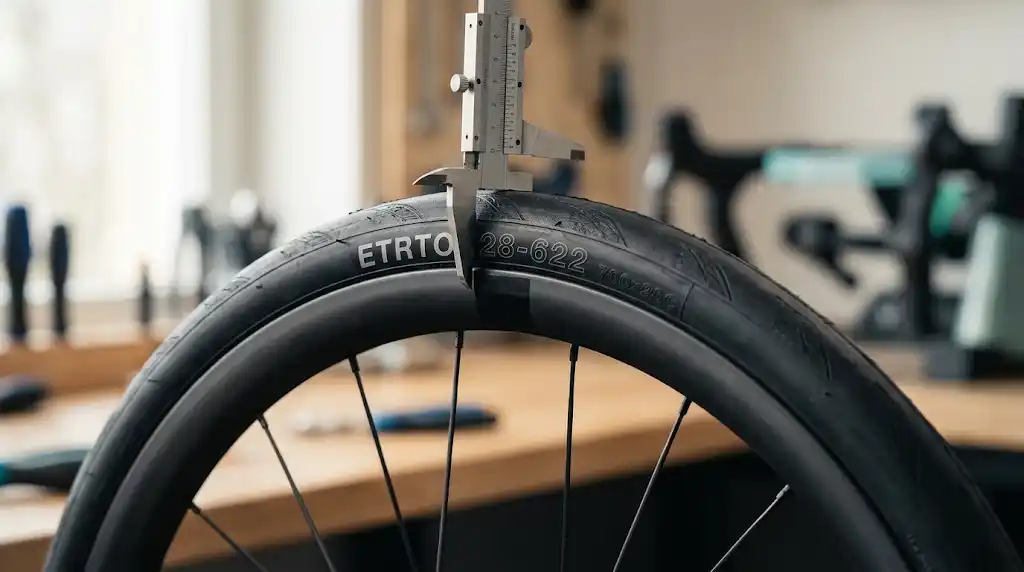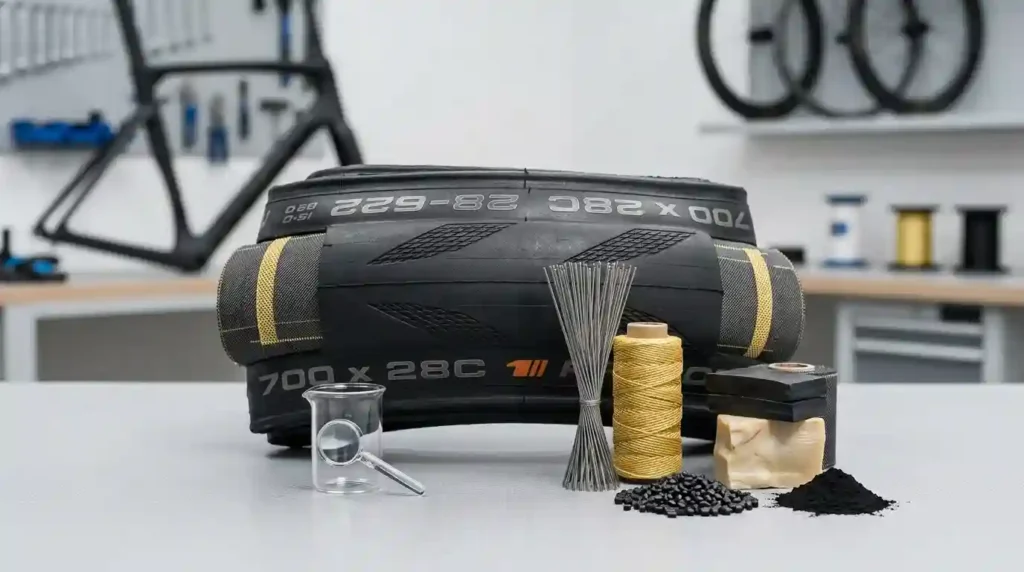
Finding the correct tire for your bike can feel needlessly complex. The raised numbers and letters stamped onto a bicycle tire sidewall describe crucial specifications including tire size, width, recommended inflation pressure, casing density, and rim safety standards.
Understanding these markings separates a smooth, efficient ride from poor cornering grip, handling issues, or premature tread wear. A tire’s markings detail how it will perform across varied terrain, whether you ride asphalt, gravel, or singletrack.
Different numbers govern distinct performance characteristics:
- Size & Width: Measurements like 700 x 28c or 29 x 2.25 dictate fit and air volume.
- ISO/ETRTO: The standardized metric designation (such as 28-622) that ensures exact rim compatibility.
- PSI Ratings: The operational pressure range required to prevent pinch flats and rim strikes.
- TPI & Casing: Threads-per-inch values indicating suppleness, rolling efficiency, and durability.
Whether you commute through city streets on an e-bike, race on smooth pavement, or tackle rocky trails, this practical guide decodes every marking stamped on your tire sidewall.
What do the numbers on bike tyres mean?
The numbers on bike tires identify the tire’s width, diameter, and exact bead fit. Additional markings state recommended tire pressure (PSI), casing thread density (TPI), tubeless compatibility, rubber durometer, and maximum load ratings. Reading these markings ensures proper rim compatibility, optimal traction, and safe operation.
What Do the Numbers on Bike Tyres Mean?
Every bicycle tire features a series of raised markings on its sidewall. These numbers provide the technical blueprint of the tire, detailing its physical dimensions, structural limits, and installation rules.
+———————————————————————————–+
| |
| CONTINENTAL GRAND PRIX 5000 [ 28 – 622 ] (700 x 28c) 95-115 PSI 3/330 TPI |
| |
+———————————————————————————–+
| | | | |
+– Brand & Model +– ETRTO +– French +– Pressure +– Casing
(Width-BSD) Format Range Threads
Common Sidewall Markings Explained
- French Format (e.g., 700 x 28c): A traditional road and gravel sizing system indicating overall outer tire diameter (700 mm) and width (28 mm).
- Decimal Format (e.g., 29 x 2.25): An Imperial measurement system primarily used for mountain bikes, showing outer diameter and width in inches.
- Fractional Format (e.g., 26 x 1 3/8): An older Imperial standard commonly found on vintage, cruiser, or utility bicycles.
- ETRTO/ISO (e.g., 28-622): The universal metric standard. The first number is width in millimeters; the second is the exact bead-seat diameter (BSD).
Matching the tire precisely to your wheel’s internal rim width and bead-seat diameter is essential. Choosing a tire simply because a single number looks familiar can lead to blowouts, poor bead seating, or dangerous frame clearance issues.
The Three Most Important Tire Numbers
- Bead-Seat Diameter (BSD): Identifies exact wheel fit, such as 622 mm (standard 700c/29er) or 584 mm (27.5-inch/650b).
- Mounted Width: Indicates tire width, such as 25 mm, 32 mm, or 2.4 inches, affecting air volume and clearance.
- PSI Range: Defines the minimum and maximum pressure limits for safe, efficient operation.
Why Tire Numbers Can Be Confusing
Legacy sizing systems often use identical nominal numbers to describe incompatible rim sizes. For example, a vintage 26 x 1 3/8 tire uses a 590 mm rim diameter, whereas a 26 x 1.5 tire uses a 559 mm rim diameter. They cannot be interchanged.
Modern rim designs also influence the real-world dimensions of a tire. Mounting a tire on a wider internal rim expands the tire casing, making a 28 mm tire measure closer to 30 mm once inflated.
How to Read Common Bike Tire Size Markings
Tire sizes are communicated through three distinct sizing standards: Millimeter (French), Imperial (Inches), and Universal Metric (ISO/ETRTO).
+——————-+———————-+——————–+——————–+
| Sizing Standard | Example Marking | Primary Application| Key Advantage |
+——————-+———————-+——————–+——————–+
| French System | 700 x 25c | Road, Gravel | Familiar to riders |
| Imperial System | 29 x 2.25 | Mountain, Cruiser | Easy width visual |
| ISO / ETRTO | 25-622 | All Bicycles | 100% Precise fit |
+——————-+———————-+——————–+——————–+
What Does 700 x 25c Mean?
The 700 x 25c label is the classic road cycling tire measurement.
- 700: Represents the traditional nominal outer diameter of the inflated tire in millimeters.
- 25: Represents the approximate width of the tire in millimeters (25 mm).
- c: Historically indicated a specific internal rim width code (a, b, c, or d). Today, “c” simply denotes a modern 622 mm road rim fitment.
Always cross-reference a 700c tire with its ISO size (622) to guarantee proper rim seating.
What Does 700 x 28c Mean?
The 700 x 28c marking denotes a 28 mm wide road or all-road tire. Modern road cycling has shifted toward 28 mm and wider options because higher air volume allows lower tire pressures. Lower pressure reduces road vibration and rolling resistance on uneven asphalt.
Installing a 28 mm tire expands its contact patch. On modern rims with wider internal measurements (19 mm to 23 mm), a 28 mm tire may measure up to 30 mm wide once inflated. Always ensure your bike frame and brake calipers have at least 4 mm of clearance around the tire.
What Does 29 x 2.25 Mean?
The 29 x 2.25 marking is a standard mountain bike tire specification.
- 29: Refers to the nominal outer tire diameter in inches.
- 2.25: Refers to the tire width in inches (approximately 57 mm).
Wider trail tires increase tire volume, allowing you to lower pressure for enhanced cornering traction over rocks and roots. However, wider tires add rotational mass and increase rolling resistance on paved or hardpack surfaces.
What Is the ISO/ETRTO Number on a Bike Tire?
The ISO (International Organization for Standardization) or ETRTO (European Tyre and Rim Technical Organisation) format is the global standard for bicycle tire sizing. It removes guesswork by displaying exact millimeter measurements in a two-number format: [Width] – [Bead-Seat Diameter].
ISO / ETRTO FORMAT
37 – 622
— —
| |
Tire Width in Millimeters —+ +— Bead-Seat Diameter (BSD) in mm
How to Read 37-622
An ISO rating of 37-622 provides precise specifications:
- 37: The inflated tire casing width is approximately 37 mm.
- 622: The internal tire bead diameter is exactly 622 mm.
A 700 x 35c road tire, a 29 x 2.1 mountain bike tire, and a 37-622 hybrid tire all share the exact same 622 mm bead-seat diameter. Every one of these tires will fit onto a standard 622 mm rim, provided the rim’s internal width can accommodate the chosen tire width.
Why ISO Numbers Matter for Rim Compatibility
Matching the precise bead-seat diameter (BSD) prevents installation errors. A traditional 27-inch road tire (BSD 630 mm) cannot be installed on a 700c wheel (BSD 622 mm), even though “27” sounds smaller than “29”. ISO measurements eliminate this confusion by providing clear metric values.
PAA: Can any 700c tire fit any 700c wheel?
No. While all 700c tires share the same 622 mm bead-seat diameter, a tire’s width must fit your wheel’s internal rim width. Mounting a wide 45 mm tire on a narrow 15 mm internal rim can cause tire squirm, poor cornering stability, or bead dislodgement. Always check your rim manufacturer’s approved tire width range.
What Does the Tire Width Number Mean?
Tire width dictates handling, comfort, aerodynamic drag, and grip. Width is listed either in millimeters (25 mm, 32 mm, 40 mm) for road and gravel setups, or inches (2.25″, 2.4″, 2.6″) for mountain bikes.
+——————+——————+——————+——————–+
| Discipline | Popular Widths | Primary Terrain | Key Advantage |
+——————+——————+——————+——————–+
| Road Racing | 25 mm – 28 mm | Smooth Asphalt | Aerodynamics, Speed|
| All-Road/Endurance| 28 mm – 32 mm | Rough Pavement | High Comfort & Speed|
| Gravel | 38 mm – 45 mm | Dirt, Fine Gravel| Grip, Shock Absorption|
| Trail / MTB | 2.3″ – 2.6″ | Rocks, Roots, Mud| Traction, Rim Impact Protection|
+——————+——————+——————+——————–+
Narrow vs. Wide Bike Tires
- Narrow Tires (23 mm – 25 mm): Offer light weight and aerodynamic advantages at higher speeds. However, they require higher pressure, leading to a firmer ride and less traction on rough surfaces.
- Wide Tires (28 mm – 2.6″): Hold a larger volume of air, allowing lower inflation pressures. This enables the tire to absorb vibrations, maintain contact with rough ground, and provide better cornering traction.
How Rim Width Changes Tire Shape
Internal rim width directly alters a tire’s inflated profile.
- Mounting a tire on a narrow rim creates a lightbulb-shaped profile. This increases lateral flex (“squirm”) when cornering hard at low pressures.
- Mounting a tire on a wide rim creates a squarer profile. This supports the sidewall, improving stability and allowing for lower operational PSI.
What Does PSI Mean on a Bike Tire?
PSI stands for Pounds per Square Inch, measuring the air pressure inside your tire. Bicycle tires state a safe operating range on the sidewall, such as MAX 110 PSI or 45 – 65 PSI.
TOO HIGH PRESSURE OPTIMAL PRESSURE TOO LOW PRESSURE
(Harsh / Slow Bounce) (Supple / Maximum Grip) (Pinch Flat Risk / Squirm)
/—–\ /—–\ /—–\
| | | | | / \
| . | | — | | ===== |
\_____/ \_____/ \_______/
Tiny Contact Patch Ideal Contact Patch Excessive Deformation
How to Choose the Right Tire Pressure
Sidewall PSI numbers represent absolute structural safety limits, not universal setting targets. Your target pressure depends on system weight, tire casing, and surface conditions:
- Calculate System Weight: Combine total weight (Rider + Bicycle + Gear).
- Account for Tire Volume: Larger tires require significantly less pressure to support the same load.
- Adjust for Conditions: Reduce pressure by 2–4 PSI on wet pavement or loose dirt to enlarge the tire’s contact patch. Increase pressure on smooth pavement to maintain stability.
Tire Pressure Guidelines by Discipline
- Road (700 x 28c): 65 – 85 PSI (Closer to 65 PSI for lighter riders; 85 PSI for heavier riders).
- Gravel (700 x 40c): 30 – 45 PSI (Tubeless setups can run 28 – 35 PSI).
- Mountain Bike (29 x 2.4″): 18 – 26 PSI (Lower in front for traction, slightly higher in rear for rim protection).
- Commuter (700 x 35c): 45 – 60 PSI (Balanced for durability, shock absorption, and load carrying).
- E-Bike (700 x 45c Heavy Duty): 50 – 65 PSI (Requires higher pressure to support motor and battery weight).
What PSI should I put in my bike tires?
Always stay within the minimum and maximum PSI range stamped on your tire sidewall. Calculate your target pressure based on system weight, tire volume, and surface conditions. Lower the pressure slightly for loose or rough terrain to improve grip; increase it slightly for heavy loads to protect against rim impacts.
Why Too Much or Too Little PSI Can Be a Problem
- Over-Inflation: Excess pressure reduces traction by causing the tire to bounce over road surface imperfections rather than absorbing them. This leads to early rider fatigue and higher rolling resistance outdoors.
- Under-Inflation: Low pressure risks pinch flats (where the rim pinches the inner tube over bumps) or rim damage. It also causes tire squirm, reducing control during high-speed cornering.
What Does TPI Mean on a Bike Tire?
TPI stands for Threads Per Inch. It measures the density of nylon or cotton threads woven within one inch of the tire casing beneath the rubber tread.
LOW TPI CASING (e.g., 60 TPI) HIGH TPI CASING (e.g., 120 TPI)
Thicker Nylon Threads + Heavy Rubber Thinner Threads + Supple Rubber Matrix
| | | | | | | | | |||||||||||||||||||||||||||||||||||||||
| | | | | | | | | |||||||||||||||||||||||||||||||||||||||
+——————————-+ +————————————-+
– High Puncture & Cut Resistance – Supple, Low Rolling Resistance
– Stiffer Ride Quality – Conforms Quickly to Rough Terrain
Low-TPI vs. High-TPI Casings
- Low TPI (27 – 60 TPI): Built using thicker threads coated with thicker rubber. These tires are heavier, stiffer, and highly puncture-resistant. They are common on commuter, touring, and budget bikes.
- High TPI (120 – 320 TPI): Built using fine, tightly woven threads. High-TPI casings require thinner rubber coatings, making the tire lighter, more flexible, and supple. They conform quickly to road surfaces, reducing rolling resistance and improving grip.
Does Higher TPI Make a Bike Tire Faster?
Yes. High-TPI tires deform around pavement imperfections with minimal energy loss, lowering rolling resistance. However, because their individual threads are finer, high-TPI tires can be more susceptible to sidewall cuts unless combined with protective puncture belts.
What Do Tire Tread Numbers and Patterns Tell You?
Tread design affects rolling resistance, cornering grip, braking performance, and mud shedding. Choosing the right tread pattern depends on where you ride.
+——————-+—————————–+————————————+
| Tread Style | Visual Characteristics | Best Surface Application |
+——————-+—————————–+————————————+
| Slick | Smooth rubber, tiny sipes | Dry, clean pavement |
| Semi-Slick | Smooth center, side knobs | Hardpack dirt, commuter paths |
| File Tread | Diamond diamond pattern | Dry gravel, firm off-road |
| Aggressive Knobby | Deep, open tread blocks | Loose dirt, mud, technical trails |
+——————-+—————————–+————————————+
Road Bike Tread Patterns
Road bike tires feature smooth centers or light tread texturing. On hard, paved surfaces, tread knobs are unnecessary for grip—rubber compound and tire pressure drive traction. Slick road tires maximize the contact area on asphalt.
Mountain Bike Tread Patterns
Off-road traction relies on tread blocks digging into loose soil.
- Knob Height: Deep knobs dig into mud and loose dirt; shorter knobs roll faster on hardpack.
- Knob Spacing: Widely spaced knobs shed sticky mud quickly; tightly packed knobs reduce rolling resistance on dry, hard surfaces.
- Front vs. Rear: Front tires often feature tall, directional side knobs for steering grip. Rear tires prioritize horizontal knob faces for propulsion and braking power.
Gravel Tire Tread Patterns
Gravel tires feature a smooth or diamond-file center strip for speed on paved sections, paired with raised side knobs for traction when leaning into gravel corners.
What Do Tire Compound and Rubber Markings Mean?
The rubber compound formulation dictates wet traction, tread life, and cornering grip. Compound characteristics are often identified on the tire using trade names or durometer ratings.
Soft vs. Hard Rubber Compounds
Rubber hardness is measured using a Shore A durometer:
- Soft Compounds (50a – 60a): Offer strong grip on wet rocks and off-road surfaces, but wear quickly and increase rolling resistance.
- Hard Compounds (65a – 70a): Offer lower rolling resistance and long tread life, but provide less cornering grip on slippery or wet surfaces.
Dual and Triple Rubber Compounds
Many performance tires combine multiple compounds across the tread:
DUAL-COMPOUND RUBBER TREAD PROFILE
Firm Center Rubber (62a-70a)
[ Fast Rolling + Long Wear ]
|
+——————+——————+
| |
Soft Shoulder (50a-55a) Soft Shoulder (50a-55a)
[ Max Cornering Grip ] [ Max Cornering Grip ]
- Center Tread: Uses a firm, durable rubber compound to extend lifespan and reduce rolling resistance.
- Shoulder Knobs: Use a soft, tacky rubber compound to optimize grip when leaning into turns.
What Does a Puncture Protection Number or Belt Marking Mean?
To prevent flats, manufacturers layer specialized protective fabrics beneath the tread rubber or across the sidewalls.
TIRE CROSS-SECTION WITH PUNCTURE BELT
Tread Rubber
+—————————+
|====== PUNCTURE BELT ======| <– Aramid / Kevlar Layer
+—————————+
| Casing Fabric (High TPI) |
+—————————+
Common Protection Technologies
- Aramid/Kevlar Belts: Lightweight fabric woven directly under the tread area to stop glass, thorns, and sharp debris from reaching the inner tube or tubeless cavity.
- Sidewall Shielding: Woven cross-ply nylon layers extending from bead to bead to prevent sharp rocks from slicing tire sidewalls.
Do More Protective Layers Make a Tire Better?
Extra puncture layers add weight and stiffen the tire casing, which can increase rolling resistance and make the ride feel harsher. Racing tires use minimal, targeted protection to maximize speed, whereas commuter and touring tires incorporate thicker puncture belts to handle daily urban debris.
What Does Tubeless Ready Mean on a Bike Tire?
Tires marked Tubeless Ready (TLR), Tubeless Compatible (TC), or Tubeless Easy (TLE) are designed to be run without an inner tube when paired with liquid sealant, sealant-compatible rim tape, and dedicated tubeless valves.
CLINCHER WITH INNER TUBE TUBELESS READY SETUP
/——-\ /——-\
| (O) | <– Inner Tube | ~ ~ ~ | <– Liquid Sealant
| | | ~ ~ ~ |
+===—===+ +===—===+
Hooked Rim Only Hooked or Hookless Rim
What You Need for a Tubeless Setup
- Tubeless-Ready Tire & Rim: Features an engineered bead profile that locks securely into place under air pressure.
- Tubeless Rim Tape: Seals the interior spoke holes of the rim to keep air from escaping.
- Tubeless Valve Stem: Uses a rubber bung to seal the valve hole on the rim.
- Liquid Sealant: A latex-based liquid that instantly coats and seals small punctures while riding.
How to Set Up Tubeless Bike Tires
- Prepare Rim: Apply airtight tubeless rim tape over the spoke bed and insert the tubeless valve stem.
- Mount Tire: Push one tire bead into the center channel of the rim, then fit the second bead.
- Add Sealant: Inject 2 to 4 ounces of liquid tubeless sealant through the removable valve core or directly into the unseated tire casing.
- Seat the Bead: Inflate rapidly using a high-volume floor pump or air compressor until the tire bead snaps into the rim shoulder.
- Distribute Sealant: Rotate and shake the wheel sideways to distribute sealant along the beads and casing.
How do you set up tubeless bike tires?
Tape a tubeless-compatible rim, install a tubeless valve, and mount a tubeless-ready tire. Inject liquid sealant, inflate rapidly with a floor pump or air compressor until the tire beads snap onto the rim shoulders, then rotate the wheel to spread the sealant evenly across the interior.
How Tire Numbers Affect Rolling Resistance
Rolling resistance represents the energy lost as a tire deforms under load. Tread compound, casing construction, width, and air pressure all affect this efficiency.
Tire Width and Rolling Resistance
At equal inflation pressures, a wider tire features a shorter, wider contact patch than a narrow tire. This shorter contact patch reduces casing deformation at the tire’s leading edge, lowering rolling resistance.
NARROW TIRE CONTACT PATCH WIDE TIRE CONTACT PATCH
(Longer Deformation Area) (Shorter Deformation Area)
+——-+ +—————+
| | | |
| | +—————+
| | Shorter Direction of Travel
+——-+ <– Lower Hysteresis
This efficiency allows wide tires to be run at lower pressures, absorbing surface bumps while maintaining speed on real-world roads.
Casing Flex and Energy Loss
Stiff casing materials create energy loss (hysteresis) as they flex. Supple, high-TPI casings require less energy to deform around road surface variations, translating more of your pedal stroke into forward motion.
How E-Bike Tires Use Different Numbers and Ratings
Electric bikes place greater demands on tires due to motor torque, higher average speeds, and additional system weight from the battery and motor.
What Is an E-Bike Tire Load Rating?
Tires designed for e-bikes often display European safety certification markings stamped on the sidewall:
E-50 CERTIFICATION MARKING
+—————+
| E-BIKE READY | <– Certified for speeds up to 50 km/h (31 mph)
| ECE-R75 | Mandatory for Class 3 E-Bikes in many jurisdictions
+—————+
- ECE-R75 Certification: Indicates the tire is tested and certified for high-speed e-bikes capable of speeds up to 50 km/h (31 mph).
- Load Index: A numerical code detailing the maximum weight capacity the tire casing can safely support at maximum inflation pressure.
Do E-Bikes Need Higher Tire Pressure?
E-bikes do not always require maximum pressure, but because the total bike system weight is higher, they typically need higher inflation pressure than traditional bikes of similar width. Proper pressure prevents pinch flats, protects rims, and extends battery range by reducing rolling resistance under load.
How to Match Bike Tire Numbers to Your Rim
To select a compatible tire, compare its markings against your wheel’s physical specifications.
MEASURING YOUR RIM
<- Internal Rim Width ->
+—————+
| +——-+ |
| | | |
|—| |—|
+—————+
<— External Rim Width —>
Step 1: Check Your Existing Tire
Locate the size printed on your tire sidewall. Note both the French/Imperial size (700x28c) and the ISO measurement (28-622).
Step 2: Check Your Rim
Locate the rim size sticker near the valve hole or measure the internal rim width using calipers.
- Match the Bead-Seat Diameter exactly (e.g., ISO 622 tire to ISO 622 rim).
- Cross-reference tire width with internal rim width using the chart below.
+——————–+———————————–+
| Internal Rim Width | Safe Approved Tire Width Range |
+——————–+———————————–+
| 15 mm | 23 mm – 32 mm |
| 17 mm | 25 mm – 38 mm |
| 19 mm | 28 mm – 45 mm |
| 21 mm | 32 mm – 50 mm (1.95″) |
| 25 mm | 40 mm – 2.4″ |
| 30 mm | 2.25″ – 2.6″ |
+——————–+———————————–+
PAA: How do I know what size tire fits my bike?
Check the ISO rating printed on your current tire sidewall (e.g., 28-622). Match the second number (622) exactly to your rim diameter. Choose a tire width that fits your internal rim width and maintains at least 4 to 6 mm of clearance between the tire, frame, and fork.
Common Bike Tire Sizes Quick Reference
Use this reference table to compare standard bike tire markings, sizes, and typical applications:
+—————–+—————+—————-+——————————–+
| Tire Marking | ISO Standard | Recommended Rim| Typical Bike Application |
+—————–+—————+—————-+——————————–+
| 700 x 25c | 25-622 | 15 mm – 17 mm | Road racing, smooth asphalt |
| 700 x 28c | 28-622 | 17 mm – 19 mm | All-road, endurance road |
| 700 x 38c | 38-622 | 19 mm – 21 mm | Gravel, pavement commuting |
| 27.5 x 2.3 | 58-584 | 25 mm – 30 mm | Trail / All-Mountain MTB |
| 29 x 2.25 | 57-622 | 23 mm – 28 mm | Cross-Country / Trail MTB |
| 26 x 1.95 | 50-559 | 19 mm – 21 mm | Vintage MTB, cruiser, utility |
+—————–+—————+—————-+——————————–+
How to Choose the Right Bike Tire Using the Numbers
- Verify Diameter: Ensure the tire’s ISO BSD matches your rim’s BSD (e.g., 622 for 700c/29er).
- Select Width: Balance speed against terrain. Choose narrow sizes (25 mm – 28 mm) for pavement or wider sizes (38 mm+ / 2.2″+) for rough roads and trails.
- Choose Casing Density: Pick 60 TPI for daily commuting durability or 120+ TPI for supple, fast performance.
- Check Protection Requirements: Ensure the tire includes a puncture belt if you ride in areas with glass or thorns.
How to Adjust Bike Tire Pressure After Changing Tire Size
Switching to a different tire width requires adjusting your target PSI. Wider tires hold more air volume, requiring less pressure to support the same load.
Target Tire Pressure Formula
You can estimate your baseline front and rear inflation pressures using this system-weight formula:
TotalSystemWeight(lbs)=RiderWeight+BikeWeight+Gear
RearTirePSI=TotalSystemWeight5WidthAdjustmentFactor
FrontTirePSI=RearTirePSI0.90
- Width Factor: 25mm = 1.3, 28mm = 1.0, 32mm = 0.85, 40mm = 0.65, 2.2″ = 0.45.
Fine-Tuning Pressure on the Road or Trail
- If the ride feels harsh or slides in corners: Reduce pressure by 2 to 3 PSI.
- If the tire squirms in turns or strikes the rim: Increase pressure by 3 to 5 PSI.
Common Mistakes When Reading Bike Tire Numbers
- Assuming 700c fits 27-inch rims: A 27-inch rim has a 630 mm BSD, while a 700c rim has a 622 mm BSD. They are incompatible.
- Inflating to Maximum Sidewall PSI: The max PSI listed on the sidewall is a structural safety limit, not a daily target. Max pressure often leads to a harsh ride and higher rolling resistance outdoors.
- Ignoring Frame and Fork Clearance: Installing wider tires without checking clearance can cause the tire to rub against the frame, damaging the paint or carbon structure.
- Confusing Fractional and Decimal 26-inch Sizes: A 26 x 1.5 tire (ISO 559) will not fit a 26 x 1 1/2 rim (ISO 584). Always check the ISO number.
How to Tell When Your Bike Tires Need Replacing
Tire performance declines as rubber wears down over time. Inspect your tires regularly for these warning signs:
SIGNS OF TIRE WEAR
Square Tread Profile Exposed Casing Threads Sidewall Dry Rot/Cracks
+———–+ +———–+ +—————+
/ \ / | | | | | \ / / / / / / / / \
| ======= | | | | | | | | | / / / / / / / |
\ / \ | | | | | / \ / / / / / / / /
+———–+ +———–+ +—————+
- Flat Center Strip: A worn road tire develops a flat center profile, leading to sluggish cornering response.
- Visible Casing Threads: If woven fabric or puncture belts show through the tread, replace the tire immediately.
- Dry Rot & Sidewall Cracking: Fine cracks along the sidewall indicate the rubber compound has degraded from age or UV exposure.
- Frequent Punctures: As tread rubber thins, sharp debris penetrates the casing more easily.
How to Fix a Flat Bike Tire
Inner-Tube Flat Repair
- Remove the wheel from the bike frame.
- Unseat one tire bead using tire levers, then pull out the damaged inner tube.
- Check the inside and outside of the tire casing for the object that caused the puncture.
- Install a new inner tube, re-seat the tire bead, and inflate to your target PSI.
Tubeless Puncture Repair
TUBELESS PLUG REPAIR STEP
1. Locate Puncture 2. Insert Plug Tool 3. Trim & Reinflate
|| || ||
+–||–+ +–||–+ +–||–+
| \/ | | [==] | | || |
+——+ +——+ +——+
- Locate the puncture hole where sealant is escaping.
- Insert a tubeless repair plug (“bacon strip”) directly into the hole using an insertion tool.
- Pull the tool straight out, leaving the rubber plug in place to seal the opening.
- Re-inflate the tire with a hand pump or CO2 inflator.
How Tire Testing Helps You Choose Between Bike Tires
Independent laboratory testing removes marketing bias by evaluating tire performance under controlled conditions.
What Key Metrics to Compare
- Rolling Resistance (Watts): Measures power lost to casing friction at specific loads and pressures. Lower wattage ratings indicate a faster tire.
- Puncture Resistance (Scores): Evaluates the force required for a blade or needle to pierce the tread and sidewall.
- Actual Width & Weight: Measures real-world weight and width when mounted on standard test rims.
Frequently Asked Questions About Bike Tire Numbers
What do the numbers on bike tyres mean?
They identify the tire’s outer diameter, width, exact bead-seat diameter, operating pressure limits, and casing construction.
What does 700 x 28c mean on a bike tire?
It indicates a tire designed for a 700c wheel (~622 mm BSD) with an inflated width of approximately 28 mm.
What PSI should I use for my bike tires?
Target pressure depends on system weight, tire volume, terrain, and rim style. Calculate your baseline pressure within the minimum and maximum range stamped on your tire’s sidewall.
Is a higher TPI bike tire better?
Higher TPI tires are lighter and offer a smoother, faster ride, but lower TPI tires are thicker and provide better puncture protection for commuting.
Can I put a wider tire on my bike?
Yes, as long as the tire matches your rim’s bead-seat diameter, fits your internal rim width, and leaves at least 4 to 6 mm of frame clearance.
Are tubeless tires better than tires with inner tubes?
Tubeless tires reduce pinch flats, allow lower operating pressures for enhanced grip, and self-seal small punctures, making them popular for gravel and mountain biking.
How do I know when my bike tire is worn out?
Replace your tire if the center tread is worn flat, threads are visible through the rubber, sidewalls show deep dry-rot cracks, or you experience frequent punctures.
Does a wider bike tire reduce rolling resistance?
Yes. At identical inflation pressures, wider tires have a shorter contact patch that deforms less, reducing casing energy losses over real-world road surfaces.
Final Takeaways: Learn the Numbers Before You Buy or Inflate
Understanding tire markings ensures you choose the right options for performance, fit, and safety:
- Verify ISO Sizes: Always match the ISO/ETRTO rating (622, 584, 559) to your wheel rim before purchasing.
- Optimize Pressure: Use system weight and tire volume to calculate your daily PSI targets rather than running maximum sidewall pressure.
- Match Tread and Casing to Your Ride: Choose high TPI and flexible casings for speed, or robust puncture belts and low TPI for urban commuting.
Find Your Ideal Tire Setup
Stop guessing your tire size and air pressure targets. Use the Free Bike Tire Pressure Calculator & Tire Finder Tool at TheBikeTires.com to find optimal inflation pressures and tire options tailored to your bike, body weight, and riding style.

Mohidul Islam is a leading cycling technology specialist and bike tire consultant with over 15 years of hands-on experience in the bicycle industry. He holds a Bachelor of Science in Mechanical Engineering from Penn State University, where he focused heavily on material science, tread mechanics, and rubber compound performance. Over the past decade and a half, Alex has conducted extensive field testing, tubeless setup evaluations, and tire pressure modeling for road, mountain, and e-bikes. His practical insights and data-driven approach help cyclists of all levels optimize grip, speed, and durability on every ride.