
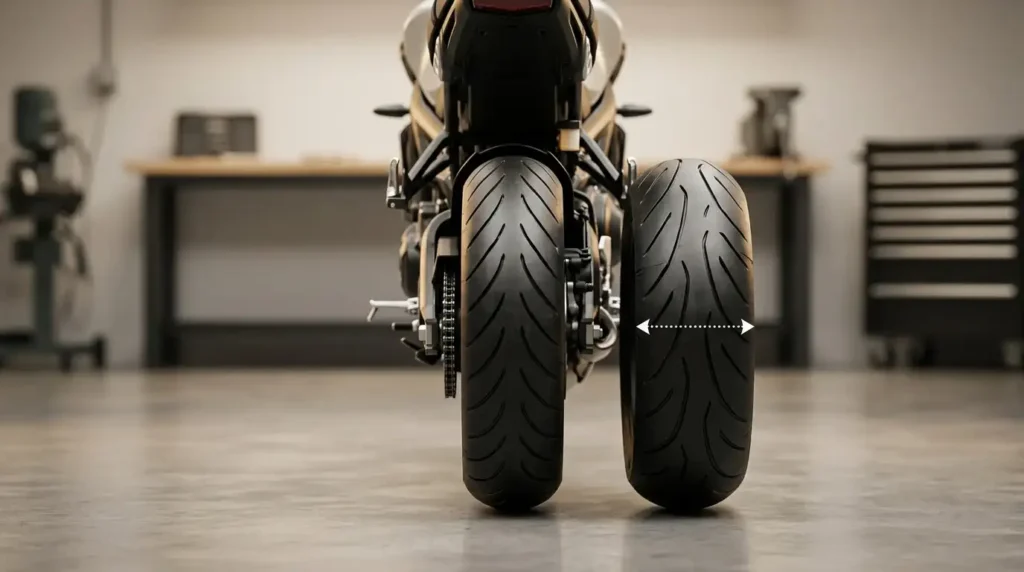
Upgrading to a wider bicycle tire is one of the most effective ways to improve ride comfort, cornering grip, and overall traction. However, installing a tire that exceeds your frame, fork, or rim limitations can cause dangerous frame rub, erratic handling, or catastrophic tire failure.
Determining the maximum tire width for your bicycle depends on frame and fork clearance, internal rim width, brake type, and drivetrain spacing. A wider tire is not automatically better for every setup, so your chosen size must safely clear every component under real-world riding conditions.
The practical goal is simple: find the widest tire your setup can safely accommodate without risking component contact, compromised handling, or rim incompatibility.
How Much Wider Tire Can You Fit on a Bike?
Most bicycles can accept a tire that is 2 mm to 6 mm wider than the stock factory tire, but the exact upper limit varies across frames, forks, rims, and brake components.
[ Frame / Fork Arch ]
+—————————–+
<– Clearance –> |
| +—————+ |
| | |
/ \ |
| Wider Tire | |
\ / |
+—————+ |
|
+—————————–+
<– Safety Margin: 4-6mm –>
As a general rule, maintain a mandatory safety clearance rather than fitting a tire that barely clears the frame when the bike is stationary in a work stand.
When sizing up, always account for key operational factors that expand effective tire volume:
- Tire Growth: High volume casings expand over time once fully inflated and seated.
- Rim Width: Wider internal rim dimensions increase the actual measured width of the tire beyond the label size.
- Dynamic Flex: Wheel, frame, and fork flex under heavy sprinting or cornering forces push the tire closer to frame stays.
- Debris Space: Mud, gravel, and road grit stick to the tread, requiring extra room to prevent paint damage or frame wear.
What Determines Maximum Tire Width?
Three physical hardware parameters dictate how wide you can go on any bicycle setup:
Frame and Fork Clearance
Inspect the tightest physical pinch points around your current tires. For the front wheel, check the fork crown, arch, and fork blades. For the rear wheel, measure the tightest gaps at the chainstays, seatstays, seat tube, and front derailleur clamp.
Rim Internal Width
Your wheel’s internal rim width dictates the mounted profile and real-world width of the tire casing. Mounting a wide tire on an overly narrow rim creates an unsafe “lightbulb” profile that squints under cornering loads.
Brakes and Drivetrain
Rim brake calipers, mechanical derailleur cages, and drive chains can limit available space long before the frame itself restricts width. Disc-brake bikes eliminate caliper restrictions, but chainstay clearance remains a primary bottleneck.
Why Manufacturer Clearance Matters
Bike manufacturers specify a maximum tire size for every specific frame design to ensure safe operation. Published manufacturer specifications account for mechanical tolerances, dynamic frame deflection, and international safety standards (such as ISO 4210).
Official published clearance is far more reliable than assuming two bikes with identical wheel sizes will accept the same tire. A gravel bike with 700c wheels might accept up to a 45 mm tire, whereas an aggressive road bike with 700c wheels may top out at 28 mm to 30 mm.
Pay close attention when assessing setups with specific component hardware:
- Disc-Brake Frames: Generally provide superior clearance around the fork crown and seatstays compared to rim-brake models.
- Rim-Brake Bikes: Brake caliper arches and cable pull arms strictly limit tire height and width.
- Fenders & Racks: Full-coverage fenders usually require at least 10 mm to 15 mm of additional clearance above and beside the tire tread.
- Suspension Forks: Suspension arches and full-compression crown clearances require careful verification to avoid sudden tire jamming.
How to Check if a Wider Bike Tire Will Fit
Follow this step-by-step checklist to measure your bicycle and verify tire compatibility before purchasing new rubber:
- Record Current Specifications: Note your existing tire’s printed size, real measured width, and current tire pressure (PSI).
- Consult Frame Documentation: Check your bike manufacturer’s stated maximum tire clearance rating.
- Measure Existing Frame Clearance: Use precision calipers to locate the narrowest gap between your current tire and frame/fork.
- Measure Rim Internal Width: Remove the tire or check manufacturer wheel specs to identify the internal channel width in millimeters.
- Compare Labeled vs. Mounted Dimensions: Account for tread expansion, as modern tires routinely inflate wider than their printed sidewall label.
- Test Mounted Wheel Alignment: Ensure the wheel sits perfectly centered in the dropouts or thru-axles.
- Verify Dynamic Safety Margin: Confirm at least 4 mm to 6 mm of remaining space around all sides for mud, flex, and debris.
Measure Frame Clearance
Accurate measurements prevent costly buying errors. Do not rely on visual estimates when sizing up your tires.
[ Seatstay / Chainstay ]
| |
|<– Gap (A) –>| (Left Clearance)
[Tire Width]|
|<– Gap (B) –>| (Right Clearance)
|
Use a digital or vernier caliper to check the space between the tire casing and the chainstays, seatstays, seat tube, and brake hardware. Always measure at the absolute narrowest point along the entire radius of the wheel, not at the widest-looking section.
Measure both the left and right sides independently. Drivetrain dish, subtle wheel out-of-roundness, or slight frame asymmetry frequently make clearance tighter on one side.
Check Fork and Front-Tire Clearance
Front wheel tire clearance requires rigorous safety evaluation to maintain steering control and prevent front-wheel lockups.
Measure the physical gap around the top of the tire beneath the fork crown, as well as the lateral space between the tire sidewalls and both fork legs.
Suspension forks require careful physical checks:
- Static Clearance: Measure space under the fork arch.
- Full Compression Check: Let all air out of an air fork (or remove the coil spring) and compress the fork completely.
- Crown Contact Risk: Confirm the tread does not contact the bottom of the steer tube crown at maximum travel.
+——————————————————-+
| SUSPENSION FORK FULL-COMPRESSION SAFETY CHECK |
+——————————————————-+
| 1. Depress air valve to deflate air spring completely.|
| 2. Push fork down to hard bottom-out stop. |
| 3. Verify minimum 6mm gap between tire top & crown. |
+——————————————————-+
Check Rear-Tire Clearance
The rear wheel hub sits inside a high-stress mechanical junction where frame flex is most pronounced during out-of-saddle climbs.
Carefully inspect three critical rear frame regions:
- Chainstay Bridge & Yoke: The tightest restriction point on almost all road, gravel, and hardtail frames.
- Bottom Bracket Junction: Space behind the seat tube where grit and mud collect rapidly.
- Drivetrain Components: Distance between the outer tire knobs and the front derailleur cage or drive chain in the lowest gear.
Mud buildup can quickly strip paint and damage carbon frame structures if lateral clearance drops below minimum safe thresholds on gravel or trail rides.
How Much Clearance Should a Bike Tire Have?
Operating clearance must account for structural wheel flex, frame distortion, trail mud, road debris, and physical tire growth. A tire that fits inside a repair stand can easily rub the frame when subjected to real-world cornering loads.
Recommended Safety Clearances by Discipline
| Riding Discipline | Minimum Lateral Clearance | Minimum Vertical Clearance | Recommended Conditions |
| Smooth Pavement / Road | 3 mm−4 mm | 4 mm | Clean dry asphalt, sealed roads |
| All-Road / Endurance | 4 mm−5 mm | 5 mm | Rough pavement, light chipsseal |
| Gravel / Cross | 6 mm | 8 mm | Dirt, dry gravel, fine dust |
| Wet Gravel / Mud | 8 mm−10 mm | 10 mm+ | Sticky clay, wet gravel, debris |
| Trail / Mountain Bike | 6 mm−8 mm | 8 mm−10 mm | Rocks, aggressive cornering, mud |
Applying these buffer margins preserves your paint finish, protects carbon fiber structural integrity, and prevents debris lockups.
Why a Few Millimeters Can Matter
A nominal printed tire size rarely matches its actual mounted metric dimension. Manufactured tire casings expand differently depending on internal rim design and operating pressures.
Factors Influencing Mounted Width
- Rim Channel Width: A tire mounted on a wider internal rim expands approximately 1 mm in actual width for every 2 mm−3 mm of added internal rim width.
- Inflation Pressure: Running maximum recommended PSI stretches tire casings to their absolute limit, whereas lower pressures allow casing relaxation.
- Casing Suppleness: High-thread-count casings (120 TPI+) stretch significantly more over the first 48 hours of installation than thick 30 TPI commuter tires.
+——————————————————-+
| TIRE WIDTH vs. CLEARANCE DEFINITIONS |
+——————————————————-+
Nominal Tire Width: Print label size (e.g., 28mm) |
| Mounted Tire Width: Actual caliper width on rim |
Frame Clearance: Physical gap left between frame & tire|
+——————————————————-+
Always evaluate your total wheel, rim, and tire system as a cohesive unit rather than relying strictly on printed sidewall labels.
Does Rim Width Affect How Wide a Tire Fits?
Yes, internal rim width directly alters a tire’s mounted profile, overall width, and sidewall structure.
Narrow Rim (Pinched) Wide Rim (Optimized Profile)
+———–+ +———–+
/ \ / \
| Bulb Shape | | Straight Wall |
\ / \ /
+–+ +–+ +—–+ +—–+
| | | |
+—–+ +—–+
[Narrow Channel] [Wide Channel]
Mounting a wide tire onto an overly narrow rim forces the rubber into an unstable “lightbulb” shape. This profile squirms under lateral cornering forces, prompting riders to overinflate the tire and negate the comfort benefits of wider rubber.
Conversely, pairing a narrow tire with an excessively wide rim creates a square, flat profile that exposes rim lips to stone impacts and harsh bottom-outs.
Tire Width and Internal Rim Width Compatibility
To optimize casing support, pair internal rim channel widths with compatible tire widths as outlined in standardized ETRTO (European Tyre and Rim Technical Organisation) guidelines:
| Internal Rim Width (mm) | Recommended Minimum Tire Width | Optimal Tire Width Range | Maximum Safe Tire Width |
| 15 mm−17 mm | 23 mm | 25 mm−28 mm | 32 mm |
| 19 mm−21 mm | 25 mm | 28 mm−35 mm | 45 mm |
| 23 mm−25 mm | 30 mm | 35 mm−45 mm | 57 mm (2.25 in) |
| 27 mm−30 mm | 42 mm (1.65 in) | 2.1 in−2.4 in | 2.6 in |
| 35 mm+ | 2.3 in | 2.6 in−2.8 in | 3.0 in |
Why Tire-and-Rim Compatibility Matters
Proper tire-to-rim structural alignment ensures optimal cornering grip, steering precision, bead retention, and rim protection.
- Hooked Rims (Crochet): Utilize an inward-facing lip to physically lock traditional wire or folding tire beads. Compatible with a broad range of tire pressures and sizes.
- Hookless Rims (TSS / Straight-Side): Feature straight vertical sidewalls requiring tubeless-specific tires with precise bead tolerances. Maximum allowable pressure is strictly capped at 73 PSI (5.0 bar).
- Bead Seating Safety: Mismatched combinations risk tire blow-offs under severe lateral loads or harsh impacts.
Always consult tire and wheel manufacturer rim-width charts prior to seat-bead installation.
How Much Wider Tire Can I Fit Based on My Current Size?
Upgrading your bike’s tire volume requires analyzing specific frame and wheel categories.
Road Step-Up: [25mm] —> [28mm] —> [30mm] (Comfort / Traction)
Endurance Step-Up: [32mm] —> [35mm] —> [38mm] (Light Gravel / Pavement)
Gravel Step-Up: [40mm] —> [45mm] —> [50mm] (Rough Off-Road / Technical)
Going From 25mm to 28mm or 30mm
Moving from traditional 25 mm racing tires up to 28 mm or 30 mm options is the most common road bike performance upgrade across the US.
- Clearance Requirements: Ensure your brake calipers (if rim-braked) and fork crown have at least 3 mm−4 mm of surrounding air space.
- Performance Impact: Delivers superior vibration absorption on rough chip-seal roads while allowing lower operating pressures without increasing rolling resistance.
Going From 32mm to 35mm or 38mm
Popular across endurance road, commuter, and city hybrid platforms.
- Clearance Requirements: Check seat tube proximity, chainstay width, and full fender mounting stays.
- Performance Impact: Opens up multi-surface versatility, transforming a road commuter into a light gravel-capable setup.
Going From 40mm to 45mm or Wider
Common on modern gravel and adventure rigs taking on technical terrain.
- Clearance Requirements: Verify chainstay yoke width and front derailleur battery or cable pull clearance.
- Performance Impact: Provides substantial air volume, shielding rims from harsh root impacts and expanding traction on loose fire roads.
Can You Put Wider Tires on a Road Bike?
Modern endurance road bikes routinely accept tires up to 32 mm−35 mm, whereas older rim-brake race frames frequently top out at 25 mm or 28 mm.
Benefits of Wider Road Tires
- Vibration Isolation: Higher air volume absorbs high-frequency road buzz, delaying upper-body fatigue.
- Lower Pressures: Reduces harsh vertical impacts without raising pinch-flat risks.
- Cornering Confidence: Expands the contact patch, boosting cornering traction over cracked asphalt and wet surfaces.
When Wider Road Tires Are a Bad Idea
- Frame Contact: The tire rubs against carbon chainstays or alloy brake bridges during hard out-of-saddle efforts.
- Rim Pinch: The tire casing exceeds approved rim width limits, resulting in unsafe rim handling.
- Debris Clearance: Grit gets trapped between the tire casing and fork arch, scratching the paint finish.
Can You Put Wider Tires on a Mountain Bike?
Mountain bikes rely on high-volume tires for trail traction, but maximum width remains bounded by wheel diameter (29 in, 27.5 in, or 26 in), suspension design, and rear swingarm dimensions.
[ Trail Tread / Cornering Knobs ]
/ \
| High Air Volume | –> Lower PSI / High Grip
\ /
[ Wide Rim Channel Support ]
Wider MTB Tires for More Grip
Moving from a 2.25 in cross-country tire to a 2.4 in or 2.5 in trail tire dramatically expands the cornering tread footprint.
- Air Volume Boost: Higher volume lets you lower operating pressures by 2−4 PSI, keeping the tread glued to loose rocks and off-camber roots.
- Compound Impact: Pair wider tread profiles with soft rubber compounds for maximum technical trail control.
When an MTB Tire Is Too Wide
- Poor Casing Support: Mounting a 2.6 in tire onto a narrow 22 mm internal rim leads to severe tire squirm and bead instability.
- Weight Penalty: Excess rubber mass hurts acceleration and climbing speed.
- Swingarm Rub: Mud-caked tire shoulder knobs rub against internal chainstay pivot bridges.
Can You Put Wider Tires on a Gravel Bike?
Gravel platforms offer substantial tire volume flexibility, catering to everything from smooth fire roads to rocky singletrack.
Gravel Tire Width Comparison
[40mm Gravel Tire] =====================> Balanced speed / asphalt efficiency
[45mm Gravel Tire] ==============================> All-round comfort / rough gravel
[50mm Gravel Tire] =========================================> Maximum off-road control
- 40mm Tires: Ideal for dry, packed dirt roads and fast pavement transitions. Offers low weight and rapid acceleration.
- 45mm Tires: The sweet spot for general gravel riding. Blends high vibration dampening with low rolling resistance over coarse gravel.
- 50mm (2.0 in) Tires: Designed for demanding singletrack and rocky multi-day bikepacking routes. Demands ample frame clearance to prevent mud pack-up.
Does a Wider Tire Need Lower PSI?
Yes. Because wider tires hold a significantly larger volume of air, they require less internal pressure (PSI) to support the same system load compared to narrower tires.
Running lower pressure in a wider tire allows the casing to deform around obstacles rather than deflecting off them, improving both traction and rolling efficiency over rough terrain.
+——————————————————-+
| THE VOLUME vs. PRESSURE PRINCIPLE |
+——————————————————-+
High Air Volume –> Lower PSI Required |
| Low Air Volume –> Higher PSI Required |
Goal: Maintain stable casing wall without rim strikes|
+——————————————————-+
Basic Tire Pressure Calculation
To estimate a baseline inflation target based on total system weight (rider weight + bicycle weight + gear weight), use this standard benchmark formula:
Base Pressure (PSI)=(4Total System Weight (lbs))×(Mounted Tire Width (mm)28)
Note: Reduce the front tire pressure by 2 to 3 PSI relative to the rear tire to account for static rearward weight bias.
Example Calculation
For a total system weight of 200 lbs (175 lb rider + 25 lb bike) running 32 mm mounted tires:
Base Pressure=(4200)×(3228)=50×0.875=43.75 PSI
- Rear Tire Target: 44 PSI
- Front Tire Target: 41 PSI
How Rider Weight Changes PSI
System weight dictates tire support requirements. Lighter riders running excessive pressure sacrifice traction, whereas heavier riders running underinflated tires risk rim damage.
Recommended Baseline PSI by Total System Weight
| Total Weight (Rider + Bike) | 25mm Road | 28mm Road | 38mm Gravel | 2.4 in MTB (Tubeless) |
| 150 lbs (68 kg) | 65 PSI | 55 PSI | 32 PSI | 18 PSI |
| 180 lbs (82 kg) | 75 PSI | 65 PSI | 38 PSI | 22 PSI |
| 210 lbs (95 kg) | 88 PSI | 76 PSI | 44 PSI | 25 PSI |
| 240 lbs (109 kg) | 100 PSI | 88 PSI | 50 PSI | 28 PSI |
How to Know If PSI Is Too Low
Watch for these clear mechanical signs that your tire pressure is set too low for your weight and riding style:
- Cornering Squirm: The tire casing rolls under the rim during aggressive cornering, creating a floating, unpredictable steering feel.
- Rim Strikes: Physical clunking sounds as bumps push the tire casing flush against the metal rim lip.
- Sidewall Stress Lines: Diagonal cross-hatching creases appearing along the outer rubber sidewall casing.
- Tubeless Burping: Sudden air loss occurring when high cornering loads pull the tire bead away from the rim locking shoulder.
Wider Tires, Rolling Resistance, and Speed
A wider tire is not inherently slower than a narrow tire. At equal pressures, a wider tire features a wider but longitudinally shorter contact patch, which decreases casing deformation losses near the tread center.
Narrow Tire Contact Patch: Wide Tire Contact Patch:
(Long & Narrow) (Short & Wide)
+——–+ +——-+
| |
+—–+ +——-+
+————-+ Less Casing Deflection
Higher Hysteresis Loss
Wider Tires on Smooth Roads
On pristine track wood or fresh asphalt, narrow tires offer slight aerodynamic benefits at speeds above 20 mph (32 km/h). However, on typical real-world pavement, wider tires operated at slightly lower pressures match or exceed narrow tires in rolling speed while significantly reducing road vibration.
Wider Tires on Rough Roads
When pavement transitions to broken concrete, chip-seal, or gravel, high-volume tires roll measurably faster than overinflated narrow tires. Lower pressures absorb bumps, preventing forward momentum from being lost to vertical bike bounce.
How Tire Construction Changes the Best Width
Tire performance depends as much on internal casing architecture as it does on width dimensions.
Casing TPI (Threads Per Inch)
- High TPI (120−320 TPI): Utilizes fine nylon or cotton threads, producing a supple casing that conforms easily to terrain for maximum speed and grip.
- Low TPI (30−60 TPI): Uses thicker fabric threads, adding structural stiffness and abrasion durability at the expense of ride suppleness.
Puncture Protection
Integrates protective woven aramid (Kevlar) or dense breaker belts underneath the center tread channel:
- Pro: Reduces thorn cuts and sharp glass penetrations.
- Con: Adds rotating mass and slightly increases casing stiffness.
Tread Pattern and Rubber Compound
- Slick Center Tread: Optimizes speed across dry pavement and smooth dirt.
- Shoulder Knobs: Engage during leaning maneuvers to provide lateral cornering bite on loose surfaces.
- Rubber Durometer: Soft durometer compounds (45a−50a) cling to wet rocks; hard compounds (60a−70a) maximize tread longevity.
Tubeless vs. Inner Tube When Going Wider
Upgrading to wider tires provides an ideal opportunity to transition to a modern tubeless system.
Tubeless Setup Inner Tube Setup
+——————-+ +——————-+
Outer Tire Casing | | Outer Tire Casing |
Liquid Sealant | | Inner Tube |
+——————-+ +——————-+
| Air Valve & Tape | | Standard Rim |
+——————-+ +——————-+
(Pinch-Flat Immune) (Pinch-Flat Vulnerable)
Benefits of a Wider Tubeless Tire
- Zero Pinch-Flats: Eliminates inner tube pinch cuts (snake bites) when running low pressures over sharp edge hits.
- Self-Healing Punctures: Liquid latex tubeless sealant coats small tread punctures automatically while riding.
- Enhanced Comfort: Lower operating pressures improve tire compliance and trail feel.
What to Check Before Installing Tubeless
- Rim Compatibility: Verify your rim channel features a hooked or hookless tubeless safety bead retention shoulder.
- Tire Compatibility: Confirm the tire bead is explicitly labeled “Tubeless Ready” (TLR), “Tubeless Compatible” (TC), or “Universal System Tubeless” (UST).
- Rim Tape Seal: Apply airtight tubeless rim tape across the internal rim channel, completely covering all spoke holes.
- Tubeless Valve: Install a properly sized Presta valve, tightening the locknut securely against the rim face.
- Fresh Sealant: Add 2−4 oz (60−120 ml) of fresh latex sealant per wheel.
- Bead Seating: Use a floor pump or compressor to seat the tire bead onto the rim shoulders with an audible snap.
Do Wider Tires Affect Bike Handling?
Swapping to wider tires subtly alters your bike’s handling characteristics, steering agility, and cornering profile.
WIDER TIRE HANDLING DYNAMICS
+—————————————————————+
| Slightly Increased Gyroscopic Mass –> High-Speed Stability |
Expanded Contact Footprint –> Higher Cornering Grip |
Larger Overall Diameter –> Marginally Raised BB |
+—————————————————————+
Wider Tires and Cornering Grip
A wider tire mounted on a properly matched rim maintains a round, predictable crown profile, expanding traction and steering stability through fast, leaned turns.
Wider Tires and Steering
Increasing overall tire volume slightly increases wheel weight and overall outer diameter. This adds mild gyroscopic stability, making steering feel stable at high speeds while slightly reducing lightning-fast turn-in responsiveness.
What About Wider Tires on E-Bikes?
Electric bikes (e-bikes) place unique structural demands on tires due to their higher overall mass and the instantaneous motor torque applied to the rear wheel.
+——————————————————-+
| E-BIKE TIRE REQUIREMENT CHECKLIST |
+——————————————————-+
✔ ECE-R75 Certification (Rated for 30 mph / 50 km/h) || ✔ Heavy-Duty Reinforced Sidewalls |
| ✔ Higher PSI Allowance for Combined Load Mass |
+——————————————————-+
E-Bike Tire Pressure
Calculate your starting pressure based on total combined mass, including bike, battery, motor, and payload weight:
- Weight Factor: E-bikes typically add 20−30 lbs (9−14 kg) over non-electric bicycles.
- Inflation Target: Increase baseline tire pressure by 3−5 PSI compared to a non-assisted bike of the same size to avoid pinch flatting under heavy motor torque.
E-Bike Tire Durability
- Look for ECE-R75 safety approval stamps on tire sidewalls for fast Class 3 e-bikes (28 mph assistance).
- Select tires featuring reinforced multi-ply casing belts to handle intense acceleration without tread tearing.
Common Problems When Installing a Tire That Is Too Wide
Over-sizing your tire selection can create several functional issues:
Tire Rub
A tire that clears the frame on a work stand can flex into the chainstays when you pedal out of the saddle. Persistent rubbing will wear through paint, degrade carbon fiber frame walls, and weaken the tire sidewall casing.
Mud and Debris Buildup
Tight frame clearance leaves no room for trail mud to clear the wheel. Sticky mud and trapped gravel act like sandpaper against internal chainstay stays, clogging the wheel arch.
Poor Tire Shape
Mounting a wide tire onto an overly narrow rim forces the casing into a rounded profile that rolls under heavy cornering loads, degrading handling predictability.
Step-by-Step Guide to Upgrading to a Wider Bike Tire
Follow this complete setup checklist when mounting wider tires:
[Record Specs] -> [Measure Clearance] -> [Check Rim Width] -> [Mount Tire] -> [Spin Test]
- Record Current Tire Size: Note your existing tire measurements printed on the sidewall.
- Check Manufacturer Limits: Look up your frame’s maximum official tire size rating.
- Measure Physical Clearance: Use vernier calipers to find your tightest frame, fork, and brake gaps.
- Verify Internal Rim Width: Confirm your internal rim channel dimension falls within approved limits.
- Install New Tire: Mount the wider tire, paying close attention to directional tread arrows.
- Inflate to Baseline Target: Pump the tire to your target starting pressure based on total system weight.
- Conduct Spin Clearance Check: Spin the wheel in the frame, watching for wobbles or frame contact.
- Test Frame Deflection: Apply hand pressure to the tire sidewall toward each stay to ensure sufficient flex clearance.
- Conduct Low-Speed Ride Test: Perform tight turns and out-of-saddle pedaling efforts in a safe area.
- Re-Inspect Stays: Check frame stays for any signs of rub marks after your initial test ride.
Required Workshop Tools
- Precision digital or vernier calipers.
- High-volume tire levers.
- Floor pump with accurate pressure gauge.
- Digital tire pressure gauge.
How to Choose the Best Wider Tire for Your Riding Style
Matching tread characteristics and casing options to your primary riding terrain ensures optimal setup performance:
Urban / Commuting –> Heavy Puncture Belt / Smooth Rolling Tread
Gravel / Adventure –> Supple 120 TPI Casing / Side Tread Knobs
Mountain Trail –> Dual-Compound Rubber / Aggressive Shoulder Tread
E-Bike Commuting –> ECE-R75 Approved Casing / Reinforced Sidewall
Road and Commuting
Prioritize durable puncture-resistant belts (e.g., Kevlar mesh), long-wearing rubber compounds, and slick center treads with tread grooves for water displacement.
Gravel
Look for flexible 120 TPI casings, tubeless-ready beads, and tread patterns with a fast-rolling center strip paired with aggressive side knobs for loose cornering.
Mountain Biking
Focus on aggressive cornering knobs, reinforced sidewall protection grids, and multi-compound rubber for technical root and rock control.
E-Bikes
Choose tires with high load ratings, certified e-bike safety ratings, and thick tread caps designed to withstand high motor torque.
Frequently Asked Questions
Can I put a bigger tire on my bike?
Yes, provided your frame stays, fork arch, brake calipers, and internal rim width provide adequate physical clearance. Always verify that you maintain a minimum safety gap of 4 mm−6 mm around all sides of the tire.
How much wider can I go than stock?
Most standard bicycles can accept a tire that is 2 mm to 6 mm wider than the stock factory tire. However, the exact limit depends on your frame’s design and internal rim dimensions.
Will a wider tire make my bike faster?
A wider tire can be faster over real-world pavement, chip-seal, and gravel because its higher air volume and lower pressure absorb road vibration, preserving forward momentum over rough surfaces.
Can I put 32mm tires on a bike that currently has 25mm tires?
Only if your frame, fork, and brake calipers provide sufficient physical space for the additional 7 mm of casing width and 4 mm of extra casing height.
Can a wider tire damage my rim?
Yes. Installing an excessively wide tire on a very narrow rim forces the casing into an unstable shape that squarms during cornering, potentially causing bead dislodgement or rim damage under hard impacts.
Should front and rear bike tires be the same width?
Not necessarily. Many mountain and gravel cyclists run a slightly wider, aggressive tire up front for cornering control alongside a slightly narrower, faster-rolling tire in the rear.
How do I know when a bike tire needs replacing?
Replace your tire if you notice flattened center tread, visible casing threads, severe rubber dry rot, sidewall cuts, or frequent flats.
Does rim width change tire width?
Yes. As a rule of thumb, every 2 mm−3 mm increase in internal rim channel width expands a tire’s mounted width by approximately 1 mm.
Safe Upgrade Checklist
Before heading out on your upgraded tires, confirm every item on this final safety checklist:
- [ ] Verified manufacturer maximum frame clearance specs.
- [ ] Measured minimum 4 mm−6 mm clearance at all tight frame pinch points.
- [ ] Confirmed internal rim width falls within ETRTO approved ranges.
- [ ] Checked tire clearance under full suspension compression (if applicable).
- [ ] Calculated starting pressure based on total system weight and casing volume.
- [ ] Performed low-speed cornering and sprint tests to verify no frame contact occurs under load.
Find Your Ideal Tire Pressure and Tire Size
Stop guessing your tire sizing and pressure settings. Sizing up your tires without adjusting your air pressure negates the comfort and traction benefits of high-volume rubber.
Ready to optimize your ride setup? Head over to TheBikeTires.com and use our Free Bike Tire Pressure Calculator and Tire Finder Tool to calculate your baseline tire pressure (PSI) and find the perfect tire size for your bike, rider weight, and local terrain!

Mohidul Islam is a leading cycling technology specialist and bike tire consultant with over 15 years of hands-on experience in the bicycle industry. He holds a Bachelor of Science in Mechanical Engineering from Penn State University, where he focused heavily on material science, tread mechanics, and rubber compound performance. Over the past decade and a half, Alex has conducted extensive field testing, tubeless setup evaluations, and tire pressure modeling for road, mountain, and e-bikes. His practical insights and data-driven approach help cyclists of all levels optimize grip, speed, and durability on every ride.



