Choosing the right bicycle tire is one of the most effective ways to upgrade your riding experience, yet tire sizing remains one of the most confusing aspects of bike mechanics. Many US cyclists struggle with sluggish handling, frequent flats, poor cornering traction, and uncomfortable vibration simply because they are riding the wrong tire size or using incorrect tire pressure ($\text{PSI}$).
Maintaining the correct tire pressure (PSI), understanding rolling resistance, and selecting an appropriate tread pattern directly impacts your safety, speed, and comfort. A 700×28 tire is a common standard on modern road and endurance bikes across the United States, and understanding exactly what those numbers mean is the first step toward optimizing your ride.
What Does 700×28 Mean?
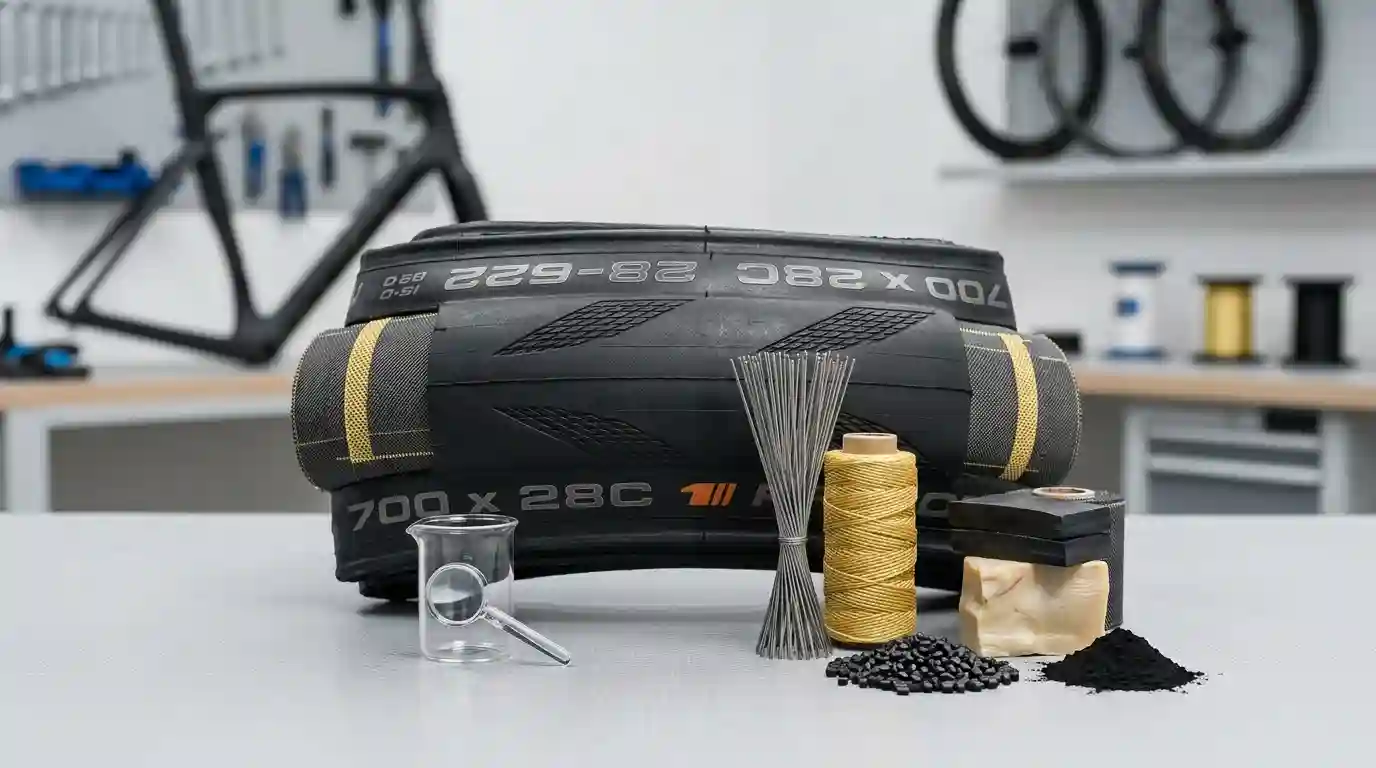
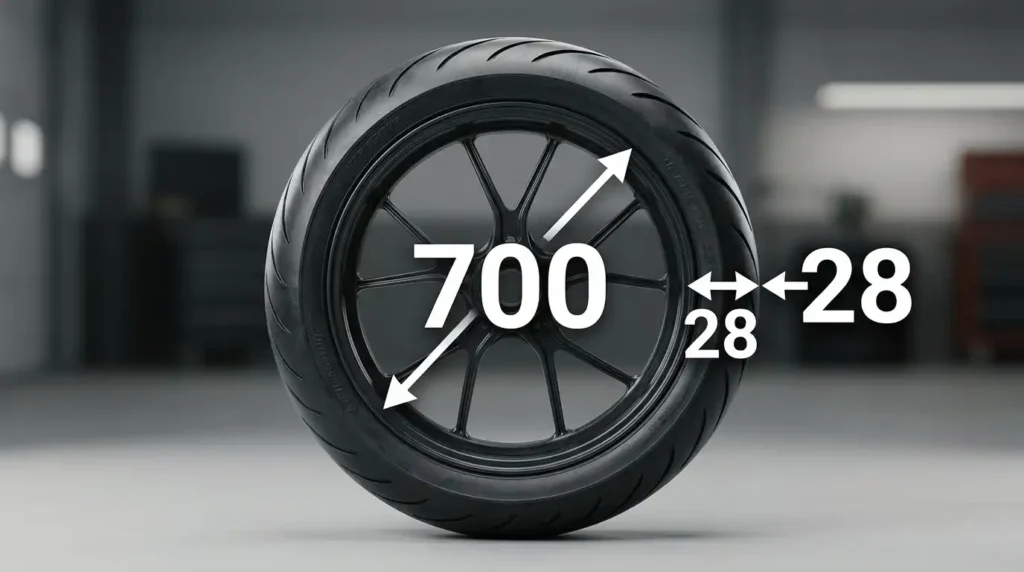
The numbers 700×28 found on a bicycle tire sidewall provide a standardized snapshot of the tire’s fitment and volume. This marking uses the traditional French sizing system, which is widely adopted for road, endurance, commuter, and gravel bikes in the US.
- 700C (Wheel Diameter): Identifies the wheel diameter category. A 700C tire is designed to seat onto a rim with a precise bead-seat diameter (BSD) of $622\text{ mm}$.
- 28 (Tire Width): Represents the nominal inflated width of the tire casing, which is approximately $28\text{ mm}$.
A 700×28 tire is a relatively narrow, road-oriented tire designed for a 700C wheel. It offers a popular balance of speed, comfort, and handling capability for asphalt and moderately rough pavement.
       [ Tire Profile Cross-Section ]
  /---------------------------------\
 /                                   \ <-- Tread Cap
|                                     |
|                                     |
|            WIDTH: ~28mm             |
|                                     |
|                                     |
 \                                   /
  \--+                             +--/ <-- Tire Bead
     |                             |
     +-----------------------------+ <-- Rim Bead Seat
     <--- BSD (Diameter): 622mm --->
What Does 700C Mean?
While “700” historically referred to the approximate outer diameter of the tire in millimeters, modern 700C tires focus strictly on the internal mounting dimension.
The precise and most critical compatibility measurement is the bead-seat diameter (BSD), which is exactly $622\text{ mm}$. This is the standard diameter used by modern road bikes, endurance bikes, commuters, hybrids, and gravel bikes across the US.
For maximum reliability when checking compatibility, riders should look for the ISO/ETRTO decimal marking (e.g., $622 \times 28$) alongside the traditional 700×28 label.
What Does 28 Mean?
The “28” designates the nominal inflated width of the tire casing, which is approximately $28\text{ mm}$.
However, the actual mounted width of a 700×28 tire can vary. The final measurement is heavily influenced by the inner rim width, the specific tire casing construction, and the inflation pressure ($\text{PSI}$).
+-------------------------------------------------------------+
|                THE INNER RIM WIDTH FACTOR                     |
+-------------------------------------------------------------+
|  A 28mm Tire on a Narrow (15mm) Rim  --> Casing Measures ~27mm |
|  A 28mm Tire on a Modern (21mm) Rim  --> Casing Measures ~29mm |
+-------------------------------------------------------------+
Is 700×28 the Same as 28mm?
Yes, the “28” in 700×28 specifically designates the tire’s nominal width in millimeters.
However, as stated above, the mounted tire width rarely measures exactly $28.0\text{ mm}$. When frame clearance is exceptionally tight—as it can be on older US road frames—riders should measure the actual mounted tire using calipers rather than relying strictly on the sidewall label.
Why Actual Tire Width Can Vary
Three key variables dictate the final mounted footprint of any 700×28 tire:
- Internal Rim Width: Mounting a $28\text{ mm}$ tire on a modern, wider internal rim channel stretches the tire casing outward, increasing both measured width and total air volume.
- Casing TPI (Threads Per Inch): High-thread-count casings ($120\text{ TPI}+$) are supple and expand more under pressure than thick, low-TPI ($30 – 60\text{ TPI}$) casings often found on entry-level US commuter bikes.
- Inflation Pressure ($\text{PSI}$): Running maximum recommended $\text{PSI}$ stretches the tire casing to its absolute limit, slightly increasing the measured width.
What Wheel Size Does a 700×28 Tire Fit?
A 700×28 tire is designed exclusively for a $622\text{ mm}$ bead-seat diameter rim, which is almost universally referred to as a 700C wheelset in the United States.
It is crucial to understand that a tire must match the wheel’s precise bead-seat diameter, not simply the outer marketing name. A 700×28 tire cannot be mounted on a 650B rim or an older 27-inch US road rim because the mounting diameters do not match.
700C vs 29-Inch Wheels
This is a common point of confusion for US cyclists transitioning between road and mountain biking.
While 700C and 29-inch sound entirely different, both wheel categories share the exact same $622\text{ mm}$ bead-seat diameter. A $29\text{-inch}$ mountain bike wheel and a $700\text{C}$ road wheel have identical mounting diameters.
The key difference lies in the inner rim width and intended application:
- 700C Rims: Generally narrower internal width ($17\text{ mm} – 21\text{ mm}$) to support narrow, high-pressure road tires.
- 29-Inch Rims: Feature wider internal widths ($23\text{ mm} – 30\text{ mm}+$) to stabilize high-volume MTB tires at low pressures.
While you can technically mount a 700×28 road tire onto a narrow $29\text{-inch}$ cross-country (XC) rim, you must first verify that the MTB rim width falls within the tire manufacturer’s approved compatibility range. Running a narrow tire on an overly wide rim can lead to unstable handling, poor sidewall support, or sudden unseating.
700C vs 650B
700C ($622\text{ mm}$ BSD) and 650B ($584\text{ mm}$ BSD) use entirely different physical diameters. These standards are not interchangeable. A 700×28 tire cannot be mounted on a 650B rim under any circumstances.
How Wide Is a 700×28 Bike Tire?
Its nominal, or labeled, width is approximately $28\text{ mm}$. However, the real-world mounted width is influenced by the rim it’s paired with.
A $28\text{ mm}$ tire represents a versatile middle ground in casing volume:
- More air volume than traditional $23\text{ mm}$ or $25\text{ mm}$ setup.
- Less air volume and cushioning than modern $32\text{ mm}$ endurance or commuter setups.
This added volume is the critical factor allowing riders to operate at lower appropriate pressures ($\text{PSI}$) without risking pinch flats, dramatically improving ride quality.
25mm vs. 28mm Tires
This is a key decision point for high-performance US road cyclists.
- 28mm Tires: Provide significantly greater air volume, improved comfort over broken asphalt, and often better cornering confidence through an expanded contact patch.
- 25mm Tires: Can offer a slight weight reduction, marginally superior aerodynamics at speeds above $22\text{ mph}$, and fit better on older road frames with restricted clearances.
When properly matched to a rider’s weight and terrain, both sizes can achieve extremely low rolling resistance.
28mm vs. 32mm Tires
Moving from $28\text{ mm}$ up to $32\text{ mm}$ represents a major shift toward endurance and multi-surface capability.
- 32mm Tires: Prioritize maximum cushioning and comfort. They hold more air volume, allowing for even lower pressures ($\text{PSI}$) ideal for coarse chip-seal and maintained hardpack dirt roads.
- 28mm Tires: Remain a strong compromise, prioritizing high-speed asphalt efficiency and responsiveness while still providing useful dampening compared to $23\text{ mm}$ racing tires.
US cyclists considering $32\text{ mm}$ tires must first carefully check their frame, fork, brake caliper, and drivetrain clearances, as $32\text{ mm}$ casings often require more room than traditional road frames allow.
Is 700×28 a Good Bike Tire Size?
For many US road riders, endurance cyclists, and daily commuters, 700×28 is an excellent tire size choice. It sits perfectly at the intersection of modern road speed, rider comfort, all-weather stability, and versatile performance.
The added volume over $23\text{ mm}$ or $25\text{ mm}$ casings allows riders to set pressures that absorb harsh vertical acceleration without sacrificing rolling speed, keeping the rider fresher for longer on demanding US routes.
Whether it is ideal depends entirely on your specific riding discipline, total system weight, local road quality, and frame clearance limitations.
700×28 for Road Bikes
A $28\text{ mm}$ tire is arguably the current “sweet spot” for performance road riding across the US. It provides the vibration dampening needed on coarse chip-seal roads without adding excessive weight.
For riders seeking maximum cornering confidence during high-speed descents—common in regions like the Colorado Rockies or the Pacific Northwest—the expanded contact footprint of a $28\text{ mm}$ tire offers substantial benefits.
700×28 for Commuting
For urban commuters facing broken asphalt, light debris, and wet roads, 700×28 provides a durable and comfortable option.
When selecting $28\text{ mm}$ commuter tires, riders should prioritize designs with reinforced puncture belts and durable rubber compounds over raw weight. It is also critical to verify whether the bike has adequate clearance for full-coverage fenders when $28\text{ mm}$ tires are installed.
700×28 for Gravel
While 700×28 can technically work on pristine, maintained hardpack dirt roads, it is not recommended as a serious gravel setup for technical US gravel riding. US gravel roads in regions like Kansas or Vermont are rough and unpredictable, demanding the high air volume provided by $38\text{ mm}$ to $50\text{ mm}+$ tires.
A $28\text{ mm}$ casing lacks the volume to run appropriate low gravel pressures without high risk of rim strikes and catastrophic tire failure. Additionally, most $28\text{ mm}$ tires feature road slick treads that struggle for grip on loose gravel or in sticky Pacific Northwest mud.
What PSI Should You Use for a 700×28 Tire?
Selecting the correct tire pressure (PSI) is the single most effective way to optimize your riding experience. There is no universal PSI number that works for every rider.
The ideal setting must factor in:
- Total System Weight: Rider weight + bike weight + gear weight. Heavier loads require higher pressures to maintain casing stability.
- Mounted Tire Width: Actual volume determines supporting capacity.
- Internal Rim Width: Affects casing support and profile.
- Casing TPI & Puncture Belt: Supple casings conform differently than stiff, armored tires.
- Road Surface Quality: Coarse pavement requires lower pressure for conformity; smooth track surfaces can tolerate higher pressures.
The optimal setting must provide adequate casing support without making the ride harsh or unstable. Overinflating wide tires results in energy lost to vertical vibration, effectively increasing real-world rolling resistance.
700×28 PSI by Rider Weight
This table provides general baseline PSI starting points for US cyclists on asphalt roads.
| Total Rider + Bike Weight | Front Tire Baseline PSI | Rear Tire Baseline PSI | Application Type |
| Lighter Riders (140-160 lbs) | $58\text{ PSI} – 63\text{ PSI}$ | $63\text{ PSI} – 68\text{ PSI}$ | Endurance Road / Supple Casing |
| Average Riders (170-190 lbs) | $68\text{ PSI} – 73\text{ PSI}$ | $73\text{ PSI} – 78\text{ PSI}$ | Balanced Performance / Road Casing |
| Heavier Riders (200-220 lbs) | $78\text{ PSI} – 83\text{ PSI}$ | $83\text{ PSI} – 88\text{ PSI}$ | Road / Heavy Commuter Casing |
| Heavier Riders (230 lbs+) | $85\text{ PSI}+$ | $90\text{ PSI}+$ | Check Max Load Ratings |
Note: Heavier riders and cargo users must check the tire manufacturer’s maximum rated pressure and weight limits.
Front vs. Rear PSI
A bicycle does not distribute weight equally. In a typical neutral riding position, the rear wheel supports approximately $60\%$ of total system weight, while the front wheel supports $40\%$.
Because the rear tire carries a larger load, it must be operated at a higher pressure to provide equivalent casing support and prevent pinch flats. US cyclists should generally set front tire pressure $3\text{ to }5\text{ PSI}$ lower than the rear tire for balanced comfort and handling.
Signs Your PSI Is Too High
If your PSI is set too high for your weight and road conditions, you will experience:
- Harsh Ride Quality: Excessive vibration through the handlebars, saddle, and pedals over chipped pavement.
- Loss of Traction: Reduced cornering grip on rough asphalt as the tire deflects off surface imperfections rather than conforming to them.
- Increased Fatigues: Premature muscular fatigue caused by constant upper-body vibration input.
Overinflating wide tires defeats their purpose, creating a skittery and uncomfortable ride with higher real-world rolling resistance.
—sim Yes, 700×28 is one of the most common tire size markings you will find on modern road, endurance, and performance commuter bikes across the United States. While those numbers look straightforward, they are part of a traditional sizing system that requires some context to ensure safe fitment and optimal performance.
Understanding exactly what those numbers mean—and how actual width can vary—is critical for your safety, cornering traction, and overall efficiency. Pairing the wrong tire with an unsuitable inner rim width compromises sidewall support, leading to dangerous handling or sudden tire unseating during aggressive cornering. Maintaining the right tire pressure (PSI) and selecting an appropriate tread pattern directly impacts your speed, comfort, and safety across asphalt or moderately rough US chip-seal roads.
What Does 700×28 Mean?
The markings 700×28 found on a bicycle tire sidewall provide a standardized snapshot of the tire’s fitment and intended volume. This label uses the traditional French sizing designation:
- 700C (Diameter Category): Identifies a tire designed around a precise $622\text{ mm}$ bead-seat diameter (BSD). This is the mounting dimension that must match your rim.
- 28 (Tire Width): Represents the nominal inflated width of the tire casing, which is approximately $28\text{ mm}$.
A 700×28 tire is therefore a relatively narrow, road-oriented tire designed for a 700C wheel. It offers a popular balance of speed, useful cushioning, and nimble handling for smooth and moderately rough pavement.
700×28 Quick-Reference Table
| Labeled Size | ISO/ETRTO Designation | Physical Dimension Meanings | Standard US Application |
| 700×28 | $622 \times 28$ | 622mm Mounting BSD | Road, Endurance, Hybrid |
| 28mm Inflated Casing Width | Asphalt / Chip-seal Pavement |
What Does 700C Mean?
While “700” historically referred to the approximate outer diameter of the tire in millimeters, modern 700C tires focus strictly on the precise mounting dimension.
       [ Tire Profile Cross-Section ]
  /---------------------------------\
 /                                   \ <-- Tread Cap
|                                     |
|                                     |
|                                     |
|                                     |
 \                                   /
  \--+                             +--/ <-- Tire Bead
     |                             |
     +-----------------------------+ <-- Rim Bead Seat
     <--- BSD (Diameter): 622mm --->
The precise and most critical compatibility measurement is the bead-seat diameter (BSD), which is exactly $622\text{ mm}$. This is the foundational standard for road, gravel, endurance, and hybrid bikes. For maximum reliability, riders should always check for the ISO/ETRTO decimal marking (e.g., $622 \times 28$) alongside the traditional French label when checking compatibility.
What Does 28 Mean?
The “28” designates the nominal inflated width of the tire casing, which is approximately $28\text{ mm}$.
However, the actual mounted width of a 700×28 tire can vary. The final measurement is heavily influenced by the inner rim width, the specific tire casing construction, and the final inflation pressure ($\text{PSI}$).
Real-World Measured Width Variability Example
| Internal Rim Width (mm) | 15mm (Narrow Road) | 17mm (Standard Road) | 19mm (Wide Road) | 21mm (Modern Road/Gravel) |
| 28mm Labeled Tire | Casing measures ~27mm | Casing measures ~28mm | Casing measures ~29mm | Casing measures ~30mm+ |
Note: Supple casings ($120\text{ TPI}+$) stretch more outward on wide rims than stiff commuter casings.
Is 700×28 the Same as 28mm?
Yes, the “28” in 700×28 explicitly designates the tire’s nominal width in millimeters. While the labeling is consistent, the 28mm measurement is rarely the exact physical dimension once mounted.
US cyclists with very tight frame clearances—typical of older racing road frames—must verify the actual mounted dimensions using calipers rather than relying strictly on the sidewall label before upgrading to $28\text{ mm}$ tires.
Why Actual Tire Width Can Vary
Three key mechanical variables dictate the final mounted width of any 700×28 tire:
- Internal Rim Width: Mounting a $28\text{ mm}$ tire on a modern, wider internal rim stretches the tire casing outward, increasing both measured width and total air volume.
- Casing TPI (Threads Per Inch): High-thread-count casings ($120\text{ TPI}+$) are supple and expand more under pressure than thick, low-TPI ($30 – 60\text{ TPI}$) casings often used on basic US commuter bikes.
- Tire Construction & Tread Pattern: Beefy, treaded city tires with thick rubber shoulders expand differently under load than supple, slick rolling resistance race tires.
What Wheel Size Does a 700×28 Tire Fit?
A 700×28 tire is designed exclusively to fit a $622\text{ mm}$ bead-seat diameter rim, which is almost universally referred to as a 700C wheelset in the United States.
It is critical to remember that a tire must match the wheel’s exact physical bead-seat diameter, not simply the outer marketing name. A 700×28 tire cannot be mounted on a 650B rim or an older 27-inch US road rim because the mounting diameters do not match.
700C vs 29-Inch Wheels
This is a very common source of confusion for US cyclists transitioning between road and mountain bikes.
While 700C and 29-inch sound entirely different, both share the exact same $622\text{ mm}$ Bead Seat Diameter. A $29\text{-inch}$ mountain bike wheel and a $700\text{C}$ road wheel have identical mounting diameters.
The critical difference is usually tire width and the rim’s inner width:
- 700C Rims: Generally narrower internal width ($17\text{ mm} – 21\text{ mm}$) to support narrow, higher-pressure road tires.
- 29-Inch Rims: Feature wider internal width ($23\text{ mm} – 30\text{ mm}+$) to stabilize high-volume MTB tires at low pressures.
700C vs 650B
700C ($622\text{ mm}$ BSD) and 650B ($584\text{ mm}$ BSD) use entirely different physical diameters. These standards are not interchangeable. A 700×28 tire cannot be mounted on a 650B rim. Always rely on the ISO/ETRTO decimal measurement when unsure about structural compatibility.
How Wide Is a 700×28 Bike Tire?
Its nominal width is approximately $28\text{ mm}$. However, the real-world measured width depends entirely on the rim width and tire construction.
Compared to other road options:
- 25mm Tires: Labeled $700\times 25\text{C}$; common on racing road bikes for lightweight acceleration.
- 28mm Tires: Provides useful added air volume, improving conformity over rough asphalt and reducing vertical acceleration fatiguing the rider on demanding US routes.
- 32mm Tires: Labeled $700\times 32\text{C}$; offers even more air volume and cushioning for endurance road, light gravel, or city commuting.
Tire Width Comparison Table (Metric)
| Nominal Tire Width | Approx. Width | Standard US Riding Type | Key Dynamic Behavior |
| 23mm | $23\text{mm}$ | Vintage / Racing (Historical) | High PSI required, minimum volume |
| 25mm | $25\text{mm}$ | High-Performance Racing Road | Agile, lightweight, precise handling |
| 28mm | $28\text{mm}$ | Road, Endurance, Commuting | Balance of speed, comfort, grip |
| 32mm | $32\text{mm}$ | Endurance, Commuter, Hybrid | High volume, maximum vibration dampening |
Is 700×28 a Good Bike Tire Size?
For many modern US road cyclists, endurance riders, and urban commuters, 700×28 is an exceptional tire size. It sits perfectly at the intersection of modern road speed, versatile cornering traction, useful vibration absorption, and manageable rotating mass.
The added casing volume over traditional $23\text{ mm}$ or $25\text{ mm}$ setups allows riders to operate at lower appropriate pressures ($\text{PSI}$), absorbing harsh vertical shocks from chipped US pavement.
Whether it is ideal depends entirely on your specific riding discipline, total system weight, local road quality, and available frame clearance.
700×28 for Road Bikes
A $28\text{ mm}$ tire is arguably the current performance standard for modern road and endurance riding across the US. It provides the vibration isolation needed on coarse chip-seal roads without adding excessive weight.
For high-speed technical descents—common in regions like the Rockies or the Appalachians—the expanded footprint of a $28\text{ mm}$ tire offers substantial benefits to cornering grip confidence.
700×28 for Commuting
For city commuters navigating broken asphalt, light gravel debris, and glass-strewn urban streets, 700×28 provides a durable and comfortable footprint.
When choosing $28\text{ mm}$ commuter tires, riders should prioritize designs featuring reinforced puncture belts and durable, longer-wearing rubber compounds over absolute minimum weight. It is also critical to verify whether full-coverage fenders can be installed without rubbing when $28\text{ mm}$ tires are used.
700×28 for Gravel
While a 700×28 casing can manage maintained hardpack dirt roads, it is not recommended as a serious US gravel setup. True gravel riding in the United States—demanding routes in regions like Kansas or Vermont—requires the significant high air volume, rim protection, and large footprint of $38\text{ mm}$ to $50\text{ mm}+$ tires.
A $28\text{ mm}$ tire cannot run appropriate low gravel pressures without extreme risk of pinch flats or rim strikes causing structural damage. Rough or loose gravel generally benefits from significantly more tire volume and an appropriate gravel tread pattern.
What PSI Should You Use for a 700×28 Tire?
Selecting the correct tire pressure (PSI) is the single most important adjustment you can make to your bicycle’s performance and safety. There is no universal PSI number that works for every rider.
The ideal setting must factor in:
- Total System Weight: Rider weight + bike weight + cargo weight. Heavier loads require higher pressures to maintain casing stability.
- Mounted Tire Width: Actual volume determines supporting capacity.
- Casing Construction: Supple race casings ($120\text{ TPI}+$) behave differently than thick commuter casings.
- Road Surface Quality: Lower pressures required to absorb vibration on broken US roads; higher pressures may be tolerated on smooth track asphalt.
The correct pressure must provide adequate casing support without making the ride harsh. Overinflating wide tires results in energy lost to vertical acceleration, effectively increasing real-world rolling resistance.
700×28 PSI Starting Points (Rider Weight)
These tables provide generic, baseline PSI starting points for US cyclists on asphaBike lt roads.
Bike Rider + Bike System Weight: Lighter Riders (140-160 lbs)
| Mounted Tire Width (Actual) | Baseline Front PSI | Baseline Rear PSI | Performance Tone | Terrain Type |
| 28mm | $58\text{ PSI} – 63\text{ PSI}$ | $63\text{ PSI} – 68\text{ PSI}$ | Balanced / Comfort | Rough US Asphalt |
| 30mm (Measured 28) | $53\text{ PSI} – 58\text{ PSI}$ | $58\text{ PSI} – 63\text{ PSI}$ | endurance Road | Coarse chip-seal |
Rider + Bike System Weight: Average Riders (170-190 lbs)
| Mounted Tire Width (Actual) | Baseline Front PSI | Baseline Rear PSI | Performance Tone | Terrain Type |
| 28mm | $68\text{ PSI} – 73\text{ PSI}$ | $73\text{ PSI} – 78\text{ PSI}$ | Balanced Performance | Typical US Asphalt |
| 30mm (Measured 28) | $63\text{ PSI} – 68\text{ PSI}$ | $68\text{ PSI} – 73\text{ PSI}$ | Endurance Road | Chipped pavement |
Rider + Bike System Weight: Heavier Riders (200-220 lbs)
| Mounted Tire Width (Actual) | Baseline Front PSI | Baseline Rear PSI | Performance Tone | Terrain Type |
| 28mm | $78\text{ PSI} – 83\text{ PSI}$ | $83\text{ PSI} – 88\text{ PSI}$ | Road / Heavier Loads | smooth Asphalt |
| 30mm (Measured 28) | $73\text{ PSI} – 78\text{ PSI}$ | $78\text{ PSI} – 83\text{ PSI}$ | Road / Heavy Loads | Broken pavement |
Note: Cargo users, bikepackers, and heavier e-bike riders must check the tire manufacturer’s maximum rated pressure and weight limits.
Front vs. Rear PSI
A bicycle does not distribute weight evenly between the two wheels. In a traditional neutral riding position, the rear wheel supports approximately $60\%$ of total system weight, while the front wheel supports $40\%$.
Because the rear tire carries a significantly larger load, it must be operated at a higher pressure than the front to provide equivalent casing support and prevent pinch flats. Exact pressure depends on rider position, bike type, tire casing, and total system weight. US cyclists should generally set front tire pressure $3\text{ to }5\text{ PSI}$ lower than the rear.
Does Rim Width Matter for a 700×28 Tire?
Yes. The inner rim channel width dictates the inflated shape, measured dimensions, and lateral sidewall support of any 700×28 tire. Riders must always check the tire manufacturer’s approved inner rim-width range.
Mounting a $28\text{ mm}$ tire on an incompatible rim can yield unpredictable results:
- 700×28 on an Overly Narrow Rim ($13\text{ mm} – 15\text{ mm}$): Pinching tire beads together forces the casing into an unstable “lightbulb” shape. This creates lateral sidewall wallowing (tire squirm) during cornering, making the steering feel imprecise and sluggish.
       Narrow Rim Channel                 Wide Rim Channel
     (Pinched / Bulb Shape)             (Supported Sidewalls)
         +-----------+                      +-----------+
        /             \                    /             \
       |   Rounded     |                  |  Structured   |
        \             /                    \             /
         +--+     +--+                      +-----+ +-----+
            |     |                               |     |
            +-----+                               +-----+
         [Narrow Channel]                     [Wide Channel]
- 700×28 on an Overly Wide Rim ($23\text{ mm}+$): The tire stretches too flat, decreasing overall air volume. This profile exposes the rim hooks to root and rock strikes, increasing flat risk. This combination must only be used if explicitly approved by the tire and rim manufacturers.
700×28 Tubeless vs. Inner Tube
A 700×28 tire size is common in both traditional inner-tube setups and modern tubeless-ready configurations.
                  INNER TUBE vs. TUBELESS CROSS-SECTION
+------------------------------------+----------------------------------+
|          Inner Tube Setup          |          Tubeless Setup          |
|  +------------------------------+  |  +----------------------------+  |
|  | Casing / Tread Structure     |  |  | Casing / Tread Structure   |  |
|  +------------------------------+  |  +----------------------------+  |
|  |           Inner Tube         |  |  |    Liquid Tubeless Sealant  |  |
|  +------------------------------+  |  +----------------------------+  |
|  |         Standard Rim Lip     |  |  |      Tubeless Rim Channel  |  |
|  +------------------------------+  |  +----------------------------+  |
|  (Pinch Flat Vulnerable)           |  (Pinch Flat Resistant)           |
+------------------------------------+----------------------------------+
Benefits of 700×28 Tubeless Tires
Tubeless Ready (TLR) systems replace traditional tubes with liquid latex tubeless sealant. The primary advantages are the ability to run appropriate lower pressures ($\text{PSI}$) for enhanced grip and comfort while effectively eliminating pinch-flat risk. Furthermore, small punctures caused by glass or thorns—common on US commuting routes—may be instantly sealed by the sealant without stopping the bike.
700×28 Inner-Tube Setup
Inner tubes remain the simplest setup, making them easy to install and repair at home or carry as a spare. Riders must always select the correct tube diameter ($700\text{C}$ / $622\text{ mm}$) and width range ($18 – 28\text{ mm}$ or $28 – 35\text{ mm}$) and match the valve type (Presta or Schrader) to the rim.
Does Tire Construction Affect Size and Performance?
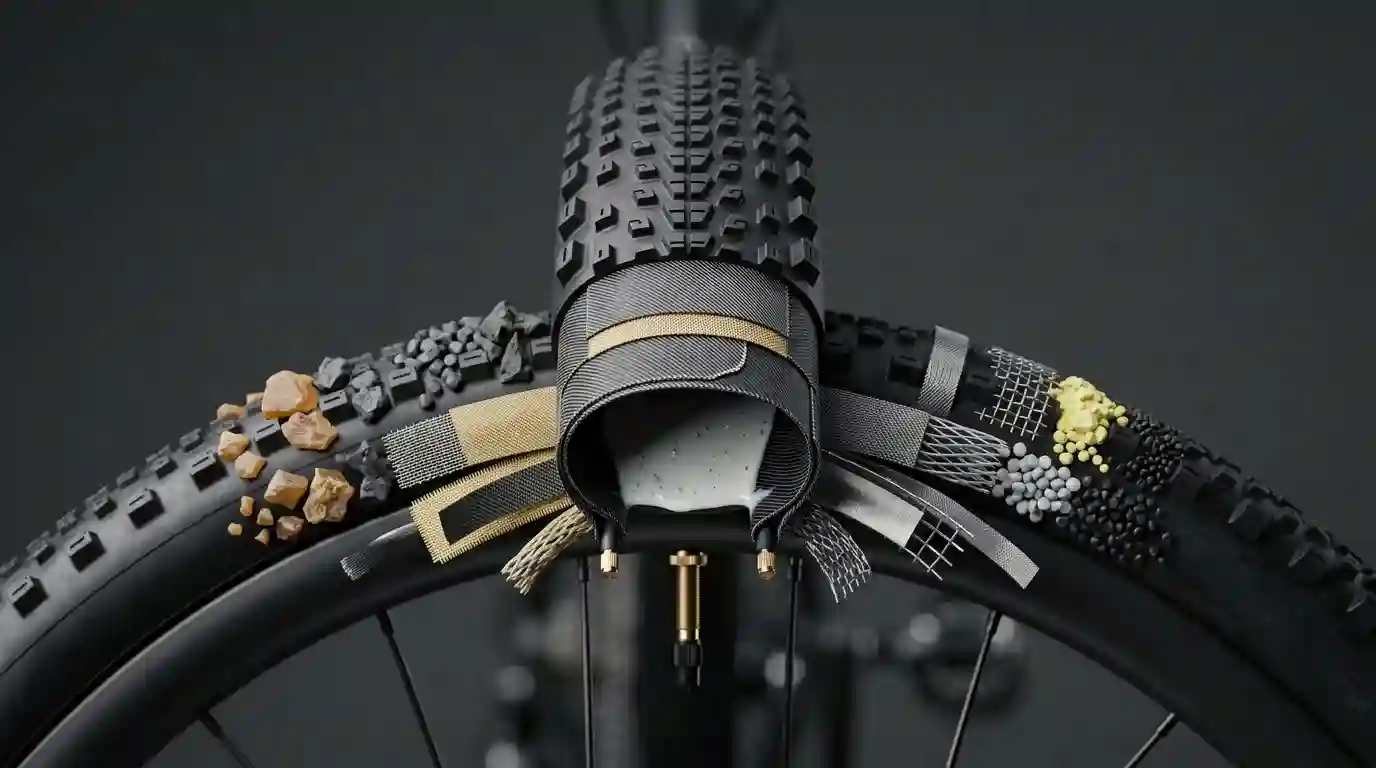
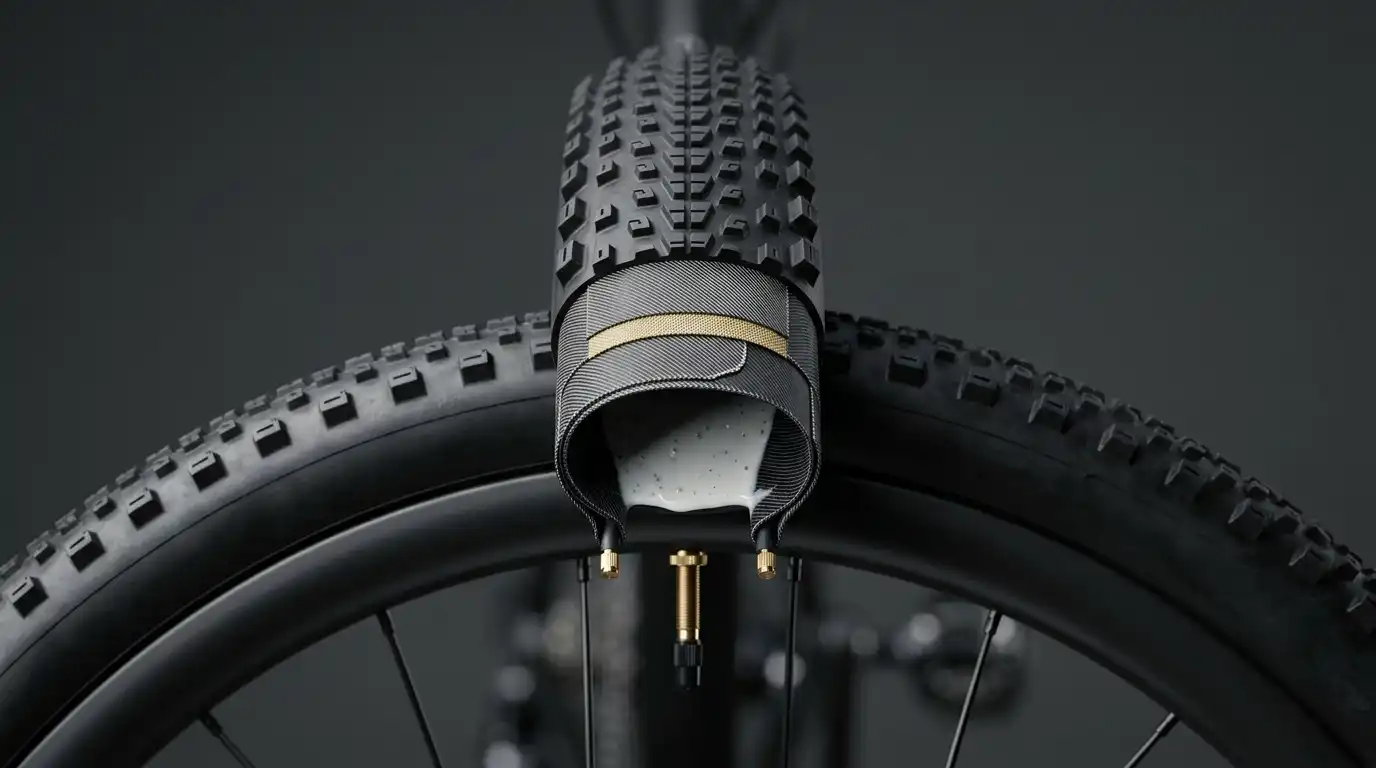
Tire construction depends as much on the underlying carcass material and rubber chemistry as physical dimensions.
       [ CROSS-SECTION OF TIRE CONSTRUCTION ]

         +---------------------------------+  <-- Tread Cap (Slick/Knob)
         |=================================|  <-- Puncture Belt
         |---------------------------------|  <-- Casing Threads (TPI)
        /                                   \
       |   Inner Rubber Air Barrier Sheath   |
Casing TPI (Threads Per Inch)
- $30 – 60\text{ TPI}$: Stiff, durable, cut-resistant casings using thick nylon threads. typical of urban commuting and entry-level US e-bikes.
- $120 – 320\text{ TPI}$: Extremely flexible, supple casings using very fine threads. Conforms smoothly to rough surfaces, maximizing cornering grip and minimizing rolling resistance. Evaluated along with rubber compound and puncture protection. TPI should not be used alone to judge tire quality.
Puncture Belts
A protective layer of woven Kevlar or dense aramid fibers positioned beneath the main tread cap shields against glass and sharp debris, adding essential durability for urban US commuting while only marginally affecting suppleness. Riders facing broken urban US infrastructure may prefer durability over minimum rolling resistance.
Tread Rubber & Durometer
Rubber hardness is measured in durometer Shore A ratings:
- Soft Compounds ($45\text{a} – 50\text{a}$): High grip on technical, off-camber US roots or technical mountain singletrack; wears quickly.
- Hard Compounds ($60\text{a} – 70\text{a}$): Minimum rolling resistance and maximum tread longevity; slick treads are suitable for smooth paved roads.
How to Know if 700×28 Fits Your Bike
Before upgrading to $28\text{ mm}$ tires, US cyclists must carefully verify three critical compatibility factors:
- Bead Diameter: Confirm your rim utilizes the $622\text{ mm}$ (700C) BSD.
- Internal Rim Width: Verify the $28\text{ mm}$ casing falls within your rim’s approved metric range.
- Available Clearances: This is the most common limitation. US cyclists must check frame clearance around:
- Chainstays and Seatstays: Check the tightest point near the rear wheel junction.
- Fork Crown and Legs: Top and lateral clearance on the front fork.
- Brake Calipers: Rim brake arms can create a major restriction point on older frames. Disc brakes usually provide more flexibility. Verify clearance around the entire tire, not just one point.
+-----------------------------------------------------------------+
|          RECOMMENDED MINIMUM FRAME SAFETY CLEARANCE             |
+-----------------------------------------------------------------+
|  Pavement & Road Riding:    3mm minimum gap on all sides        |
|  Wet Trail / Mud Riding:    8mm - 10mm minimum gap for mud      |
+-----------------------------------------------------------------+
Static clearance on a repair stand does not account for wheel flex under load or the addition of mud and debris collected during real-world riding. Riders facing mud and gravel debris should leave additional space to prevent frame damage.
Road Tire Width Comparison Table (Nominal Sizes)
| Nominal Tire Width | Approx. Width | Standard US Riding Type | Dynamic Behavior |
| 700×23 | $23\text{mm}$ | Vintage Road Racing (Historical) | Minimum volume, high PSI required |
| 700×25 | $25\text{mm}$ | high-Performance Racing Road | agile, responsive, precise handling |
| 700×28 | $28\text{mm}$ | Modern Road, Endurance, Commuting | Balance of speed, comfort, grip |
| 700×32 | $32\text{mm}$ | endurance, Hybrid, Commuting | Maximum volume, vibration isolation |
| 700×35 | $35\text{mm}$ | Commuting, Hybrid, Urban Touring | High volume, durability |
| 700×40 | $40\text{mm}$ | gravel, adventure, hybrid | Extreme volume, heavy durable treads |
Note: These are nominal sizes; actual mounted width can vary.
Common Wheel and Tire Size Mistakes
+-----------------------------------------------------------------+
|                  pressure DIAGNOSTIC SUMMARY                    |
+-----------------------------------------------------------------+
|  PSI TOO LOW  --> Sidewall Squirm, Rim Strikes, Poor Handling  |
|  PSI TOO HIGH --> Harsh Ride, Loss of Cornering Traction        |
+-----------------------------------------------------------------+
|              COMMON SIZE MISTAKES & DEFLECTIONS                 |
+-----------------------------------------------------------------+
|  Ignored Mounted Width --> Tight clearances result in frame rub|
|  Ignored Rim Width     --> Distorted shape results in unstable |
|  Confused Diameter     --> Impossible structural mismatch       |
+-----------------------------------------------------------------+
- Confusing 700C Diameter with Width: Assuming every 700C rim accepts a 28mm tire. 700C identifies diameter, not compatible tire width. Always check the rim’s internal width.
- Assuming 700×28 Means 28-Inch: Confusing 700×28 with 28-Inch tires. 700×28 does not mean a 28-inch wheel. The “28” refers to nominal tire width in millimeters.
- Ignoring Actual Mounted Width: A $28\text{ mm}$ tire may measure wider than its label suggests. measure the tire if clearance is tight.
- Ignoring Frame Clearance: A tire can fit the rim but fail to fit the bike. Static clearance does not account for dynamic frame flex under load. Check fork, chainstay, seatstay, and brake clearance.
Conclusion: Understanding 700×28
700×28 on a bicycle tire sidewall is the most common informational snapshot of modern road-bike casing sizing. It indicates a tire designed exclusively for 700C wheelsets with a physical $622\text{ mm}$ Bead Seat Diameter and featuring a nominal inflated casing width of approximately $28\text{ mm}$.
Actual mounted dimensions vary significantly based on internal rim width, tire casing construction, and inflation pressure ($\text{PSI}$).
Selecting appropriate tire rolling resistance, cornering grip, and durable tread patterns directly influences your safety and comfort. Choose tires based on the complete system of rim width, frame limitations, total rider weight, and local US road conditions rather than one nominal size number alone.
700×28 Final Quick-Check List
- [ ] Verified structural compatibility ($622\text{ mm}$ BSD, TLR if applicable).
- [ ] Checked manufacturer’s approved inner rim width range.
- [ ] Verified minimum $4\text{ mm} – 6\text{ mm}$ frame safety clearance.
- [ ] Calculated starting pressure ($\text{PSI}$) based on total system weight.
- [ ] Selected an appropriate TPI and tread pattern for local terrain.
Find Your Ideal 700×28 Tire Pressure
Pairing the right tire width with correct inflation pressure is the single most important optimization you can make. Heavier riders may need higher PSI for adequate support. Heavier riders and cargo users must check the tire manufacturer’s maximum rated pressure and weight limits. Don’tguess. use the Free Bike Tire Pressure Calculator / Tire Finder Tool at TheBikeTires.com to find a suitable starting pressure based on your exact riding setup and local roads.

Mohidul Islam is a leading cycling technology specialist and bike tire consultant with over 15 years of hands-on experience in the bicycle industry. He holds a Bachelor of Science in Mechanical Engineering from Penn State University, where he focused heavily on material science, tread mechanics, and rubber compound performance. Over the past decade and a half, Alex has conducted extensive field testing, tubeless setup evaluations, and tire pressure modeling for road, mountain, and e-bikes. His practical insights and data-driven approach help cyclists of all levels optimize grip, speed, and durability on every ride.