Choosing the right tire size is one of the most effective ways to restore or upgrade your bicycle’s ride quality, yet tire sizing remains one of the most confusing parts of bicycle maintenance for US cyclists. Many riders experience sluggish handling, frequent flats, poor cornering traction, and harsh trail feedback simply because they are riding the wrong tire volume or running incorrect tire pressure ($\text{PSI}$).
Maintaining optimal tire pressure (PSI), understanding rolling resistance, and selecting an appropriate tread pattern directly impacts your safety, control, and comfort. The 26×2.1 tire marking is a classic standard found on millions of mountain bikes, vintage retro-MTB builds, commuter setups, and e-bikes across the United States. Understanding exactly what those numbers mean is the essential first step toward optimizing your bike for your local trails and roads.
What Does 26×2.1 Mean?
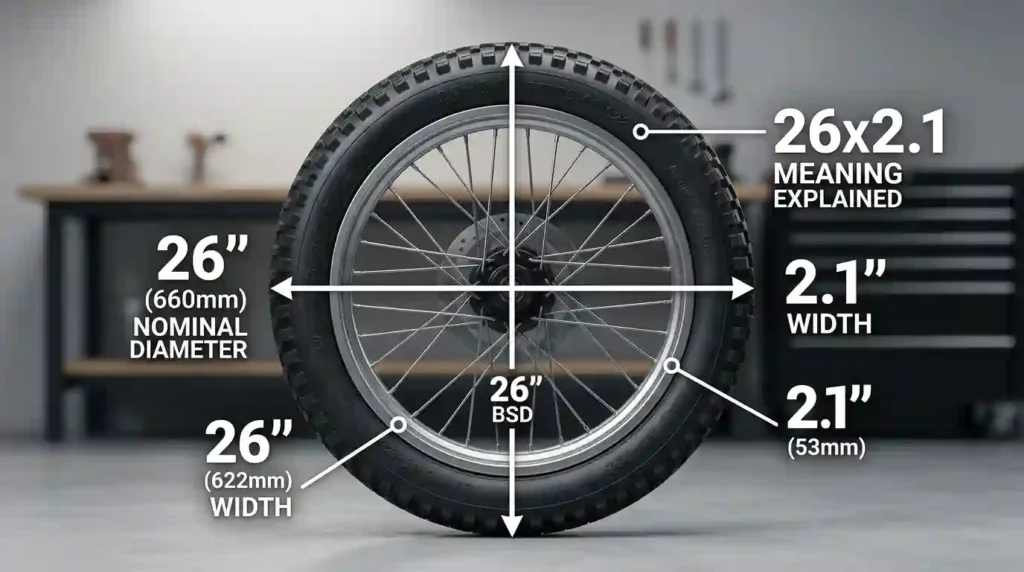
The numbers 26×2.1 stamped on a bicycle tire sidewall provide a standardized measurement of the tire’s outer wheel class and casing volume using the traditional US Imperial sizing system:
- 26 (Wheel Diameter Category): Refers to the traditional 26-inch wheel size class. Historically, this represented the approximate outer diameter of the inflated tire in inches.
- 2.1 (Tire Width): Indicates that the tire has a nominal inflated casing width of 2.1 inches (approximately $53.3\text{ mm}$).
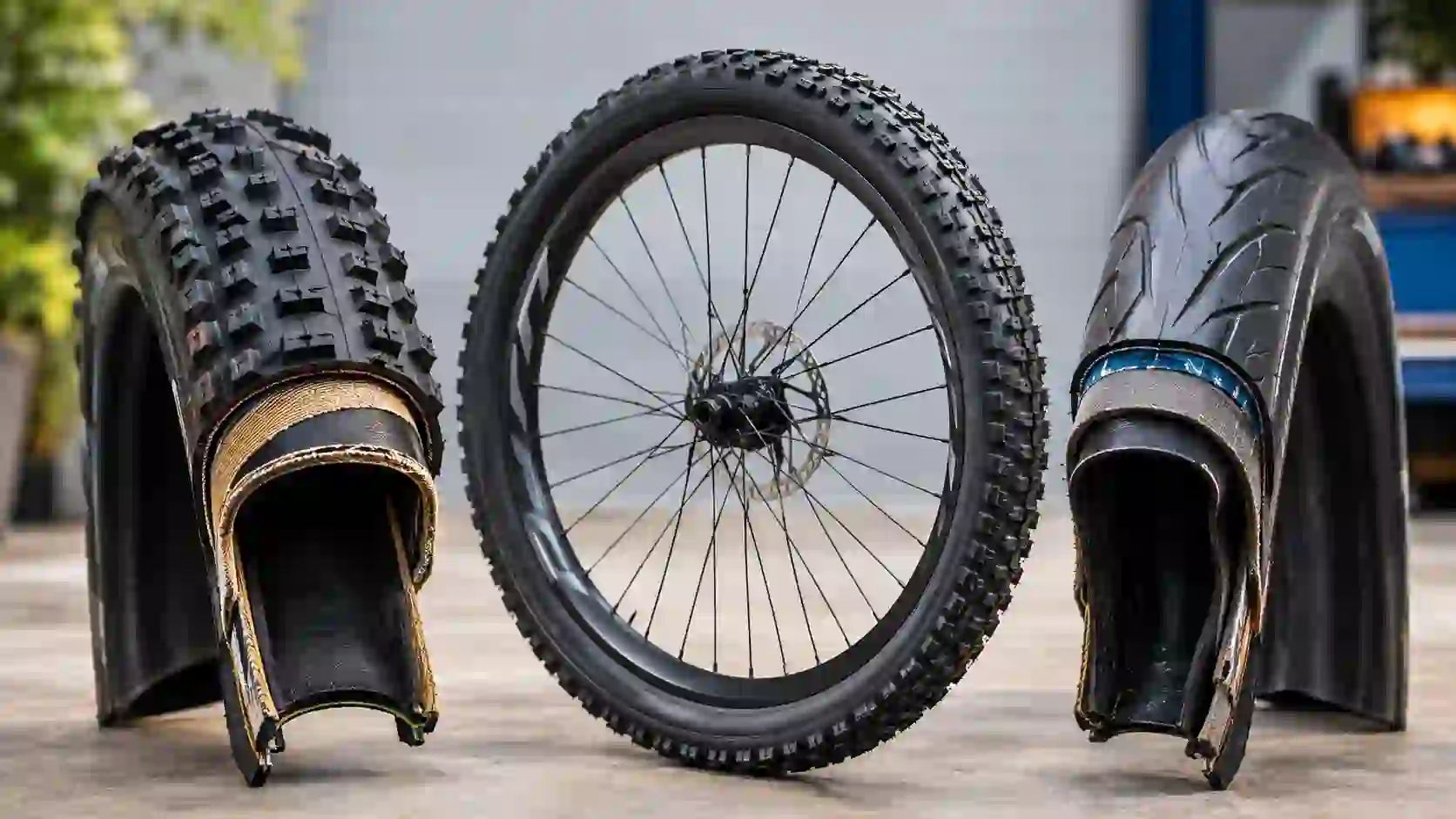
A 26×2.1 tire is a standard mid-width mountain bike and hybrid tire designed to balance off-road traction, bump absorption, and rolling efficiency.
       [ Tire Profile Cross-Section ]
  /---------------------------------\
 /                                   \ <-- Tread Cap & Knobs
|                                     |
|                                     |
|           WIDTH: ~2.1" (53mm)       |
|                                     |
|                                     |
 \                                   /
  \--+                             +--/ <-- Tire Bead
     |                             |
     +-----------------------------+ <-- Rim Bead Seat
     <--- BSD (Diameter): 559mm --->
26×2.1 Quick-Reference Table
| Labeled Size | ISO/ETRTO Marking | Imperial / Metric Meaning | Primary US Application |
| 26×2.1 | $54-559$ / $53-559$ | 26″ Wheel Class ($559\text{ mm}$ BSD) | Cross-Country (XC) MTB |
| 2.1″ Nominal Width ($\sim 53.3\text{ mm}$) | Vintage MTB, Commuter, Hybrid |
What Does the 26 Mean?
The “26” identifies the traditional 26-inch wheel and tire diameter category.
It is crucial to understand that 26 is a nominal marketing designation rather than an exact physical measurement of the inflated tire. In the traditional US sizing system, “26 inches” estimated the outer tire height when mounted on a rim.
Because different tire heights change the actual outer diameter, the precise and true compatibility measurement is the tire’s bead-seat diameter (BSD). For standard modern 26-inch mountain bikes, the BSD is exactly $559\text{ mm}$.
What Does the 2.1 Mean?
The “2.1” designates the nominal width of the tire casing in inches when fully inflated.
Converting Imperial to Metric:
$$2.1\text{ inches} \times 25.4\text{ mm/inch} = 53.34\text{ mm}$$
A 26×2.1 tire has a nominal casing width of approximately $53\text{ mm}$. However, the actual mounted width in the real world can vary depending on the inner rim width, tire casing construction, and operating pressure ($\text{PSI}$).
How Wide Is a 26×2.1 Bike Tire?
Its nominal width is approximately 2.1 inches ($53.3\text{ mm}$).
+-----------------------------------------------------------------+
|                    REAL-WORLD MOUNTED WIDTH                     |
+-----------------------------------------------------------------+
|  26x2.1 on Narrow Rim (17mm Internal) --> Measures ~49mm - 51mm |
|  26x2.1 on Standard Rim (21mm Internal)--> Measures ~53mm       |
|  26x2.1 on Wide Rim (25mm Internal)    --> Measures ~54mm - 56mm |
+-----------------------------------------------------------------+
While 2.1 inches is the target casing width, real-world measurements fluctuate. Pairing a $2.1\text{-inch}$ tire with a narrow vintage rim yields a narrower footprint than mounting it on a modern wide rim.
2.1 Inches in Millimeters
Understanding the metric conversion makes evaluating frame clearance much easier when upgrading tires:
$$\text{Tire Width in mm} = 2.1 \times 25.4 = 53.34\text{ mm}$$
Therefore, a 26×2.1 tire has a nominal metric casing width of $53.3\text{ mm}$. When measuring frame, fork, or brake clearance on your bike, use $53\text{ mm} – 55\text{ mm}$ as your baseline metric width.
Why Actual Width Can Vary
Three mechanical variables explain why two tires labeled 26×2.1 can measure differently with a pair of calipers:
- Internal Rim Width: A wider inner rim channel spreads the tire beads farther apart, broadening the casing profile and flattening the tread profile.
- Casing TPI (Threads Per Inch): High-thread-count casings ($120\text{ TPI}+$) stretch more under inflation than thick, low-TPI ($30 – 60\text{ TPI}$) heavy-duty casings.
- Operating Pressure ($\text{PSI}$): Inflating a tire to its maximum rated PSI expands the casing to its upper dimensional boundary, whereas running lower pressure reduces dynamic casing width slightly.
What Wheel Does a 26×2.1 Tire Fit?
A 26×2.1 tire fits rims designed around the standard $559\text{ mm}$ bead-seat diameter (BSD). This is the ISO standard for modern decimal 26-inch mountain bike and cruiser wheels.
You cannot rely strictly on the number “26.” A 26×2.1 (decimal) tire will NOT fit fractional 26-inch rims (such as $26 \times 1\text{ }3/8$ or $26 \times 1\text{ }1/2$), as those historical utility standards use completely different bead-seat diameters ($571\text{ mm}$ or $590\text{ mm}$).
Always match decimal sizes ($26 \times \text{decimal}$) with $559\text{ mm}$ BSD rims.
Why 26-Inch Tire Compatibility Can Be Confusing
In the early decades of bicycle manufacturing, “26-inch” became a broad catch-all marketing term for several incompatible wheel standards across the US, Europe, and the UK.
Historical 26-Inch Rim Standard Comparison
| Marking Format | Fractional / Decimal | Bead-Seat Diameter (BSD) | Compatibility Status |
| 26×2.1 | Decimal | 559mm | Modern Standard MTB / Cruiser |
| 26 x 1 3/8 | Fractional (EA3) | 590mm | Vintage English / Utility Bikes (Incompatible) |
| 26 x 1 1/2 | Fractional (F12) | 584mm | Older French Standard / 650B (Incompatible) |
| 26 x 1 3/4 | Fractional | 571mm | Schwinn S-7 Standard (Incompatible) |
Because decimal and fractional sizes are structurally incompatible, never assume two tires labeled “26” will swap onto the same wheel set.
How to Check the Exact Size (ISO/ETRTO)
To eliminate size confusion, look for the ISO/ETRTO marking molded into the sidewall rubber alongside the commercial 26×2.1 label.
An ETRTO marking appears as two numbers separated by a hyphen, such as $54-559$:
- 54: Represents the inflated tire width in millimeters ($\sim 2.1\text{ inches}$).
- 559: Represents the exact bead-seat diameter (BSD) in millimeters.
If your rim and current tire both say 559, a 26×2.1 tire will seat onto your wheel safely.
Is 26×2.1 the Same as 26-Inch?
No. “26-inch” refers to the wheel diameter family, whereas 26×2.1 specifies both the wheel family ($26\text{“}$) and the specific tire width ($2.1\text{“}$).
A single 26-inch ($559\text{ mm}$) rim can accept multiple tire widths—ranging from narrow $26 \times 1.5\text{“}$ commuter slicks up to wide $26 \times 2.4\text{“}$ trail tires—provided your frame, fork, brake calipers, and rim channel support that volume.
26×1.95 vs. 26×2.1
Upgrading from a $26 \times 1.95$ to a $26 \times 2.1$ tire is a classic mod for vintage mountain bikes and commuters seeking extra bump absorption.
- 26×1.95 Tires: Slightly narrower ($\sim 49.5\text{ mm}$), lighter, accelerate faster on smooth roads, and offer slightly tighter clearance safety margins on older frames.
- 26×2.1 Tires: Noticeably wider ($\sim 53.3\text{ mm}$), providing additional air volume for enhanced cushioning over trail roots, improved traction in loose dirt, and better rim strike protection.
26×2.1 vs. 26×2.3
Moving up to a $2.3\text{-inch}$ tire ($58.4\text{ mm}$) pushes a 26-inch bike into aggressive trail territory.
- 26×2.1 Tires: Excellent cross-country (XC) option balancing speed, lower weight, and efficient rolling on hardpack dirt and urban streets.
- 26×2.3 Tires: Higher volume permits lower PSI for loose Southwestern rock or slippery Pacific Northwest roots, but demands significantly wider frame and fork clearance.
Is 26×2.1 a Good Bike Tire Size?
Yes! 26×2.1 remains one of the most versatile and functional tire sizes for classic mountain bikes, retro commuters, bikepacking rigs, and urban e-bikes.
It provides enough air volume to cushion harsh impacts while maintaining a compact, agile rotating mass. Whether you ride fire roads in California, gravel paths in the Midwest, or pot-holed streets in New York City, a 2.1-inch tire offers a great balance of comfort and agility.
26×2.1 for Mountain Biking
For cross-country (XC) trail riding, 26×2.1 delivers nimble acceleration and responsive handling.
Its lower weight compared to downhill tires allows riders to climb efficiently. When paired with a supportive casing and the correct tire pressure (PSI), a 2.1-inch MTB tire provides reliable cornering grip through tight singletrack switchbacks.
26×2.1 for Commuting
A 2.1-inch tire is a fantastic choice for urban commuting on rough city streets.
Unlike narrow $28\text{ mm}$ or $35\text{ mm}$ road tires, a $2.1\text{-inch}$ casing contains enough air volume to roll over train tracks, pothole edges, and broken pavement without causing pinch flats. Look for commuter options featuring slick or semi-slick tread patterns and integrated puncture belts.
26×2.1 for Gravel
While modern gravel bikes typically run 700C or 650B wheels, converting a 26-inch vintage mountain bike into a “gravel grinder” is extremely popular across the US.
A 26×2.1 tire with low-profile knobs or a file-tread pattern provides superb traction on loose gravel and hardpack dirt roads. Its high volume easily outperforms standard gravel tires in deep, uncompacted gravel pits.
What PSI Should a 26×2.1 Tire Have?
Tire pressure ($\text{PSI}$) directly controls traction, comfort, rolling efficiency, and flat prevention. There is no single universal PSI for every rider.
To determine your optimal pressure, factor in:
- Total System Weight: Rider weight + bike weight + gear.
- Terrain Type: Smooth roads require slightly higher pressure; loose off-road trails require lower pressure for traction.
- Setup Type: Inner tubes require higher pressure to prevent pinch flats; tubeless setups allow lower pressures safely.
- Rim Width: Wider rims support tire sidewalls better, enabling slightly lower pressure without tire squirm.
26×2.1 PSI Baseline Table by Rider Weight
This table provides baseline starting pressures for a 26×2.1 tire on mixed dirt trails and rough pavement.
Rider + Bike System Weight Baseline Pressure Guide
| Total System Weight (Rider + Bike) | Front Tire PSI (Inner Tube) | Rear Tire PSI (Inner Tube) | Front Tire PSI (Tubeless) | Rear Tire PSI (Tubeless) |
| Lighter Riders (130 – 150 lbs) | $28\text{ PSI} – 31\text{ PSI}$ | $31\text{ PSI} – 34\text{ PSI}$ | $22\text{ PSI} – 25\text{ PSI}$ | $25\text{ PSI} – 28\text{ PSI}$ |
| Average Riders (160 – 180 lbs) | $32\text{ PSI} – 35\text{ PSI}$ | $35\text{ PSI} – 38\text{ PSI}$ | $26\text{ PSI} – 29\text{ PSI}$ | $29\text{ PSI} – 32\text{ PSI}$ |
| Heavier Riders (190 – 210 lbs) | $36\text{ PSI} – 39\text{ PSI}$ | $39\text{ PSI} – 42\text{ PSI}$ | $30\text{ PSI} – 33\text{ PSI}$ | $33\text{ PSI} – 36\text{ PSI}$ |
| Heavy / Cargo (220 lbs+) | $40\text{ PSI} – 44\text{ PSI}$ | $44\text{ PSI} – 48\text{ PSI}$ | $34\text{ PSI} – 37\text{ PSI}$ | $37\text{ PSI} – 41\text{ PSI}$ |
Always stay within the min/max pressure range molded on your tire’s sidewall.
Front vs. Rear Tire Pressure
Weight distribution on a bicycle is unequal. Under normal riding conditions, the rear wheel carries roughly $60\%$ of total load, while the front wheel carries $40\%$.
Because the rear tire supports more weight, inflate it $3\text{ to }5\text{ PSI}$ higher than the front. Running slightly lower pressure in the front expands the contact patch, enhancing cornering traction and steering control.
Signs Your PSI Is Too Low
- Tire Squirm: The tire feels unstable, folding or squirming laterally when cornering aggressively.
- Rim Strikes: You feel the metal rim harsh clunk against rocks, roots, or curb edges.
- Pinch Flats: Repeated snake-bite punctures in inner tubes caused by the tube being pinched between rim wall and obstacle.
Signs Your PSI Is Too High
- Harsh Ride Quality: Excessive trail chatter and vibration transferred directly into your hands and saddle.
- Loss of Traction: The tire bounces off rocks and roots instead of conforming to the terrain.
- Increased Rolling Resistance: On rough, unpaved surfaces, over-inflated tires lose energy to vertical vibration rather than rolling smoothly forward.
Does Rim Width Matter for a 26×2.1 Tire?
Yes! The inner rim width dictates the structural shape, sidewall support, and effective width of a mounted 26×2.1 tire.
       Narrow Rim (15mm)                  Modern Wide Rim (23mm)
     "Lightbulb" Profile                  Supported Tread Profile
         +-----------+                        +-----------+
        /             \                      /             \
       |   Rounded     |                    |  Structured   |
        \             /                      \             /
         +--+     +--+                        +-----+ +-----+
            |     |                                 |     |
            +-----+                                 +-----+
- Narrow Rims ($15\text{ mm} – 17\text{ mm}$): Pinch the tire beads together, giving the casing a rounded “lightbulb” shape. This reduces cornering stability and increases sidewall flex.
- Optimal Rims ($19\text{ mm} – 25\text{ mm}$): Provide solid sidewall support, allowing the tread knobs to contact the trail evenly for predictable cornering control.
How 26×2.1 Tire Width Affects Performance
Comfort
The generous air volume of a $2.1\text{-inch}$ tire acts as a natural suspension system. Absorbing trail chatter and road surface imperfections reduces rider fatigue over long distances.
Rolling Resistance
A wider tire is not necessarily slower. At equivalent pressures, a wider casing creates a shorter, wider contact patch that deforms less as it rolls, yielding low rolling resistance on rough terrain.
Traction and Cornering Grip
A 2.1-inch footprint allows shoulder tread knobs to dig into loose soil. Adjusting PSI to match trail conditions expands the contact patch for confident cornering traction.
26×2.1 Tire Tread, Rubber, and Casing
       [ CROSS-SECTION OF TIRE CONSTRUCTION ]

         +---------------------------------+  <-- Tread Cap & Knobs
         |=================================|  <-- Puncture Belt / Sub-Tread
         |---------------------------------|  <-- Casing Woven Threads (TPI)
        /                                   \
       |   Inner Butyl / Airtight Barrier    | <-- Rubber Liner
Tread Pattern
- Slick / Semi-Slick: Ideal for asphalt commuting and smooth bike paths; low rolling resistance.
- Small Block / XC Knobs: Great for hardpack dirt, gravel, and dry singletrack; balances speed with grip.
- Aggressive Open Knobs: Designed for wet mud, loose loam, and rocky terrain; clears debris easily.
Rubber Compound (Durometer)
Rubber hardness is measured in durometer (Shore A):
- Soft Rubber ($42\text{a} – 50\text{a}$): Maximum grip on wet rocks and roots; wears faster.
- Hard Rubber ($60\text{a} – 70\text{a}$): Long wear life and fast rolling; ideal for commuter tires.
- Dual Compound: Features hard rubber along the center tread for fast rolling and soft rubber on side knobs for cornering grip.
Casing TPI (Threads Per Inch)
- $30 – 60\text{ TPI}$: Stiff, puncture-resistant, durable nylon casing; common on entry-level and commuter tires.
- $120\text{ TPI}+$: Flexible, lightweight, supple casing; conforms smoothly to trail obstacles for low rolling resistance.
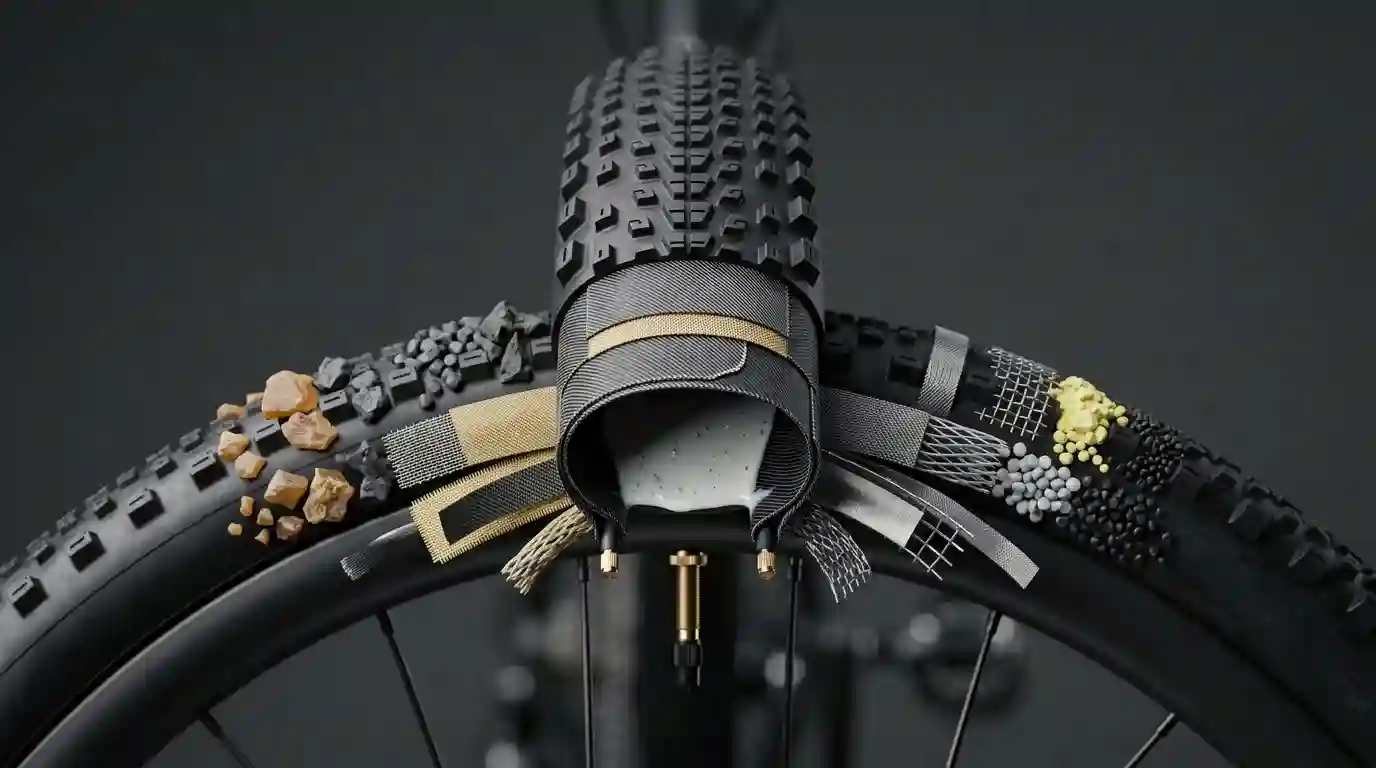
26×2.1 Puncture Protection
Flat protection is essential whether you are commuting through urban glass or riding rocky trails:
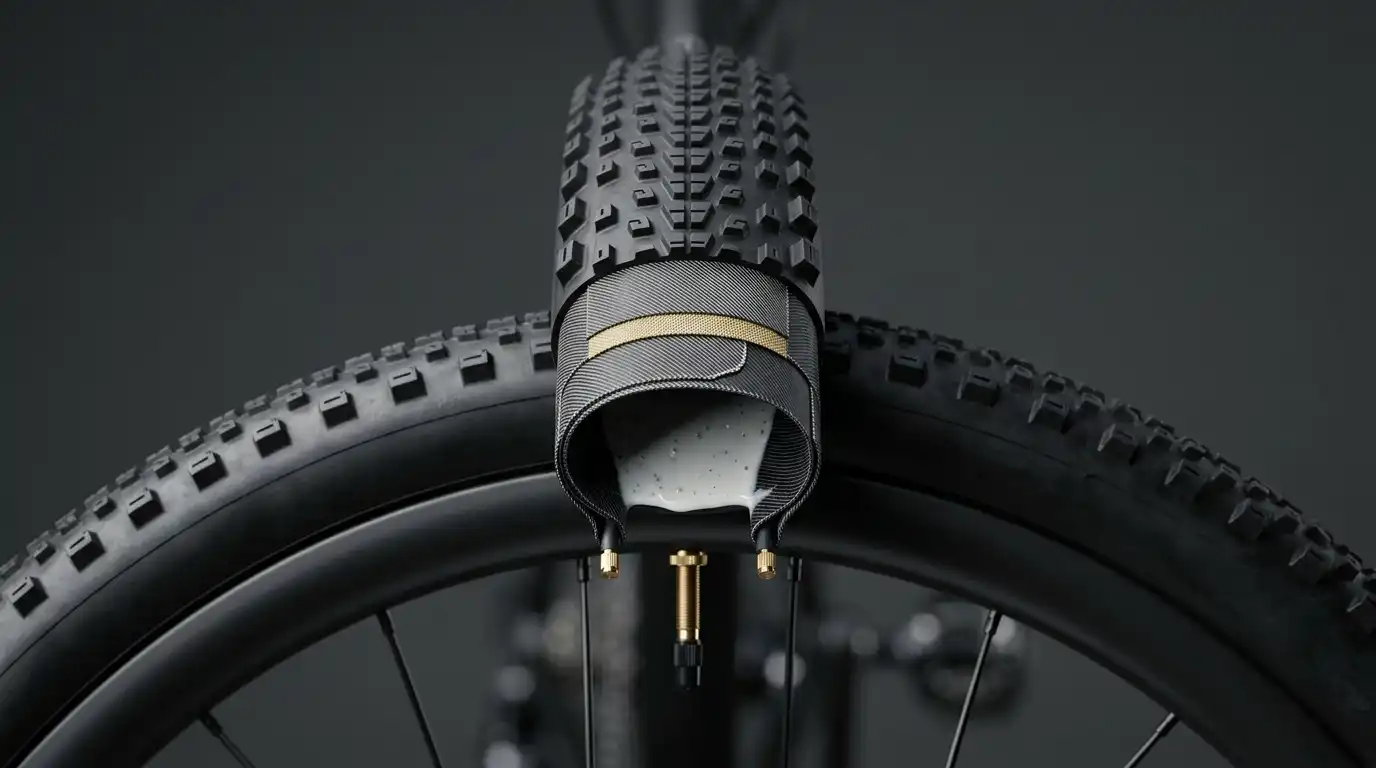
- Puncture Belts: A woven sub-tread layer (such as Kevlar or dense aramid) shields the tube or casing against thorns and glass.
- Sidewall Armor: Reinforced cross-woven fabric layers protect against sharp rock cuts in technical trail conditions.
26×2.1 Tubeless vs. Inner Tube
Many modern 26×2.1 mountain bike tires are available in Tubeless-Ready (TR) versions, though traditional inner tubes remain popular.
                      TUBELESS vs. INNER TUBE
+------------------------------------+----------------------------------+
|          Inner Tube Setup          |          Tubeless Setup          |
|  +------------------------------+  |  +----------------------------+  |
|  | Casing / Tread Structure     |  |  | Casing / Tread Structure   |  |
|  +------------------------------+  |  +----------------------------+  |
|  |           Inner Tube         |  |  |    Liquid Tubeless Sealant  |  |
|  +------------------------------+  |  +----------------------------+  |
|  |         Standard Rim Lip     |  |  |      Tubeless Rim Channel  |  |
|  +------------------------------+  |  +----------------------------+  |
|  (Pinch Flat Vulnerable)           |  (Pinch Flat Resistant)           |
+------------------------------------+----------------------------------+
Benefits of 26×2.1 Tubeless
Tubeless setups eliminate inner tubes entirely, replacing them with airtight rim tape, a tubeless valve, and liquid tubeless sealant.
- Run lower PSI without pinch flat risks.
- Sealant automatically seals thorn punctures up to $1/4\text{ inch}$.
- Reduced overall rotating mass and lower rolling resistance.
Step-by-Step Tubeless Conversion Guide
- Verify Compatibility: Ensure both tire and rim are designated Tubeless-Ready (TR/TC).
- Apply Rim Tape: Wrap tubeless tape tightly over internal spoke holes.
- Install Valve Stem: Insert a tubeless Presta valve and tighten the lock ring.
- Mount Tire: Push one tire bead into the rim center channel, then work the second bead over the rim edge.
- Add Tubeless Sealant: Inject $2\text{ to }3\text{ oz}$ of liquid tubeless sealant through the valve core or into the unseated casing.
- Seat the Beads: Inflate rapidly with a floor pump or air compressor until tire beads snap securely onto the rim.
- Check for Leaks: Rotate and shake the wheel to distribute sealant evenly across internal casing walls.
Can You Put a Wider Tire on a 26-Inch Wheel?
Often yes, but you must respect structural limits. Upgrading from a 2.1-inch tire to a 2.3 or 2.4-inch tire requires verifying clearance in three key areas:
+-----------------------------------------------------------------+
|                    CLEARANCE CHECK MATRIX                       |
+-----------------------------------------------------------------+
|  Frame Chainstays & Seatstays  --> Require 6mm minimum gap      |
|  Fork Crown & Arch             --> Require 6mm minimum gap      |
|  Brake Calipers (V-Brakes/Rim) --> Require clearance over knobs |
+-----------------------------------------------------------------+
How to Check if a 26×2.1 Tire Fits Your Bike
Follow this checklist to confirm fitment before buying a new tire:
- Read Existing Sidewall: Look for the marking $26 \times 1.95$, $26 \times 2.1$, or $54-559$.
- Confirm ETRTO BSD: Ensure the rim bead seat diameter is $559\text{ mm}$.
- Measure Internal Rim Width: Ensure inner width falls between $17\text{ mm}$ and $25\text{ mm}$.
- Inspect Frame Clearance: Measure space between current tire and chainstays/seatstays.
- Inspect Fork Clearance: Check gap under fork arch and legs.
- Check Brake System: Ensure rim brake pads or arms won’t rub on wider side knobs.
- Test Fit & Spin: Spin wheel to check for wobble, rubbing, or contact with mudguards.
Common 26-Inch Tire Size Comparison Table
| Tire Size Marking | Metric (ETRTO) | Approx. Width | Primary Riding Discipline |
| 26×1.5 | $40-559$ | $38\text{ mm}$ | Smooth Asphalt Commuting |
| 26×1.75 | $47-559$ | $44\text{ mm}$ | Hybrid, Light Gravel |
| 26×1.95 | $50-559$ | $50\text{ mm}$ | XC Mountain, Commuter |
| 26×2.1 | 54-559 | 53mm | XC MTB, Trail, Gravel, Commuter |
| 26×2.3 | $58-559$ | $58\text{ mm}$ | All-Mountain, Trail |
| 26×2.4 | $60-559$ | $61\text{ mm}$ | Downhill, Enduro, Aggressive Trail |
Widths are approximate; actual dimensions depend on rim width.
26×2.1 Tire Size and E-Bikes
Electric bikes subject tires to increased stress due to motor torque and higher overall bike weight.
When equipping a 26-inch e-bike with $2.1\text{-inch}$ tires:
- E-Bike Load Ratings: Look for tires explicitly rated for e-bike speeds ($E-25$ or $E-50$ certification).
- Higher Operating Pressure: Increase baseline PSI by $3\text{ to }5\text{ PSI}$ to compensate for battery and motor weight.
- Reinforced Casings: Choose heavy-duty casings and puncture belts to withstand high motor torque and prevent premature wear.
Common 26×2.1 Tire Mistakes
+-----------------------------------------------------------------+
|                    COMMON TIRE MISTAKES                         |
+-----------------------------------------------------------------+
|  Buying Fractional Sizes (26 x 1 1/2) instead of Decimal (26x2.1)|
|  Ignoring Inner Rim Width Compatibility                         |
|  Setting PSI based solely on sidewall max pressure              |
|  Forgetting extra clearance needed for mud and wheel flex       |
+-----------------------------------------------------------------+
How to Measure a 26×2.1 Tire
To accurately measure a mounted tire:
- Mount the tire to your rim and inflate to your target riding PSI.
- Allow the casing to settle for 12 hours.
- Use digital vernier calipers to measure across the widest point of the casing.
- Measure across the outer shoulder knobs to check overall tread width.
- Record measurements in millimeters to compare against frame clearance gaps.
Real-World Tire Testing Protocol
When evaluating 26×2.1 tires for rolling speed, grip, and durability:
- Rolling Resistance: Test tire rollout speed over a fixed descent at standardized pressures.
- Traction & Grip: Perform controlled cornering and braking tests on dirt and wet pavement.
- Puncture Testing: Monitor puncture frequency over fixed mileage across varied terrain.
People Also Ask About 26×2.1 Tires
What Does 26×2.1 Mean on a Bike Tire?
“26” designates the traditional 26-inch wheel size category ($559\text{ mm}$ bead seat diameter), while “2.1” indicates a nominal width of 2.1 inches ($\sim 53\text{ mm}$).
How Wide Is a 26×2.1 Tire?
A 26×2.1 tire is approximately 2.1 inches wide, converting to roughly $53.3\text{ mm}$ nominal width.
What PSI Should a 26×2.1 Tire Have?
Ideal PSI ranges from $25\text{ PSI}$ to $45\text{ PSI}$, depending on rider weight, tube/tubeless setup, terrain, and rim width.
Can I Put a 26×2.1 Tire on a 26×1.95 Rim?
Yes, provided both use the standard $559\text{ mm}$ bead seat diameter and the rim width falls between $17\text{ mm}$ and $23\text{ mm}$.
FAQ: 26×2.1 Bike Tires
What does 26×2.1 mean?
It indicates a tire designed for a 26-inch ($559\text{ mm}$ BSD) wheel category with a nominal width of 2.1 inches ($\sim 53\text{ mm}$).
How many millimeters is a 26×2.1 tire?
2.1 inches equals approximately $53.3\text{ mm}$ nominal width.
What rim width is best for a 26×2.1 tire?
Internal rim widths from $19\text{ mm}$ to $23\text{ mm}$ offer optimal sidewall support for a 2.1-inch tire.
What PSI is best for a 26×2.1 tire?
Starting pressures typically range from $28 – 35\text{ PSI}$ for inner tubes and $22 – 30\text{ PSI}$ for tubeless setups based on rider weight.
Is 26×2.1 good for commuting?
Yes, it provides high air volume to cushion city pot holes and tracks. Smooth or semi-slick tread patterns work best for street riding.
Is 26×2.1 good for gravel?
It is a fantastic size for retro-MTB gravel conversions, offering high volume and traction on loose dirt roads.
How long does a 26×2.1 tire last?
Tire lifespan varies from $1,500$ to $3,500\text{ miles}$, depending on rubber compound, terrain, rider weight, and braking habits.
Are tubeless 26×2.1 tires better than inner tubes?
Tubeless setups reduce pinch flats, lower rolling resistance, and allow lower pressures for better traction, though setup requires more effort initially.
Conclusion: Understanding 26×2.1 Tire Size
The 26×2.1 tire marking specifies a traditional 26-inch wheel category ($559\text{ mm}$ bead-seat diameter) combined with a nominal casing width of 2.1 inches ($\sim 53\text{ mm}$). It remains a reliable, high-performing tire choice for cross-country mountain biking, urban commuting, retro MTB builds, and gravel touring across the United States.
Ensuring proper fitment requires checking your rim’s bead-seat diameter, measuring internal rim width, verifying frame clearance, and adjusting tire pressure (PSI) for your weight and riding style.
26×2.1 Final Compatibility Checklist
- [ ] Verified rim BSD is 559mm (ETRTO $54-559$).
- [ ] Checked internal rim width ($17\text{ mm} – 25\text{ mm}$ recommended).
- [ ] Verified minimum $6\text{ mm}$ frame and fork clearance gap.
- [ ] Calculated target front and rear PSI based on total system weight.
- [ ] Selected proper tread pattern for local terrain (slick vs. knobby).
Find Your Ideal 26×2.1 Tire Pressure
Don’t guess your tire pressure! Optimize your ride quality, flat protection, and traction in seconds. Use the Free Bike Tire Pressure Calculator / Tire Finder Tool at TheBikeTires.com to calculate the ideal starting PSI for your exact weight, bike, and riding conditions.

Mohidul Islam is a leading cycling technology specialist and bike tire consultant with over 15 years of hands-on experience in the bicycle industry. He holds a Bachelor of Science in Mechanical Engineering from Penn State University, where he focused heavily on material science, tread mechanics, and rubber compound performance. Over the past decade and a half, Alex has conducted extensive field testing, tubeless setup evaluations, and tire pressure modeling for road, mountain, and e-bikes. His practical insights and data-driven approach help cyclists of all levels optimize grip, speed, and durability on every ride.