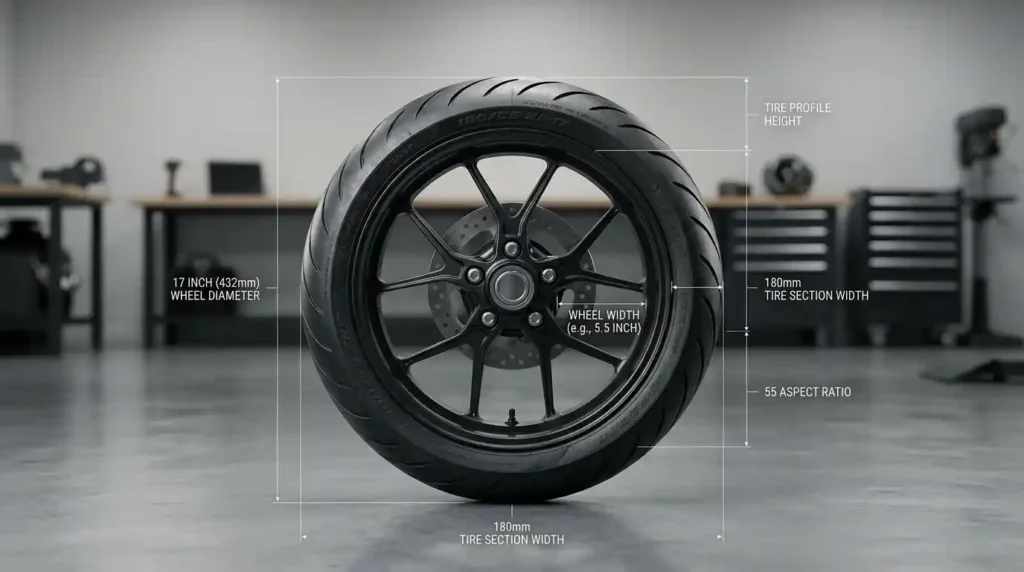
Navigating the world of bicycle specs can quickly get confusing, especially when terms like wheel size, rim size, and tire size are used interchangeably. Many US cyclists purchase tires only to find they don’t seat properly on the rim or cause severe frame rub during hard cornering. Understanding how these dimensions interact is critical for rider safety, cornering traction, and overall efficiency.
A bicycle tire operates as part of an integrated wheel-and-tire system. Pairing the wrong tire width with an incompatible inner rim width compromises sidewall support, leading to dangerous tire squirm, pinch flats, or sudden bead unseating. Maintaining the correct tire pressure (PSI) and selecting appropriate casing volume directly impacts speed, shock absorption, and control across asphalt, gravel, and singletrack.
What Is Bike Wheel Size?
Bike wheel size refers to the overall diameter category of the physical wheel structure, which consists of the hub, spokes, nipples, and outer rim.
                  [ COMPLETE BICYCLE WHEEL SYSTEM ]

                         /------- RIM -------\
                        /   +-------------+   \
                       /    |  Tire Bead  |    \
                      |     +-------------+     |
           SPOKES --> |    \       |       /    | <-- SPOKES
                      |     \     HUB     /     |
                      |      \     |     /      |
                       \    +-------------+    /
                        \   |  Tire Bead  |   /
                         \--+-------------+--/
Wheel size dictates the physical frame geometry required to hold the wheel and establishes the foundational baseline for total outer tire height.
Common Bike Wheel Sizes
- 700C: The standard diameter for modern road, endurance, gravel, and hybrid commuter bikes.
- 29-Inch: The industry standard for modern cross-country, trail, and enduro mountain bikes (MTB).
- 27.5-Inch (650B): Popular on technical mountain bikes, aggressive gravel setups, and smaller frame sizes for agile handling.
- 26-Inch: The legacy standard found on vintage mountain bikes, dirt jumpers, and fat bikes.
Wheel Size vs Rim Diameter
Marketing labels can be misleading. While 700C and 29-inch sound entirely different, both wheel categories share the exact same internal Bead Seat Diameter (BSD) of 622 mm.
+-------------------------------------------------------------------------+
|                  THE 622mm BEAD SEAT DIAMETER SHARED STANDARD           |
+-------------------------------------------------------------------------+
|  700C Road/Gravel Rim  (BSD: 622mm)  <--->  Fits 622mm Bead Seat Tires |
|  29er MTB Rim          (BSD: 622mm)  <--->  Fits 622mm Bead Seat Tires |
+-------------------------------------------------------------------------+
To ensure true mechanical fit, rely on the ISO / ETRTO (European Tyre and Rim Technical Organisation) international measurement system, which defines exact millimeter dimensions rather than marketing names.
What Is Bike Tire Size?
Bike tire size defines two distinct measurements: the tire’s internal bead diameter (which must match the rim’s BSD) and the tire’s inflated width (casing volume).
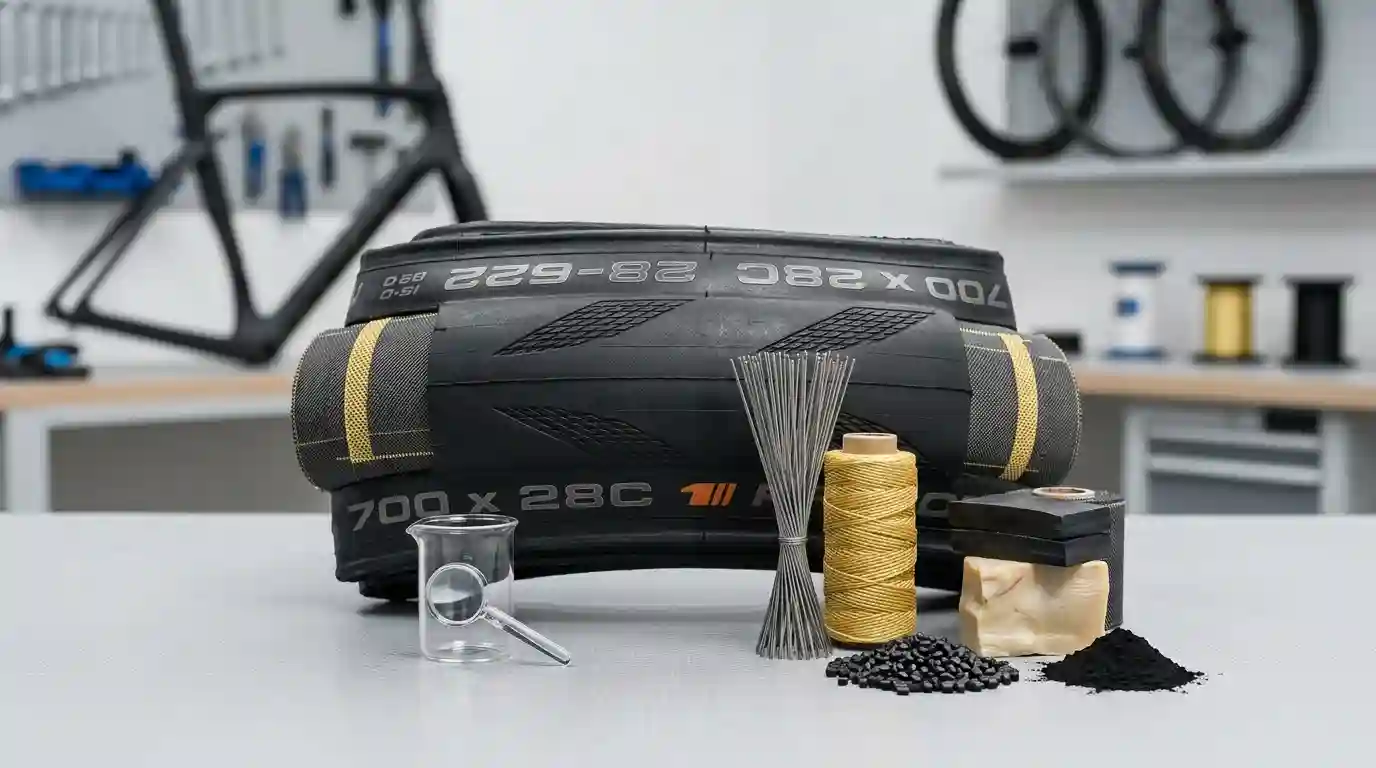
Tire size markings appear on the sidewall in standard formats such as 700×32C, 29×2.4, or 27.5×2.25. The tire’s total width determines total air volume, directly dictating cornering bite and ideal operating pressure (PSI).
How to Read a Bike Tire Size
Reading tire markings correctly prevents costly ordering errors:
- First Number: Indicates wheel diameter category or nominal outer height (e.g., 700, 29, or 27.5).
- Second Number: Indicates inflated casing width (e.g., 32 mm in metric, or 2.4 inches in imperial).
- Letter / ISO Standard: Denotes traditional rim width sizing standards or precise millimeter ratings (e.g., 622×32).
What Does 700 × 32C Mean?
- 700: Refers to the original traditional French standard for nominal outer wheel diameter (∼700 mm).
- 32: Represents a nominal inflated tire width of 32 mm.
- C: A historical French rim-width designation (modern 700C tires fit all standard 622 mm BSD rims).
What Does 29 × 2.4 Mean?
- 29: Identifies the wheel diameter category in inches (622 mm BSD).
- 2.4: Represents an inflated tread-to-tread width of 2.4 inches (∼61 mm).
Bike Wheel Size vs Tire Size: The Key Difference
| Marketing Size | ISO / ETRTO Sizing | What It Tells You | Primary Riding Application |
|---|---|---|---|
| 700C | 622×28 mm | 622 mm Rim BSD + 28 mm Width | Asphalt Road / Endurance |
| 700C | 622×40 mm | 622 mm Rim BSD + 40 mm Width | Gravel / Commuting |
| 29-Inch | 622×61 mm (2.4″) | 622 mm Rim BSD + 2.4″ Width | Trail / Enduro Mountain Bike |
| 27.5-Inch (650B) | 584×58 mm (2.3″) | 584 mm Rim BSD + 2.3″ Width | Technical MTB / Adventure Gravel |
Wheel size tells you which rim diameter the tire bead seats upon. Tire size defines the total air volume, casing height, and footprint width.
Can You Put Any Tire Width on the Same Wheel?
No. While a single rim can accommodate a safe range of tire widths, extreme pairings cause major handling and safety risks.
       Narrow Rim Channel                 Wide Rim Channel
     (Pinched / Bulb Shape)             (Supported Sidewalls)
         +-----------+                      +-----------+
        /             \                    /             \
       |   Rounded     |                  |  Structured   |
        \             /                    \             /
         +--+     +--+                      +-----+ +-----+
            |     |                               |     |
            +-----+                               +-----+
         [Narrow Channel]                     [Wide Channel]
Mounting an excessively wide 2.5-inch tire on a narrow 17 mm inner rim channel pinches the tire base into a lightbulb shape. This setup causes aggressive tire squirm, sidewall flex, and potential bead unseating during hard cornering.
Conversely, stretching a narrow 25 mm tire across a wide 30 mm internal rim flattens the tread profile, exposing vulnerable sidewalls to sharp rocks and pinch flats.
How Rim Width Affects Tire Size
A tire’s mounted casing profile shifts dramatically depending on the inner rim width:
- Narrow Internal Rims (17 mm−19 mm): Pinch tire beads together, raising casing height while decreasing measured width.
- Wide Internal Rims (23 mm−30 mm): Expand casing sidewalls outward, increasing real-world width and strengthening lateral bead support.
Tire Width and Frame Clearance
Upgrading to wider tires requires checking physical frame and fork limits. Always evaluate:
- Chainstay and Seatstay Clearance: The primary pinch point for rear tire width upgrades.
- Fork Arch / Crown Clearance: Top and side clearance limits on front suspension forks.
- Brake Caliper and Drivetrain Gap: Front derailleur clamps and rim-brake arms can contact wider casings.
+-----------------------------------------------------------------+
|          RECOMMENDED MINIMUM FRAME SAFETY CLEARANCE             |
+-----------------------------------------------------------------+
|  Pavement & Road Riding:    3mm - 4mm minimum gap on all sides  |
|  Gravel & Dry Off-Road:     6mm minimum gap for small debris     |
|  Pacific Northwest / Mud:   8mm - 10mm minimum gap for mud clear |
+-----------------------------------------------------------------+
Can You Change Tire Size Without Changing Wheels?
Yes, provided the replacement tire shares the exact same Bead Seat Diameter (e.g., replacing 700×28C with 700×35C on a 622 mm BSD rim) and falls within approved inner rim width and frame clearance limits.
You cannot change tire diameter without replacing the wheelset (e.g., mounting a 27.5-inch tire on a 29-inch wheel is impossible because the bead seat diameters do not match).
Example: Changing a 28mm Tire to 32mm
Swapping a 28 mm road tire for a 32 mm casing on a 700C wheelset:
- Bead Seat Match: Both tires utilize the standard 622 mm BSD.
- Volume Difference: The 32 mm casing offers approximately 30% greater internal air volume.
- Pressure Adjustment: Allows dropping baseline pressure by roughly 10−15 PSI, absorbing high-frequency road vibration.
- Clearance Check: Requires verifying at least 4 mm of clear space around the fork, brake caliper, and chainstays.
Example: Changing a 2.2 MTB Tire to 2.4
Swapping a 2.2-inch XC tire for a 2.4-inch trail tire on a 29-inch wheelset:
- Bead Seat Match: Both use the 622 mm BSD.
- Rim Width Requirement: Optimal performance requires an internal rim width of 25 mm−30 mm.
- Performance Impact: Increases cornering traction on loose, rocky Southwestern terrain.
- Clearance Check: Requires verifying at least 6 mm−8 mm of frame clearance to prevent mud dragging.
How Wheel Diameter Affects Bike Performance
+-----------------------------------------------------------------+
|               WHEEL DIAMETER PERFORMANCE TRADEOFFS               |
+-----------------------------------------------------------------+
|  LARGER WHEELS (29" / 700C)  --> Superior Rollover, Speed    |
|  SMALLER WHEELS (27.5" / 26") --> Faster Acceleration, Agility  |
+-----------------------------------------------------------------+
Larger Wheels (29-Inch / 700C)
- Rollover Capability: Attack angle over rocks, roots, and potholes is flatter, conserving momentum.
- Top-Speed Efficiency: High momentum retention once brought up to speed.
- Footprint Length: Produces a longer contact patch, increasing acceleration traction.
Smaller Wheels (27.5-Inch / 26-Inch)
- Rapid Acceleration: Lower rotating mass allows quicker spin-up out of tight turns.
- Maneuverability: Responsive steering feel on tight, twisting singletrack.
- Fit for Smaller Riders: Prevents toe-overlap on smaller frame geometries.
How Tire Width Affects Bike Performance
Wider Tires
- Higher air volume allows lower operating tire pressure (PSI).
- Dampens high-frequency trail vibration and harsh impacts.
- Expanded contact patch increases cornering traction and braking control.
Narrower Tires
- Reduced static weight aiding steep climbs.
- Lower frontal surface area, reducing aerodynamic drag above 20 mph.
- Fits restricted clearances on traditional rim-brake road frames.
Tire Width and Rolling Resistance
Contrary to traditional belief, wider tires do not automatically roll slower. Rolling resistance stems from internal energy loss as the casing flexes (hysteresis).
   Narrow Tire Footprint                Wider Tire Footprint
 (Long & Narrow Deformation)          (Short & Wide Deformation)
        +----------+                         +------+
        |          |                         |      |
        |          |                         |      |
        |          |                         +------+
        +----------+                     [Lower Casing Flex]
  [High Energy Deflection]
At equal inflation pressures, a wider tire forms a shorter, wider contact patch. This shorter contact patch reduces casing deformation at the tire’s leading edge, reducing rolling resistance on rough roads.
How Wheel and Tire Size Affect Tire Pressure
Tire pressure (PSI) must balance rider weight, air volume, and terrain demands. Larger air volumes require less pressure to support identical rider weights safely.
System Weight Tire Pressure Formula
Calculate baseline rear and front tire pressures using this total load equation (rider weight + bike weight + gear weight):
Baseline Rear Pressure (PSI)=(4Total System Weight (lbs))×(Mounted Tire Width (mm)28)
Baseline Front Pressure (PSI)=Baseline Rear Pressure−3 PSI
Calculation Example
A 175 lb rider on a 25 lb bike carrying 10 lbs of gear (Total System Weight = 210 lbs) running 40 mm gravel tires:
Rear PSI=(4210)×(4028)=52.5×0.70=36.75 PSI
- Rear Baseline Target: 37 PSI
- Front Baseline Target: 34 PSI
Basic PSI Setup Guide
Follow this step-by-step workflow to establish proper tire pressure:
- Identify Total System Weight: Add rider weight, bike weight, and carried gear together.
- Determine Mounted Tire Width: Measure exact inflated width using calipers.
- Calculate Baseline Pressures: Use the formula above to set rear and front targets.
- Adjust for Surface Type: Reduce pressure by 2−3 PSI for loose trail dirt; increase by 2 PSI for smooth asphalt.
- Adjust Front/Rear Weight Bias: Set front tire pressure 2−4 PSI lower than the rear tire to account for weight distribution (60% rear / 40% front).
- Field Test: If you experience sidewall squirm in sharp turns, add 2 PSI. If the bike bounces over bumps, drop 2 PSI.
Recommended Baseline PSI by Total Weight & Category
| Total System Load | 28mm Road (Tubes) | 38mm Gravel (Tubeless) | 45mm Gravel (Tubeless) | 2.4″ MTB (Tubeless) |
|---|---|---|---|---|
| 150 lbs (68 kg) | 62 PSI | 33 PSI | 26 PSI | 18 PSI |
| 180 lbs (82 kg) | 72 PSI | 38 PSI | 30 PSI | 21 PSI |
| 210 lbs (95 kg) | 82 PSI | 44 PSI | 35 PSI | 24 PSI |
| 240 lbs (109 kg) | 92 PSI | 50 PSI | 40 PSI | 27 PSI |
Signs Your PSI Is Incorrect
+-----------------------------------------------------------------+
|                  PRESSURE DIAGNOSTIC SUMMARY                    |
+-----------------------------------------------------------------+
|  PSI TOO LOW  --> Sidewall Squirm, Rim Strikes, Tire Burping   |
|  PSI TOO HIGH --> Harsh Bounce, Loss of Cornering Traction      |
+-----------------------------------------------------------------+
When Signs PSI Is Too Low
- Feeling the wheel rim strike rocks or roots over square hits.
- Lateral tire squirm or wallowing feel during hard cornering.
- Tubeless tire “burping” air and sealant under cornering loads.
Signs PSI Is Too High
- Skittering and harsh chatter over rough asphalt or chip-seal roads.
- Sudden loss of traction across wet roots or loose gravel.
- Excessive arm pump and hand fatigue from unabsorbed trail vibration.
Wheel Size and Tire Size by Bike Type
Road:       [25mm] =======> [28mm] =======> [30mm]
Commuter:   [32mm] ===============> [38mm]
Gravel:     [40mm] =======================> [45mm] =======> [50mm]
MTB:        [2.25 in] ====================================> [2.5 in]
Road Bikes
- Standard Wheel Size: 700C (622 mm BSD).
- Common Tire Range: 25 mm−30 mm.
- Key Considerations: Endurance road frames favor 28 mm−32 mm tires to reduce rider fatigue over rough chip-seal.
Gravel Bikes
- Standard Wheel Sizes: 700C or 650B (27.5-inch).
- Common Tire Range: 38 mm−50 mm.
- Key Considerations: 700C×40 mm setups favor high-speed rolling, while 650B×47 mm−50 mm options provide volume for rocky fire roads.
Mountain Bikes (MTB)
- Standard Wheel Sizes: 29-inch or 27.5-inch.
- Common Tire Range: 2.25 in−2.6 in.
- Key Considerations: Cross-country (XC) racers use fast-rolling 2.25 in−2.35 in tires, whereas trail/enduro riders rely on reinforced 2.4 in−2.5 in casings.
Commuter Bikes
- Standard Wheel Sizes: 700C or 26-inch.
- Common Tire Range: 32 mm−42 mm.
- Key Considerations: Prioritizes puncture belts and durable rubber compounds over raw weight.
E-Bikes
- Standard Wheel Sizes: 29-inch, 27.5-inch, or 700C.
- Common Tire Range: 38 mm−2.6 in.
- Key Considerations: Must feature ECE-R75 structural approval ratings, heavy multi-ply casings, and hard durometer rubber to withstand 50 lb+ bike mass and electric torque.
700C vs 650B: What’s the Difference?
      700C Wheel Standard                   650B Wheel Standard
      (622mm Bead Diameter)                 (584mm Bead Diameter)
        +---------------+                     +---------------+
       /                 \                   /                 \
      |   38mm Gravel     |                 |   47mm High     |
      |      Tire         |                 |   Volume Tire   |
       \                 /                   \                 /
        +---------------+                     +---------------+
     [Equal Outer Diameter]                [Equal Outer Diameter]
700C and 650B represent two distinct wheel rim diameters (622 mm vs. 584 mm BSD).
A 650B wheel uses a smaller rim diameter, allowing riders to fit wider, higher-volume tires (e.g., 47 mm) within the same gravel frame clearance that accepts a 700C×38 mm tire. Both configurations yield roughly identical overall outer rolling diameters.
29 vs 27.5 Bike Wheels
- 29-Inch (622 mm BSD): Maximum rollover over obstacles and momentum retention; standard on modern XC and trail bikes.
- 27.5-Inch (584 mm BSD): Offers responsive handling, faster acceleration out of turns, and better frame clearance for smaller riders.
Inner Rim Width & Tire Compatibility Chart
Pair inner rim channel dimensions with compatible tire widths following updated ETRTO safety guidelines:
| Internal Rim Width (mm) | Minimum Safe Tire Width | Optimal Performance Tire Range | Maximum Safe Tire Width |
|---|---|---|---|
| 17 mm | 23 mm | 25 mm−28 mm | 32 mm |
| 19 mm−21 mm | 25 mm | 28 mm−35 mm | 42 mm |
| 23 mm−25 mm | 30 mm | 38 mm−45 mm | 50 mm |
| 27 mm−30 mm | 2.0 in (50 mm) | 2.25 in−2.5 in | 2.6 in |
| 35 mm | 2.35 in | 2.6 in−2.8 in | 3.0 in |
How to Match a Tire to Your Bike Wheel
- Locate Sidewall Size Markings: Find the printed size on your current tire (e.g., 700×38C or 29×2.4).
- Identify Rim Bead Seat Diameter: Confirm the BSD matches (622 mm for 700C/29er, or 584 mm for 650B/27.5er).
- Measure Internal Rim Channel Width: Remove the tire and measure the internal width between the rim hooks using calipers.
- Compare Approved ETRTO Ranges: Verify your intended tire width falls within the rim manufacturer’s safety recommendations.
- Inspect Frame Clearances: Ensure at least 4 mm−6 mm of clearance around chainstays, fork legs, and brake calipers.
Wheel and Tire Compatibility for Tubeless Setups
Converting to tubeless requires precise mechanical matching between the tire bead and rim lock channel.
            Tubeless Convertible System
        +---------------------------------+
        |  Tubeless-Ready Tire Casing     |
        |  Liquid Latex Sealant           |
        +---------------------------------+
        |  Airtight Rim Tape & Valve      |
        +---------------------------------+
        (Eliminates Inner Tube Pinch Flats)
Tubeless Installation Steps
- Verify Tubeless Ratings: Confirm both tire and rim are marked “Tubeless Ready” (TLR or TC).
- Tape the Rim Channel: Apply non-porous tubeless rim tape tightly over spoke holes, stretching firm to prevent air leaks.
- Insert Tubeless Valve: Push the tubeless valve through the valve hole and secure the locknut by hand.
- Mount Tire Bead: Work one bead into the rim center, pour in liquid latex sealant (2−3 oz for gravel, 3−4 oz for MTB), then snap the second bead onto the rim.
- Seat the Bead: Inflate rapidly using a high-volume floor pump or compressor until the beads snap onto the rim shelves.
Does Tire Construction Change Size and Performance?
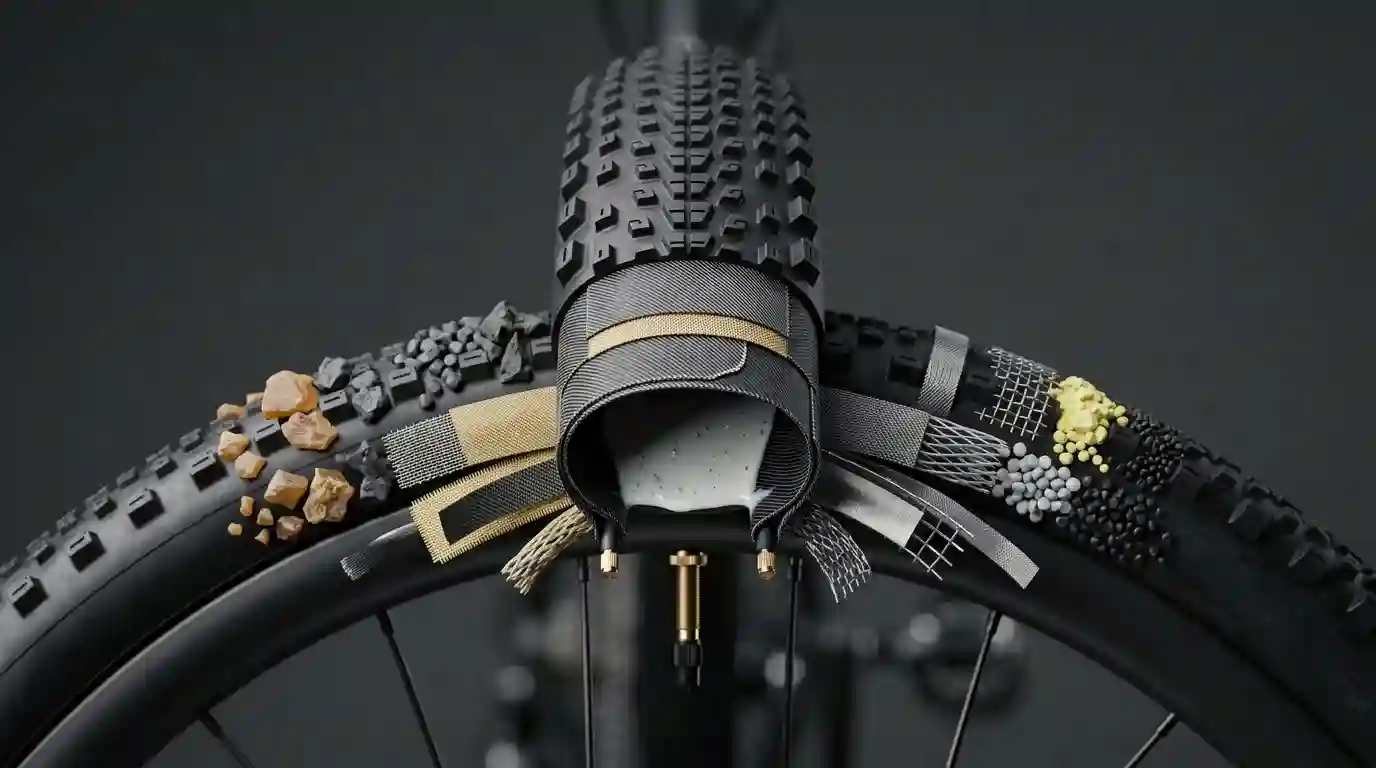
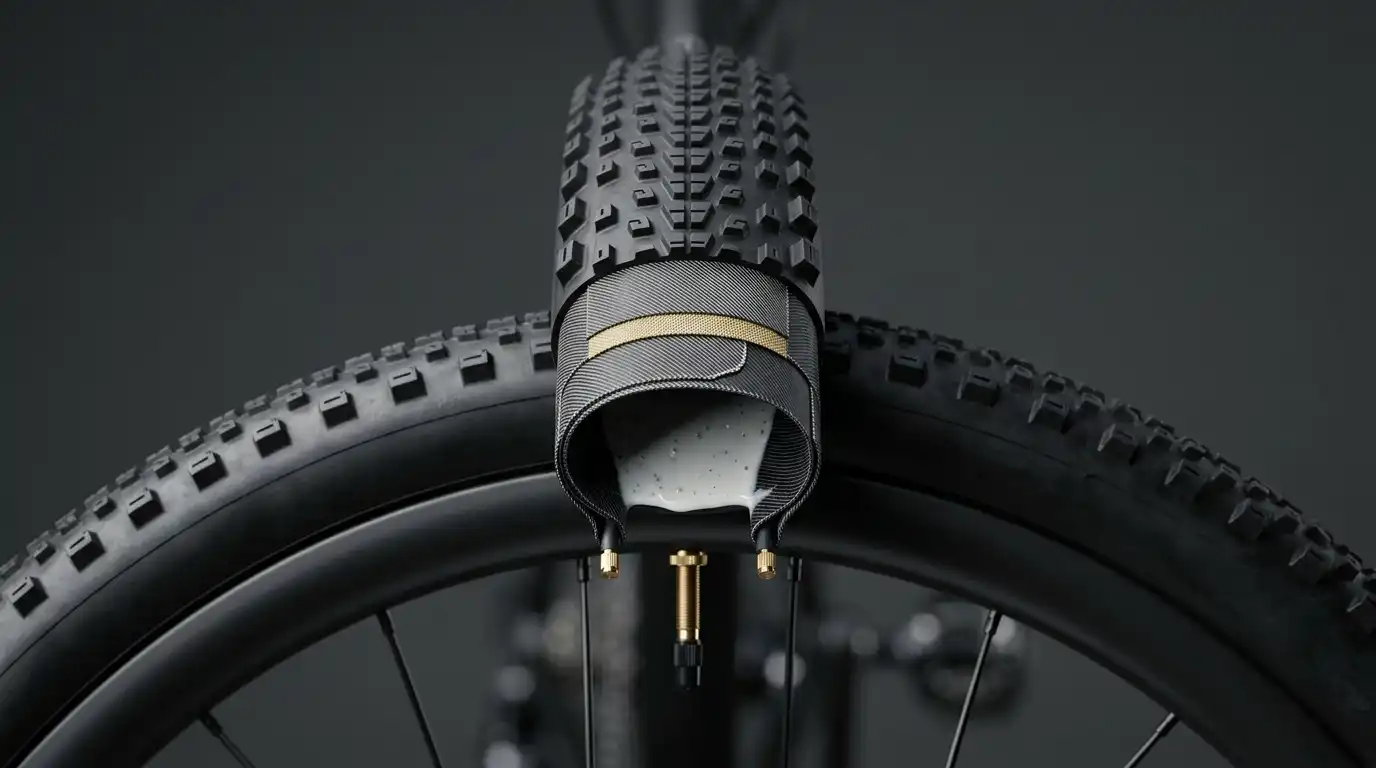
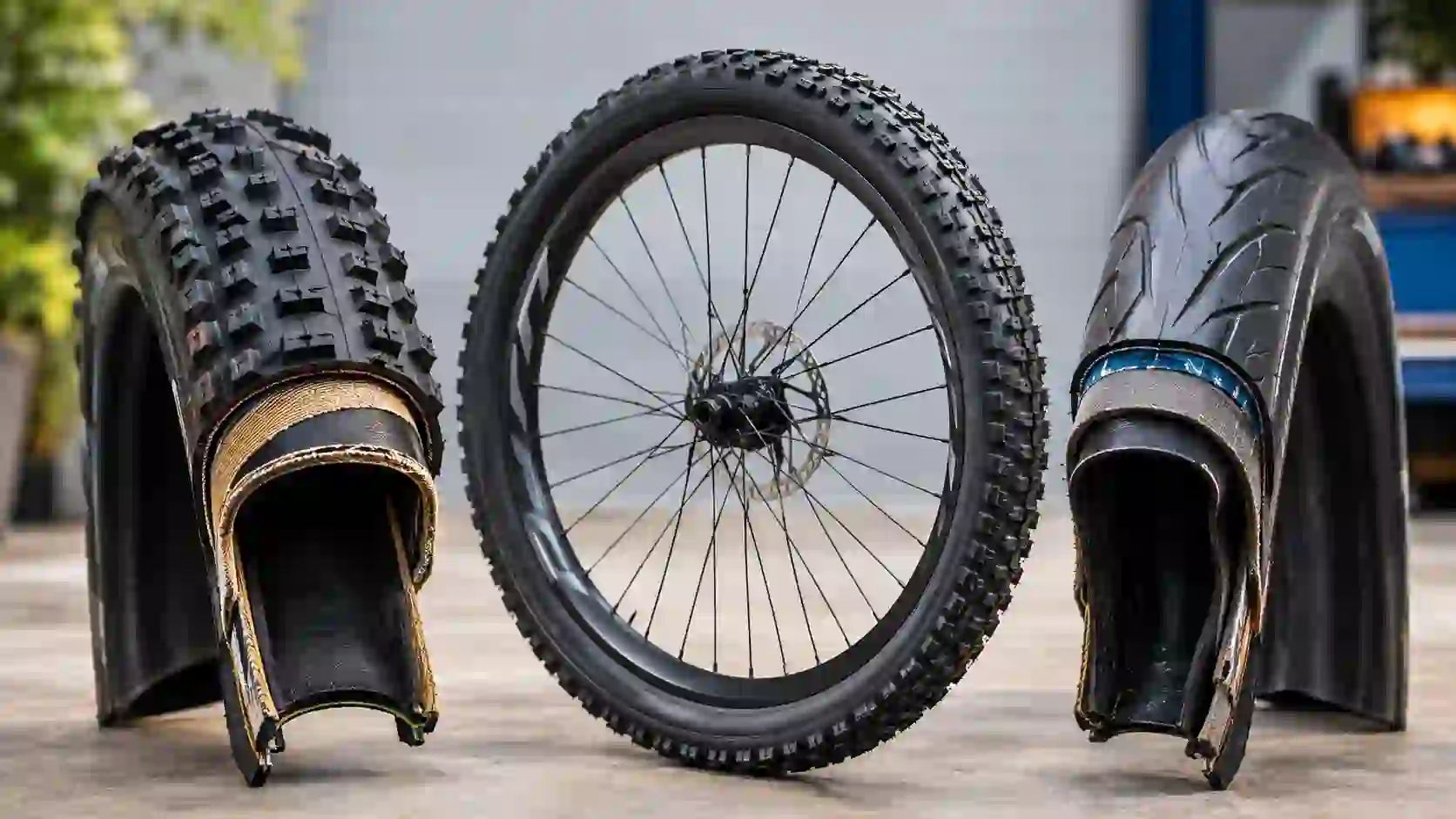
Tire behavior depends as much on internal casing architecture and rubber chemistry as physical dimensions:
       [ CROSS-SECTION OF TIRE CONSTRUCTION ]

         +---------------------------------+  <-- Tread Cap (Slick/Knob)
         |=================================|  <-- Puncture Belt
         |---------------------------------|  <-- Casing Threads (TPI)
        /                                   \
       |   Inner Rubber Air Barrier Sheath   |
Casing TPI (Threads Per Inch)
- 30−60 TPI: Thick nylon threads. Stiff, heavy, highly puncture-resistant; typical for commuters and e-bikes.
- 120−320 TPI: Supple, fine threads. Fast-rolling, lightweight casing that conforms smoothly to rough surfaces.
Puncture Belts
Woven aramid or Kevlar protective strips positioned underneath the tread cap shield against glass and thorns, adding minor weight while preventing flats.
Tread Rubber & Durometer
Rubber hardness is measured in Shore A durometer ratings (45a−70a). Soft rubber (45a−50a) grips wet rocks and roots; hard rubber (60a−70a) optimizes tread longevity and rolling efficiency.
Common Wheel and Tire Size Mistakes
- Confusing Wheel Diameter with Casing Width: Assuming a 700C tire is 700 mm wide, or that a 29-inch tire will fit a 27.5-inch wheel.
- Ignoring Internal Rim Width Limits: Forcing wide trail tires onto narrow vintage rims, causing dangerous tyre squirm.
- Overlooking Dynamic Frame Flex: Forgetting that carbon frames flex laterally under heavy pedaling, causing tight tires to rub internal chainstays.
- Inflating Wide Tires to Maximum Sidewall PSI: Overinflating high-volume tires leads to a harsh ride, lost traction, and high rolling resistance on rough roads.
How to Measure Your Bike Wheel and Tire
Accurate measurement prevents fitment issues:
- Measure Inflated Casing Width: Use digital calipers across the widest point of the tire casing at standard pressure.
- Measure Internal Rim Channel: Remove the tire and measure the inner distance between the interior rim hooks.
- Verify Outer Frame Gap: Insert metric Allen wrenches (4 mm, 6 mm, 8 mm) between the tire and frame to measure safety clearances.
                  DIGITAL CALIPER CASING MEASUREMENT
                 +----------------------------------+
                 |  [===== DIGITAL CALIPER =====]   |
                 |          |  38.2 mm  |           |
                 +----------+-----------+-----------+
                             /         \
                            |   Tire    |
                             \         /
                              +-------+
Data-Backed Tire Testing and Real-World Performance
Tire testing evaluates rolling speed, grip, and durability using controlled methodologies:
- Rolling Resistance Drum Tests: Measures power loss (watts) as tires roll over steel drums under controlled loads.
- Surface Vibration Testing: Measures shock transmission through casings across chip-seal and textured plates.
- Field Power-Meter Rollouts: Real-world field testing measuring wattage required to maintain speed across gravel and asphalt roads.
Frequently Asked Questions
Is bike wheel size the same as tire size?
No. Wheel size defines the wheel’s physical diameter category (e.g., 700C or 29-inch), whereas tire size specifies both the diameter category and inflated casing width (e.g., 700×32C).
Can I put a different size tire on my bike?
Yes, provided the new tire shares the exact same Bead Seat Diameter (BSD) as your rim, fits within your rim’s approved width range, and leaves adequate frame clearance.
Can I put wider tires on the same wheels?
Often yes, provided your internal rim channel width supports the wider casing and your frame leaves at least 4 mm−6 mm of clear space.
Does a bigger wheel make a bike faster?
Larger wheels maintain momentum better over rough surfaces due to a flatter rollover angle, but acceleration depends on total rotating mass and tire casing construction.
Can a 29-inch tire fit a 27.5-inch wheel?
No. 29-inch tires (622 mm BSD) and 27.5-inch wheels (584 mm BSD) have different bead seat diameters and are physically incompatible.
Can I use 700C tires on a 29er wheel?
Yes. Both 700C and 29-inch rims share the same 622 mm Bead Seat Diameter, provided the tire width matches the rim’s internal channel width.
How often should I replace my bike tires?
Replace tires when tread indicators disappear, casing threads become visible, rubber shows severe weather cracking, or you experience frequent punctures.
Are tubeless tires better than inner tubes?
Tubeless setups eliminate pinch flats, self-seal small punctures, and allow lower operating tire pressures (PSI) for enhanced cornering traction.
Final Compatibility Checklist
- [ ] Matched tire Bead Seat Diameter (BSD) to rim diameter (622 mm or 584 mm).
- [ ] Checked internal rim channel width against ETRTO compatibility charts.
- [ ] Verified at least 4 mm−6 mm of clearance around chainstays, fork, and brakes.
- [ ] Calculated starting tire pressure (PSI) based on total system weight.
- [ ] Selected an appropriate casing TPI and tread pattern for your local terrain.
- [ ] Confirmed tubeless component compatibility if running tubeless.
Find the Right Tire and PSI for Your Bike
Choosing the right tire size and maintaining proper pressure transforms your ride quality, cornering confidence, and rolling speed.
Don’t guess your tire setup. Visit TheBikeTires.com to use our Free Bike Tire Pressure Calculator and Tire Finder Tool to calculate your baseline pressure (PSI) and discover optimal tire recommendations for your bicycle!

Mohidul Islam is a leading cycling technology specialist and bike tire consultant with over 15 years of hands-on experience in the bicycle industry. He holds a Bachelor of Science in Mechanical Engineering from Penn State University, where he focused heavily on material science, tread mechanics, and rubber compound performance. Over the past decade and a half, Alex has conducted extensive field testing, tubeless setup evaluations, and tire pressure modeling for road, mountain, and e-bikes. His practical insights and data-driven approach help cyclists of all levels optimize grip, speed, and durability on every ride.