
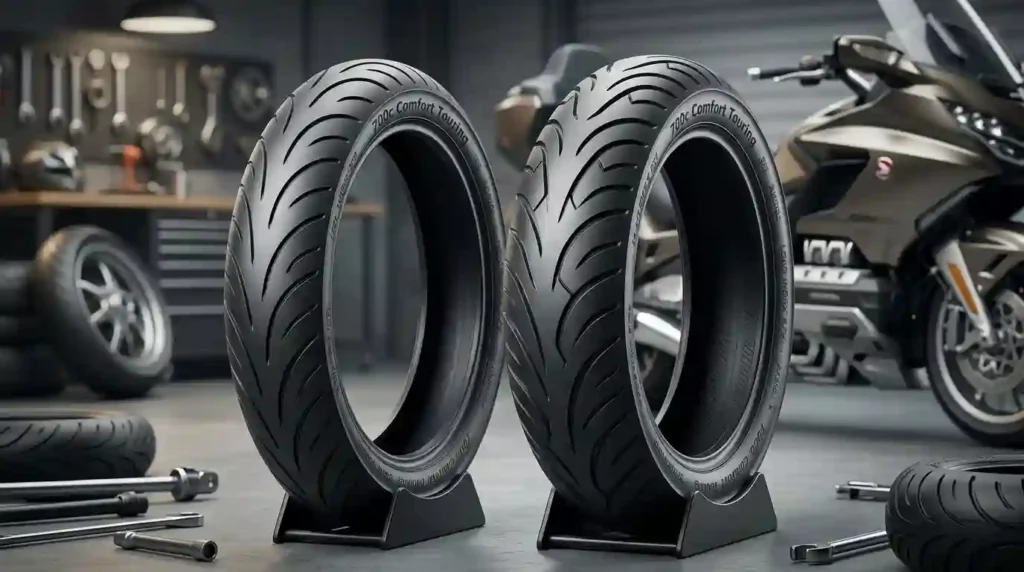
Numb hands, a buzzing saddle, and a bike that bounces over every crack are common complaints. Flats, poor cornering grip, and the wrong PSI make rides worse. If you want the best 700c bike tyres for comfort, you need more than a brand name.
First, a quick fact. 700c is a wheel diameter standard, not a tire width. Comfort depends heavily on tire width, construction, pressure, and casing. For the wheel basics, read what 700c means on a bike tire.
Wider 700c tires are a common way to smooth out rough pavement. Many road bikes now fit 32mm or more, so the option is open to more riders than ever. The best tire is the one that balances comfort, rolling resistance, grip, durability, and bike compatibility.
Quick answer: The best 700c bike tires for comfort are usually wider tires that fit your frame and rims, run at an appropriate PSI, and use a flexible casing suited to your riding surface.
Tire choice and correct pressure shape your safety, speed, and comfort. A good setup grips well, rolls smoothly, and resists flats. A harsh tire also tires you out faster, so comfort is a speed feature too. Long rides, daily commutes, and weekend tours all feel shorter on the right rubber. See how we work in our testing process and editorial policy.
What Makes a 700c Bike Tire Comfortable?
Three things matter most. Each one changes how the road feels through your hands and seat.
- Tire width: More air volume improves vibration damping and impact absorption.
- Tire pressure: A lower, suitable PSI can make rough roads feel smoother.
- Casing construction: A flexible casing improves ride feel and road contact.
A comfortable tire also protects you. Smooth contact with the road means steadier steering and better braking on rough surfaces. New to tire design? Our guide on how bike tires work is a helpful start.
Why Tire Width Matters for Comfort
Common 700c widths include 28mm, 30mm, 32mm, 35mm, and 38mm. Wider tires hold more air. That extra air lets you run lower pressure without hitting the rim. Think of air volume as the spring in your suspension. More volume means a softer, more controlled spring.
Actual mounted width depends on rim width and tire construction. Learn more in bike tire width explained. You can also decode labels like 700×28.
How Tire Pressure Changes Ride Quality
Too much PSI creates a harsh, bouncy ride. Too little causes heavy tire deformation and rim impacts. Neither is comfortable for long.
Start inside the maker’s pressure range. Then fine-tune for rider weight and terrain. Not sure why pressure drops? See why bike tyres lose air.
How Casing TPI Affects Comfort
TPI means threads per inch in the tire casing. Flexible, high-TPI casings can give a smoother ride in some designs. Lower-TPI casings often favor durability and puncture protection.
A thin, supple casing bends easily around bumps, so the tire keeps rolling instead of bouncing. A thick casing resists cuts but feels stiffer. Do not judge by TPI alone. Look at casing layers, rubber compound, and puncture belt design too. Our guide to bike tire casing explains each part.
Best 700c Tire Widths for Comfortable Riding
| Tire Width | Best Use | Comfort Level |
|---|---|---|
| 25mm | Fast road riding | Moderate |
| 28mm | Road + mixed pavement | High |
| 30-32mm | Comfortable road riding | Very high |
| 35-38mm | Commuting + rough roads | Excellent |
| 40-45mm | All-road/gravel | Excellent |
Treat these ranges as general starting points, not universal advice. Check frame, fork, brake, and rim clearance before going wider. Leave at least 4mm of space around the tire for mud, debris, and wheel flex. Our post on how much wider a tire you can fit shows how.
Comfort gains also start to level off. The jump from 25mm to 28mm is easy to feel. The jump from 38mm to 45mm matters less on pavement. Wider is not automatically better. A tire that is too heavy or poorly matched to the bike can spoil the ride. For a broader view, see what tyre width you should choose.
Best 700c Tires for Road Comfort
For road comfort, focus on supple casings, moderate widths, low rolling resistance, and suitable PSI. Many riders land on 28-32mm. These sizes soften chip seal and patched asphalt without feeling slow. They also corner well, because a wider contact patch keeps its shape under lean.
Slick or lightly treaded designs work best on pavement. They roll efficiently and give plenty of grip on dry roads. Modern supple road tires often match narrower, stiffer ones for speed on real roads, so you rarely give up pace for comfort. Our article on the best tyre width for road and city riding goes deeper.
Ideal 700c Width for Smooth Roads
On smooth roads, 28-30mm gives a useful speed and comfort balance. Choose a casing that fits your priorities. A fast, supple casing suits racers, while a tougher one suits training miles. On fresh blacktop, a 28mm tire can feel almost as quick as a 25mm one.
Aero rim compatibility can matter at higher speeds. Check your rim maker’s tire range before you buy.
Ideal 700c Width for Rough Roads
On rough roads, 30-35mm adds air volume and softens harsh hits. A lower, suitable PSI improves grip and comfort. Cracked pavement in the Northeast and frost-heaved roads in the Midwest are good examples. Dropping 3 to 5 PSI on these roads often helps more than any new tire.
Riders who see debris often should look for stronger casing protection. In cities with glass and metal scraps, a light belt under the tread is cheap insurance.
Best 700c Tires for Commuting Comfort
Commuters need puncture protection, durability, comfort, and wet-weather grip. They ride in all weather and rarely have time for roadside repairs. When your bike has clearance, consider 32-40mm tires. Reinforced casings and puncture belts add peace of mind. A flat on a wet morning ruins the day, so durability counts as much as softness. Wide tires also handle potholes and rail crossings with more confidence.
For more, see the best bike tyre size for commuting and our guide on what bike tyre to buy for commuting.
Top 700c Commuter Tire Features
Look for these traits:
- Durable rubber compound for high mileage.
- Puncture belt to block glass and road debris.
- Reflective sidewalls for better visibility in city traffic.
Slick vs Treaded 700c Commuter Tires
Slick tires roll efficiently on paved roads. Wet-weather grip comes mostly from the rubber compound, not deep grooves. Light grooves or shallow tread add practical confidence on rainy days, such as a Pacific Northwest winter commute. Deep tread is usually unnecessary for normal pavement commuting.
Want ready-made picks? Browse the best bike tyres for everyday riding and our tips on how to choose bike tires for everyday riding.
Best 700c Tires for Gravel and All-Road Comfort
Wider 700c gravel tires add air volume and traction. Compare 38mm, 40mm, 45mm, and wider options. Check tubeless compatibility and puncture protection too.
Many riders pick 700c gravel tires so they can keep road wheels and still ride dirt. Terrain shapes the choice. Southwestern loose rock and washboard roads in the Rockies both reward more volume and lower pressure.
Ideal Width for Light Gravel
For light gravel, 35-40mm balances pavement speed with gravel comfort. A semi-slick tread suits mixed surfaces. Flexible casings can cut vibration on rough roads.
Ideal Width for Rough Gravel
For rough gravel, 40-45mm+ adds stability and impact absorption. A more aggressive tread improves loose-surface cornering traction. Pacific Northwest mud also calls for open tread that sheds muck. Tubeless setups lower the risk of pinch flats at suitable pressures.
How Tire Pressure Affects 700c Tire Comfort
Five factors set the right pressure for you:
- Rider and system weight
- Tire width and air volume
- Rim width
- Casing construction
- Road or trail surface
Pressure is the easiest comfort setting to change. A few PSI can turn a harsh bike into a smooth one. It costs nothing and takes a minute with a pump and a gauge. Use a gauge, because most floor pump dials are off by several PSI. Check again after a week, since tires lose a little air every day. Check pressure often, as our guide on how often to check bike tyres explains.
How to Find the Right PSI
Follow these steps. They take about ten minutes the first time.
- Check the tire maker’s minimum and maximum pressure.
- Enter rider and bike weight into a reliable pressure calculator.
- Start near the recommended range.
- Test the bike on your normal riding surface.
- Adjust PSI in small steps of 2 to 3 PSI.
Simple PSI Formula for 700c Tires
Here is a simple formula you can use as a first guess. Add rider, bike, and gear weight in pounds to get system weight. Put about 45% on the front wheel and 55% on the rear. Multiply each load by a width factor: 0.66 (28mm), 0.52 (32mm), or 0.39 (38mm). Subtract 5 to 10% for rough or wet roads, and about 10% for tubeless.
Example: A 175 lb rider on a 20 lb bike makes 195 lb. The rear carries about 107 lb and the front about 88 lb. On 32mm tires, that is roughly 56 PSI rear and 46 PSI front.
PSI by Rider Weight
The table below shows starting PSI (front / rear) for tubeless setups.
| System Weight | 28mm | 32mm | 38mm |
|---|---|---|---|
| 150 lb | 45 / 54 | 35 / 43 | 26 / 32 |
| 175 lb | 52 / 64 | 41 / 50 | 31 / 38 |
| 200 lb | 59 / 73 | 47 / 57 | 35 / 43 |
| 225 lb | 67 / 82 | 53 / 64 | 40 / 48 |
| 250 lb | 74 / 91 | 59 / 72 | 44 / 54 |
Add 5 to 10% if you run inner tubes. Treat every number as a first guess, then test it. Never exceed the pressure limit on the tire or rim. Heavy systems on hookless rims may hit the rim limit first. In that case, move to a wider tire instead of pumping harder.
What Happens at Too-High PSI?
Ride quality turns harsh. The tire loses contact with rough pavement, so it skips over bumps instead of absorbing them. Higher PSI also does not automatically mean lower rolling resistance. On real roads, the vibration it adds can slow you down.
What Happens at Too-Low PSI?
Handling may feel vague or unstable. The tire can squirm in corners. Rim strikes become more likely. Tubeless tires can suffer sidewall instability or burping if pressure drops too far.
How Rim Width Affects 700c Tire Comfort
Remember that 700c describes wheel diameter, not tire width. Inner rim width changes the mounted shape and actual width of a tire. Always use the tire and rim maker’s compatibility ranges.
| Internal Rim Width | Typical 700c Tire Range |
|---|---|
| 15-17mm | 23-32mm |
| 19mm | 25-40mm |
| 21-23mm | 28-45mm |
| 25mm | 32-50mm |
These are rough guides. Confirm with your rim maker. For fit checks, see bike tire size compatibility and bike wheel size vs tire size.
Hooked vs. hookless: A hooked rim has a small lip that locks the bead in place. A hookless rim has a straight wall and relies on a tight bead fit. Many hookless rims cap pressure near 72 PSI (5 bar), so check your rim label.
What Rim Width Is Best for 700c Tires?
Narrow road rims often pair with narrower road tires. Wider rims support wider tires better and give the tire a more stable shape. The tire sits more squarely, which improves grip and ride feel. Avoid extreme tire-to-rim combinations, such as a 45mm tire on a very narrow road rim.
Why Actual Tire Width Can Differ
The same labeled 32mm tire can measure differently on different rims. Rim width, casing design, and pressure all change the final number. Measure the mounted tire when exact clearance matters.
Our guides on how to measure bike tire size and how to read bike tire size can help.
Tubeless vs Inner Tube for 700c Comfort
Compare comfort, puncture resistance, maintenance, and setup. Tubeless can allow lower pressures when the tire and rim are compatible. Setup takes more skill, and sealant needs a refresh every few months. Inner tubes remain simple and practical for many road and commuter bikes.
Benefits of Tubeless 700c Tires
- Lower risk of traditional pinch flats.
- Tubeless sealant can seal many small punctures. This liquid latex mix coats the inside of the tire.
- Lower pressures can improve traction and comfort when set correctly.
When Inner Tubes Make More Sense
Tubes install easily for beginners. Roadside repairs are simple, and any shop can help. Latex or lightweight tubes can also improve ride feel at a low cost. They also suit bikes and wheels that are not tubeless compatible.
Tire Tread and Rubber Compound for Comfort
Tread pattern affects rolling resistance and surface grip. Rubber compounds trade durability for grip. A smooth tire can still handle wet roads well when its compound and design suit the job.
Learn the basics in why bike tires have different tread patterns and how much tread a bike tyre should have.
Slick vs Treaded 700c Tires
Slick tires are efficient on paved surfaces. They also wear evenly and run quietly. Light tread suits mixed road conditions, such as paved paths with patches of dirt. Aggressive tread adds rolling resistance on pavement but helps on loose ground.
How Rubber Compound Affects Ride Feel
Durometer measures rubber hardness. Softer compounds, with a lower number, grip better but wear faster. Harder compounds last longer. Most road tires use a number between roughly 50 and 70 on the Shore A scale.
Dual-compound designs balance cornering grip and mileage. See what bike tire rubber compound is for details.
Puncture Protection vs Comfort
Reinforced construction adds protection but can stiffen the casing. Compare puncture belts, sidewall protection, casing layers, and weight. Choose protection based on where and how often you ride.
Are Puncture-Protected Tires Less Comfortable?
Some reinforced tires feel firmer because of extra casing material. Modern designs can balance protection with flexibility. A belt that covers only the tread leaves the sidewalls flexible, which keeps the ride soft. Do not judge comfort by weight alone.
Best Choice for High-Mileage Commuters
Put reliable puncture protection first. Then pick a slightly wider tire to win back some comfort. Many high-mileage riders choose 35mm or 38mm for this reason. Check real-world durability reviews alongside lab testing.
Our guide on what makes a good bike tyre covers the trade-offs.
How Rider Weight Changes the Best 700c Tire
Heavier riders need enough air volume and casing support. Pressure should account for the full system weight. Never pick tire width by rider weight alone.
Best 700c Tire Width for Heavier Riders
Wider tires add useful air volume. Heavier riders often feel the benefit of 32mm and up. Stronger casings reduce the risk of rim impacts and sidewall damage. Confirm the tire and rim load ratings.
How to Set PSI for Rider Weight
Use rider, bike, and gear weight together, not rider weight alone. Follow the maker’s pressure limits. Then adjust for real handling and road conditions. If the bike feels bouncy, drop 2 to 3 PSI. If it feels vague in corners, add a little.
Best 700c Tire Features to Look For
Flexible Casing
A flexible casing improves road feel and vibration absorption. This is the main source of that smooth, floating feel on good road tires. Compare casing TPI and construction layers. Weigh supple performance against durability.
Puncture Belt
A belt sits under the tread and helps on debris-heavy roads. It is a thin layer of tough fabric or polymer. It suits commuting well. Balance protection with weight and flexibility.
Tubeless Compatibility
Check both tire and rim compatibility. Not every 700c tire or rim is tubeless ready. Use proper tubeless sealant and rim tape. Follow the maker’s mounting and pressure advice.
E-Bike Compatibility
E-bikes add weight and e-bike torque. Look for suitable load and speed ratings, which are often printed on the sidewall or listed by the maker. Many e-bike tires carry a speed rating of 25 mph or 28 mph. Durable casings help manage the extra wear. Hard starts on a rear hub motor can chew through a soft tire quickly.
For materials and build, see what bike tyres are made of.
How to Choose the Best 700c Tire for Your Bike
Quick how-to:
- Identify your primary riding surface.
- Check your current tire width.
- Measure or confirm rim internal width.
- Check frame and fork clearance.
- Choose your comfort-to-speed balance.
- Select casing and puncture protection.
- Confirm tubeless compatibility if needed.
- Set a starting PSI.
- Test and fine-tune the setup.
Not sure about your current size? Try how to find bike tyre size and what bike tire size you need. New riders may like the best bike tyres for beginners.
Always check fit before you buy. Our guide on whether a bike tire will fit your wheel walks through it. Sidewall codes are covered in what the numbers on bike tyres mean.
How We Evaluate 700c Tires for Comfort
We look at three areas:
- Rolling resistance: Performance under controlled load and pressure.
- Puncture resistance: Standardized puncture-force testing where available.
- Ride quality: Casing flexibility, vibration absorption, and real-world handling.
Rolling Resistance Testing
Good tests use controlled conditions. Pressure, rider load, and surface type all matter. Lab results are useful but are not the only measure of comfort. A drum cannot copy the bumps, cracks, and seams you ride every day.
Puncture and Durability Testing
Compare puncture-force and tread-wear data where available. A tire that resists punctures in a lab may still cut easily on sharp gravel. Consider casing construction and protective layers. Combine test data with long-term real-world use.
Real-World Comfort Testing
Test on smooth, rough, and mixed pavement. Try the same tire at different suitable PSI settings. Ride the same loop each time so the results are fair. Record comfort, steering feel, grip, and rolling efficiency.
Common Mistakes When Choosing Comfortable 700c Tires
- Assuming the widest tire is always the most comfortable.
- Ignoring rim width and frame clearance.
- Running the same PSI regardless of tire width and rider weight.
- Choosing heavy puncture protection when comfort is the top goal.
- Picking a tire based only on brand or advertised TPI.
- Skipping fit checks. Read can I use wider tires on my bike and can you put narrower tires on a bike first.
Planning a bigger change? See can you change bike tire width and can I put a different size tire on my bike.
Frequently Asked Questions About 700c Bike Tires
More answers live on our site FAQs page.
Are wider 700c tires more comfortable?
Usually. Wider tires give more air volume and better vibration damping. Comfort still depends on PSI, casing, rim width, and road surface.
What is the most comfortable 700c tire size?
A good starting range is 30-35mm for many road and city riders. The maximum practical width depends on your frame, fork, brakes, and rims.
What PSI should I use for a 700c tire?
No single PSI works for every rider. Rider weight, tire width, rim width, casing, and terrain all change the right number. For wet roads, drop pressure slightly for more grip, but not so low that the tire squirms.
Are 32mm tires more comfortable than 28mm?
They can be, especially on rough pavement. A suitable 32mm tire can run lower pressure and still give good support. The extra 4mm adds roughly 30% more air volume than a 28mm tire.
Can I put wider 700c tires on my bike?
Only if the frame, fork, brakes, wheels, and rims support the larger size. Check the maker’s clearance specs before you upgrade.
Are tubeless 700c tires more comfortable?
They can be, because tubeless setups may allow lower pressure. The tire, rim, sealant, and PSI must all be compatible.
How long do 700c bike tires last?
It varies with compound, rider weight, surface, pressure, and how often you ride. Many road tires last 2,000 to 4,000 miles, and tough commuter tires often last longer. Replace tires when you see tread wear, cuts, cracks, bulges, or casing damage. See how often bike tyres should be replaced.
Are 700c tires good for gravel?
Yes, if the width and tread suit the terrain. Hardpack, fire roads, and rail trails are all easy fits for a 40mm 700c tire. Wider 700c gravel tires offer strong comfort and traction on mixed surfaces.
Final Verdict: Choosing the Best 700c Bike Tires for Comfort
Here is the short version:
- 28-32mm: A strong choice for comfortable road riding.
- 32-40mm: Excellent for commuting and rough pavement when compatible.
- 40mm+: Better for gravel and mixed surfaces when the bike has clearance.
Put correct PSI, rim compatibility, casing quality, tread design, and puncture protection ahead of width alone. A well-set 32mm tire beats a poorly set wider one. Curious how bike tires differ from other tires? See the difference between bike tyres and car tyres.
Test Your Exact Setup With Our Free Calculator
Ready to feel the difference? Enter your bike type, tire width, rim width, and weight into the Free Bike Tire Pressure Calculator / Tire Finder Tool at TheBikeTires.com. You will get a clear starting PSI and tire ideas that fit your bike.
Our tool takes the guesswork out of width, rim, and weight. It also helps you compare tire options that fit your bike. Do not guess. Check your setup today and ride with more comfort, grip, and confidence.

Mohidul Islam is a leading cycling technology specialist and bike tire consultant with over 15 years of hands-on experience in the bicycle industry. He holds a Bachelor of Science in Mechanical Engineering from Penn State University, where he focused heavily on material science, tread mechanics, and rubber compound performance. Over the past decade and a half, Alex has conducted extensive field testing, tubeless setup evaluations, and tire pressure modeling for road, mountain, and e-bikes. His practical insights and data-driven approach help cyclists of all levels optimize grip, speed, and durability on every ride.



