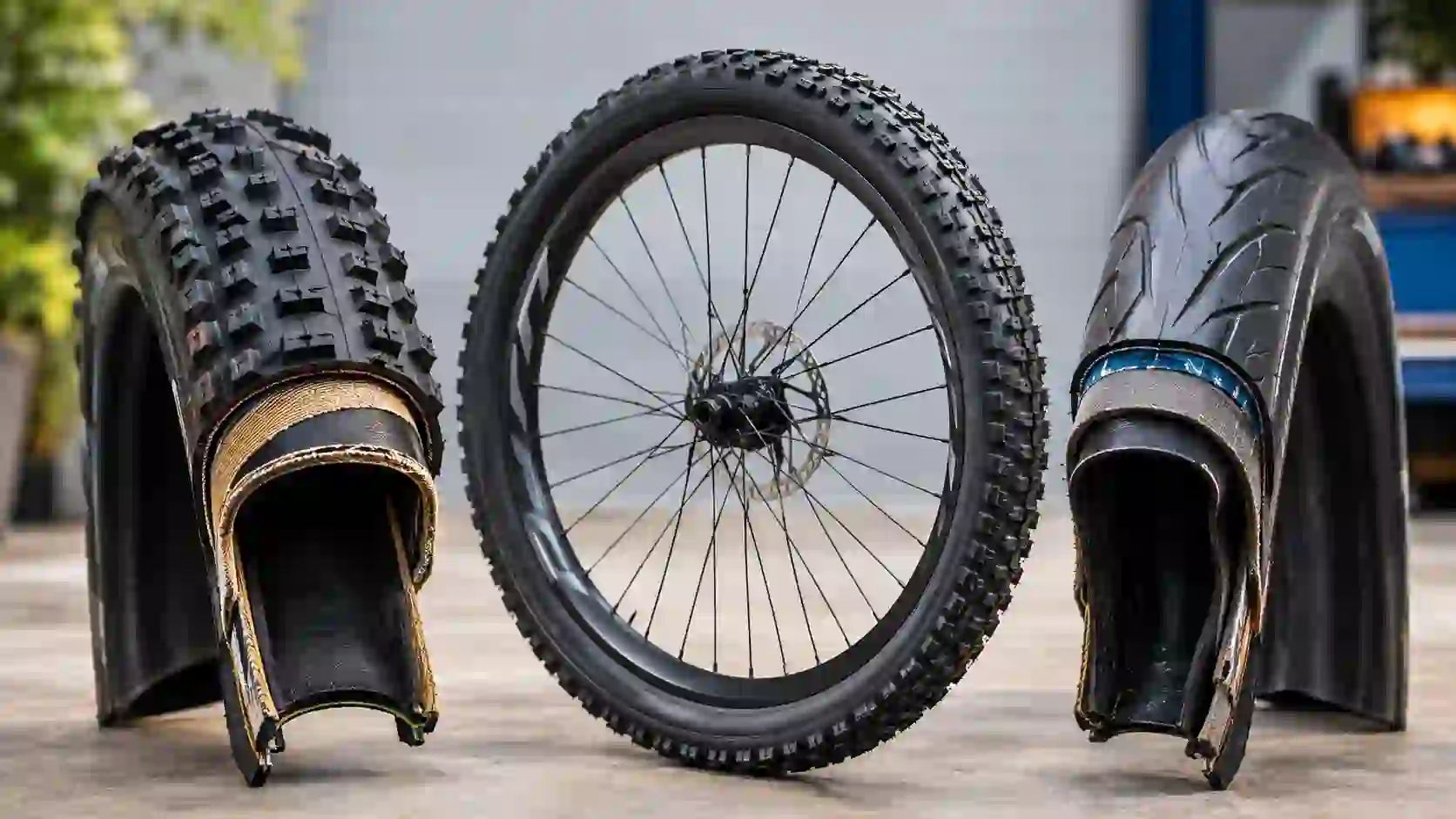
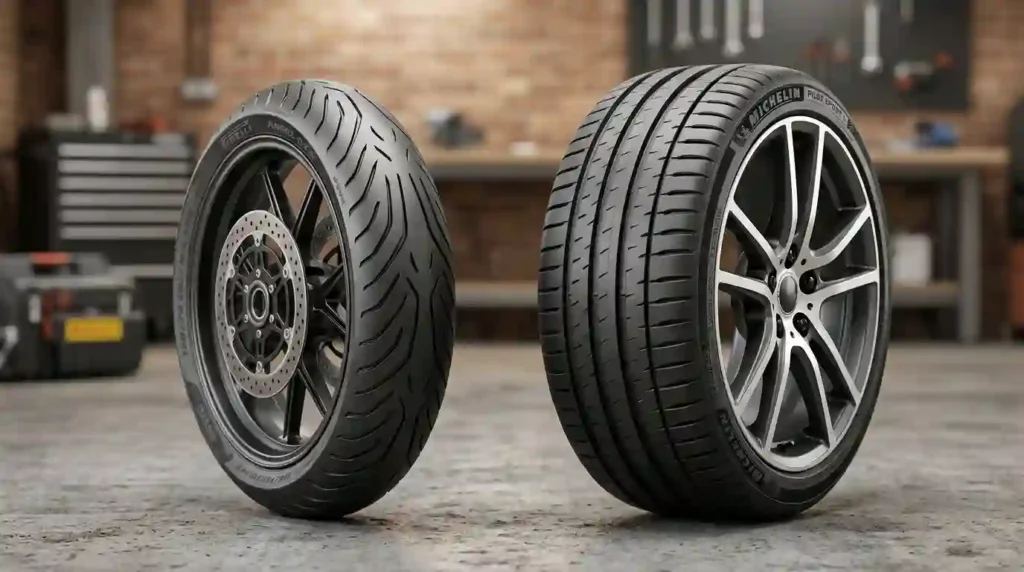
At first glance, bicycle tires and car tires seem like close relatives. Both rely on vulcanized rubber, air pressure, structured tread patterns, and reinforced casings to keep you moving. However, their underlying engineering serves completely different vehicles, loading forces, and dynamic operating conditions.
A bicycle tire is designed for a lightweight vehicle where rider-controlled leaning dictates steering, while a car tire supports thousands of pounds across four flat contact patches subjected to extreme cornering and braking forces. Choosing the right tire and understanding its design directly impacts your safety, cornering grip, rolling speed, and overall comfort.
BIKE VS CAR TIRE DESIGN
┌─────────────────────────────────────────────────────────────┐
│ BICYCLE TIRE: Round Profile │ CAR TIRE: Flat Profile │
│ – Leans into turns │ – Stays flat on pavement │
│ – High PSI / Low Air Volume │ – Moderate PSI / High Volume │
│ – 160–300 lbs Total Load │ – 3,000–6,000 lbs Total Load │
│ – Light, Supple Casing │ – Heavy Steel Belts & Layers │
└─────────────────────────────────────────────────────────────┘
The core differences come down to physical size, air pressure dynamics, casing construction, tread behavior, contact patch shape, total load capacity, and handling characteristics. Understanding these structural variations helps you optimize your bike’s tire pressure (PSI), select the ideal tread, and improve your daily ride quality.
Featured Snippet Summary:
Bike tires differ from car tires mainly in size, construction, pressure, tread design, and load capacity. Bicycle tires are lighter and narrower, use flexible high-TPI fabric casings, and operate at higher pressures relative to their small air volume. Car tires are heavier and wider, using thick steel-belted radial casings built to support massive vehicle loads and lateral cornering forces.
Bike Tires vs. Car Tires at a Glance
Comparing these two tire categories side-by-side highlights how radically their construction varies based on total weight and mechanical demands.
| Feature | Bike Tires | Car Tires |
| Typical Width | Narrow to wide (25 mm–2.5 in / 1.0–2.5 in) | Much wider overall (185 mm–325 mm / 7.2–12.8 in) |
| Construction | Lightweight, flexible fabric casing (Nylon/Cotton) | Heavy-duty steel-belted radial casing |
| Operating Pressure | High PSI relative to volume (20–100+ PSI) | Lower PSI relative to large volume (30–35 PSI average) |
| Total System Load | Rider + bike + cargo (approx. 150–300 lbs) | Vehicle + passengers + cargo (3,000–6,000+ lbs) |
| Contact Patch | Small, rounded elliptical footprint | Much larger, flat rectangular footprint |
| Tread Profile | Curved round profile for active leaning | Flat square profile for planted vehicle stability |
| Rim Interface | Bicycle-specific (Hooked or Hookless bead) | Automotive-specific heavy metal rim flanges |
| Rolling Resistance | Critical metric directly impacting rider energy output | Important metric, but balanced with vehicle load & engine power |
| Puncture Protection | Woven fabric belts (Aramid/Kevlar) & liquid sealant | Thick rubber undertread, steel belts & reinforced plies |
Air Pressure Warning: Inflation pressure (PSI) must never be compared without considering tire casing volume and total wheel load.- Engineering Purpose: Both tire categories are engineered around completely different real-world operating conditions and safety standards.
What Is the Main Difference Between Bike and Car Tires?
Bike tires prioritize low weight, minimal rolling efficiency losses, responsive handling, and rider feedback. Every extra gram on a bicycle wheel increases rotational mass, requiring direct physical effort from the cyclist to accelerate.
DYNAMIC CORNERING FORCES
BICYCLE: Leans into turn CAR: Stays flat, resists roll
(Vector forces align) (High lateral shearing)
/ │
/ ┌───┴───┐
/ │ CAR │
/ └───┬───┘
/ │
(Round Tire) (Flat Tire)
Car tires prioritize extreme load capacity, multi-directional stability, aggressive braking traction, heat dissipation, and long tread life under heavy loads. Because an automobile engine supplies driving power, automotive tire design can utilize heavy steel reinforcement belts that would make a bicycle virtually unrideable.
Bicycle tire construction can be much more flexible because the tire supports a far smaller overall load. A flexible bike tire casing allows the rubber to deform smoothly over pavement cracks, rocks, and trail debris.
Why Bike Tires Are So Much Narrower
A narrow bicycle tire minimizes aerodynamic drag and dramatically reduces overall rotational weight. This creates the agile, responsive steering feel that cyclists rely on when negotiating sharp corners or climbing steep hills.
BICYCLE TIRE WIDTH SPECTRUM
┌─────────────────────────────────────────────────────────────┐
│ Road: 25–32 mm ─▶ Minimum weight & aerodynamic drag │
│ Gravel: 38–45 mm ─▶ Mixed-surface comfort & air volume │
│ MTB: 2.2–2.6 in ─▶ Maximum trail grip & impact absorption│
└─────────────────────────────────────────────────────────────┘
Modern road, gravel, and mountain bike (MTB) tires vary widely in width because different terrain types require specific levels of air volume and ground traction. A road bike on smooth asphalt thrives on a narrow 28 mm tire, whereas a trail bike tackling rocky terrain in the Pacific Northwest requires a wide 2.4-inch casing for traction and pinch-flat protection.
Practical tire size selection is always governed by internal rim width and frame/fork clearance. Mounting a tire that is too wide for your frame can cause dangerous tire rub, damaging both the frame and the tire sidewall.
Why Car Tires Are Much Heavier
Car tires must support light trucks and passenger vehicles weighing between 3,000 and 6,000+ pounds across diverse road surfaces. A passenger tire must maintain structural integrity while experiencing high acceleration, heavy emergency braking, lateral cornering forces, and extreme heat build-up at highway speeds.
To withstand these forces, car tires incorporate internal layers of woven steel belts, thick rubber sidewalls, and reinforced radial ply casings. These heavy structural layers add significant mass, but they prevent casing distortion under massive automotive loads.
Bike Tire vs. Car Tire Pressure: What Is the Difference?
Bicycle tires frequently display much higher pressure numbers stamped on their sidewalls than automotive tires. High-pressure road bike tires are inflated between 65 and 90 PSI, whereas a typical passenger car tire runs between 30 and 35 PSI.
PRESSURE VS AIR VOLUME
┌─────────────────────────────────────────────────────────────┐
│ BIKE TIRE: High PSI / Small Volume │
│ 70 PSI × Small Surface Area = Light Support Force │
├─────────────────────────────────────────────────────────────┤
│ CAR TIRE: Lower PSI / Large Volume │
│ 32 PSI × Huge Surface Area = Massive Support Force │
└─────────────────────────────────────────────────────────────┘
This difference does not mean a bicycle tire holds more total structural force than a car tire. Pressure must always be evaluated in conjunction with total internal air volume and the surface area of the tire’s contact patch.
Proper tire pressure depends on tire width, rider and system weight, rim width, casing construction, surface terrain, and whether you run an inner tube or a tubeless setup.
Why Bike Tires Can Use High PSI
Narrow bicycle tires contain a small internal air volume and produce a small ground contact patch. To support a rider’s weight without collapsing down to the wheel rim, narrow tires require higher inflation pressure per square inch.
Higher pressure prevents the tire casing from buckling under load, reducing the risk of bottoming out the rim against pavement edges. However, modern wider bicycle tires carry significantly more air volume, enabling cyclists to run lower pressures safely while improving rider comfort and cornering traction.
Why Car Tires Use Lower PSI
Car tires contain a massive internal air volume spreading across a wide structural footprint. Because the internal surface area of an automotive tire is vast, a lower pressure of 32 PSI exerts thousands of pounds of total upward force across the tire casing, easily supporting a multi-ton vehicle.
Automotive tire pressure recommendations are carefully calculated based on axle weight distribution, vehicle handling dynamics, tire heat buildup at high speeds, and manufacturer chassis tuning.
PAA Target: Why do bike tires have higher PSI than car tires?
Bike tires use higher PSI than car tires because they have a much smaller internal air volume and contact area. Higher pressure per square inch is required to support the weight of the rider and bike without the narrow tire collapsing or bottoming out against the wheel rim.
Can You Use Car Tire PSI Rules for a Bike?
No. Never attempt to apply automotive inflation standards or automotive thumb-rules to a bicycle tire. Setting a bike tire to a standard automotive 32 PSI could cause a narrow road tire to bottom out instantly on the rim, causing a pinch flat or rim damage. Conversely, inflating a wide mountain bike tire to 60 PSI can cause poor traction, harsh handling, or an explosive bead failure.
Bicycle tire pressure must always be calculated using the tire’s rated specifications, internal rim dimensions, and the combined weight of the bike, rider, and cargo.
OPTIMIZING BIKE TIRE PRESSURE
┌─────────────────────────────────────────────────────────────┐
│ 1. Check Sidewall Range ─▶ Find MIN/MAX pressure guidelines │
│ 2. Weigh Total System ─▶ Combine Rider + Bike + Gear │
│ 3. Factor Tire Width ─▶ Wider tires require lower PSI │
│ 4. Evaluate Terrain ─▶ Lower PSI for rough/wet surfaces │
│ 5. Test & Adjust ─▶ Fine-tune by 2–3 PSI increments │
└─────────────────────────────────────────────────────────────┘
Basic Bike PSI Setup
- Check Specifications: Locate the minimum and maximum pressure ratings embossed on your tire’s sidewall.
- Calculate System Weight: Factor in your body weight, the bike’s weight, and any loaded cargo or water bottles.
- Account for Rim & Tire Width: Wider rim channels expand internal tire volume, allowing for a lower operating PSI.
- Start Within the Target Window: Set your pressure within the recommended operating range.
- Fine-Tune for Terrain: Lower your pressure slightly (2–4 PSI) for rough gravel or wet trail conditions to increase rubber contact and cornering grip.
How Bike and Car Tire Construction Differs
Bicycle tires rely on light, ultra-flexible fabric casings to absorb surface road chatter and maximize rolling speed. Car tires utilize multi-layered steel-belted radial construction designed to maintain dimensional stability under extreme vehicle loads and high cornering speeds.
CROSS-SECTION ANATOMY
BIKE TIRE CASING CAR TIRE CASING
┌────────────────────┐ ┌────────────────────┐
│ Outer Tread Rubber │ │ Outer Tread Rubber │
│ Aramid Protection │ │ Steel Belt Layer 1 │
│ Woven Nylon Casing │ │ Steel Belt Layer 2 │
│ Inner Tube / Air │ │ Radial Polyester │
│ Folding Kevlar Bead│ │ Heavy Steel Bead │
└────────────────────┘ └────────────────────┘
While both designs utilize protective belts, reinforced sidewalls, and engineered rubber compounds, their construction methodologies target different performance objectives.
What Is Casing TPI on a Bike Tire?
On a bicycle tire, TPI stands for Threads Per Inch. It measures the thread density of the woven nylon, cotton, or aramid casing fabric supporting the rubber.
LOW TPI (30–60 TPI) HIGH TPI (120–320 TPI)
┌───────────────────┐ ┌───────────────────────┐
│ Thick nylon threads│ │ Ultra-fine threads │
│ Heavy rubber coat │ │ Thin rubber coat │
│ Durable & stiff │ │ Supple & fast-rolling │
└───────────────────┘ └───────────────────────┘
- High TPI (120–320 TPI): Uses fine, lightweight threads packed closely together. This creates a thin, supple casing that flexes effortlessly over pavement bumps, improving comfort, grip, and speed.
- Low TPI (30–60 TPI): Uses thicker nylon threads coated in heavier rubber. This yields a stiffer, heavier casing that offers cut resistance for commuting and e-bike applications.
Car tires utilize complex structural radial plies, polyester cords, and steel belt networks that are not measured using standard bicycle TPI ratings.
Why Bicycle Casings Are Flexible
A flexible tire casing allows the rubber tread cap to conform over micro-imperfections in the road or trail surface. This reduces the energy lost to vibration, helping the bike roll faster while keeping the rubber planted during hard cornering.
The primary trade-off of a lightweight, supple casing is reduced cut and tear resistance. For this reason, gravel and mountain bike tires often incorporate woven protection belts into the sidewalls to guard against sharp rocks.
Bike Tire vs. Car Tire Tread Patterns
Tread patterns govern how a tire interacts with asphalt, gravel, loose dirt, wet rocks, and mud. Bicycle tread patterns range from completely smooth road slicks to aggressive mountain bike knobs. Car tire tread designs are engineered to maintain vehicle tracking, eject standing water, handle snow, and limit cabin road noise.
BICYCLE TREAD CATEGORIES
┌─────────────────────────────────────────────────────────────┐
│ Road Slick: Smooth rubber for maximum asphalt contact │
│ Semi-Slick: Smooth center ridge + raised cornering knobs │
│ Knobby MTB: Tall, widely-spaced knobs for mud & loose dirt │
└─────────────────────────────────────────────────────────────┘
Road Bike Tire Tread
Many performance road bike tires feature completely smooth (slick) center tread caps. Because bicycle tires feature a narrow, rounded profile, they cut through thin water films on asphalt without hydroplaning. On paved surfaces, rubber compound friction matters far more than deep tread grooves.
Gravel Tire Tread
Gravel tires bridge the gap between paved speed and off-road traction. They typically feature a tightly packed center tread for fast rolling on hard surfaces, paired with raised shoulder knobs that bite into loose dirt when the bike is leaned into a turn.
Mountain Bike Tire Tread
Mountain bike tires utilize tall, widely spaced rubber knobs designed to penetrate loose soil, mud, and loam. Open spacing between the knobs allows the tire to clear packed mud as the wheel rotates. Prominent side knobs provide cornering control when riding technical singletrack.
Car Tire Tread
Automotive tread patterns are flat, wide, and heavily channeled to pump large volumes of water out from under the wide tire footprint to prevent hydroplaning. Car tires feature continuous tread blocks, lateral grooves, and small sipes to maximize braking stability, wet-weather safety, and long-distance treadwear.
Rubber Compounds: Bike Tires vs. Car Tires
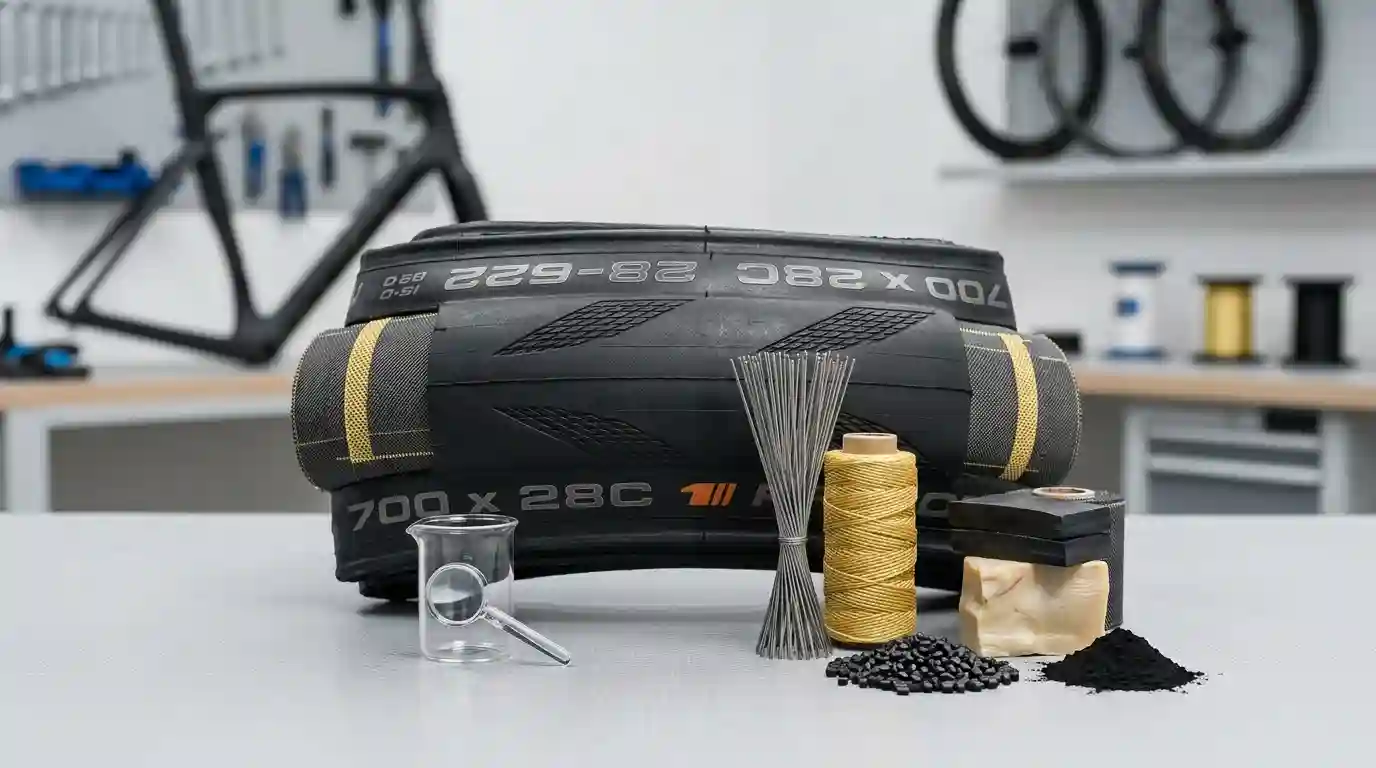
Rubber compounds balance traction, rolling speed, and wear life. Both bike and car tires blend natural and synthetic rubbers with silica, carbon black, and plasticizers to achieve specific performance goals.
DUROMETER HARDNESS SCALE
┌─────────────────────────────────────────────────────────────┐
│ Soft Rubber (42a–50a): High traction, faster tread wear │
│ Hard Rubber (60a–70a): Low rolling resistance, high mileage │
└─────────────────────────────────────────────────────────────┘
Soft Rubber vs. Hard Rubber
Rubber hardness is rated on a Shore A Durometer scale:
- Soft Compounds (42a–50a): Deliver excellent grip on wet rocks, roots, and pavement, but wear down quickly under heavy braking.
- Hard Compounds (60a–70a): Resist wear and lower rolling resistance, making them ideal for long-distance commuting.
- Multi-Compound Tires: Performance bike tires frequently feature a hard rubber center strip for fast rolling and long tread life, paired with soft rubber shoulder tread for cornering grip.
Car tires must manage higher operating temperatures, heavy vehicle weights, and sustained highway speeds, requiring specialized rubber chemistry built for heat resistance and extended mileage.
Why Bike Tires Have Different Rolling Resistance
Rolling resistance is the mechanical energy lost as a tire continuously flexes and deforms while rolling over a surface. Because human legs produce far less power than an automobile engine, minimizing rolling resistance is a top priority for cyclists.
FACTORS INFLUENCING ROLLING RESISTANCE
┌─────────────────────────────────────────────────────────────┐
│ Casing Suppleness (High TPI = Faster, lower resistance) │
│ Air Pressure Optimization (Prevents vibration energy loss) │
│ Rubber Compound Formulation (Silica blends roll faster) │
│ Tire Casing Thickness (Thinner casings flex easier) │
└─────────────────────────────────────────────────────────────┘
Bicycle Rolling Resistance
Bicycle tire rolling resistance is heavily influenced by casing flex. Stiff casings waste rider energy as internal heat when bending. Supple casings conform smoothly over bumps, preserving forward momentum.
Running excessively high air pressure on rough pavement actually increases rolling resistance by causing the bike to bounce over micro-imperfections (impedance losses), transferring vibration into the rider rather than driving the bike forward.
Car Tire Rolling Resistance
Automotive rolling resistance directly impacts fuel economy and electric vehicle (EV) battery range. However, automotive tire designers must balance rolling efficiency against vehicle load requirements, emergency braking distance, wet weather safety, and structural durability.
Bike Tire vs. Car Tire Contact Patch
The contact patch (or tire footprint) is the area where the tire rubber physically meets the road surface.
CONTACT PATCH PROFILE COMPARISON
┌─────────────────────────────────────────────────────────────┐
│ BIKE TIRE FOOTPRINT │ CAR TIRE FOOTPRINT │
│ Narrow & Oval │ Wide & Rectangular │
│ (Changes shape as bike leans)│ (Stays flat against road) │
│ ( ) │ [──────────] │
└─────────────────────────────────────────────────────────────┘
A bicycle tire produces a small, narrow, oval-shaped contact patch due to its curved, rounded tire casing. A car tire creates a much larger, flat, rectangular contact patch designed to stay planted flat against the pavement.
Does a Wider Bike Tire Have More Grip?
A wider bicycle tire allows a rider to run lower inflation pressure safely, creating a wider, shorter contact patch that conforms better to rough ground. While a wider tire increases casing volume and improves rough-surface traction, actual cornering grip also depends on rubber compound quality, tread design, and terrain conditions.
Puncture Protection: Bike Tires vs. Car Tires
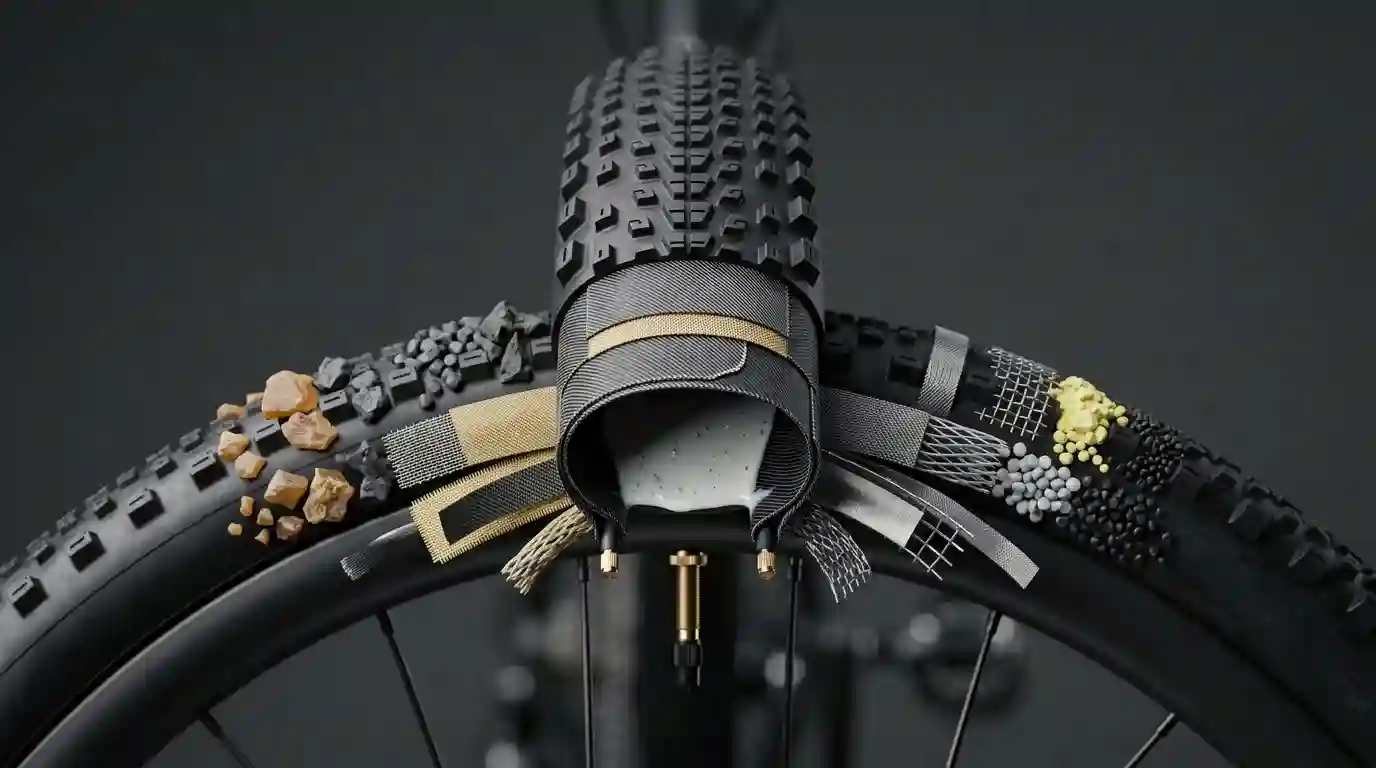
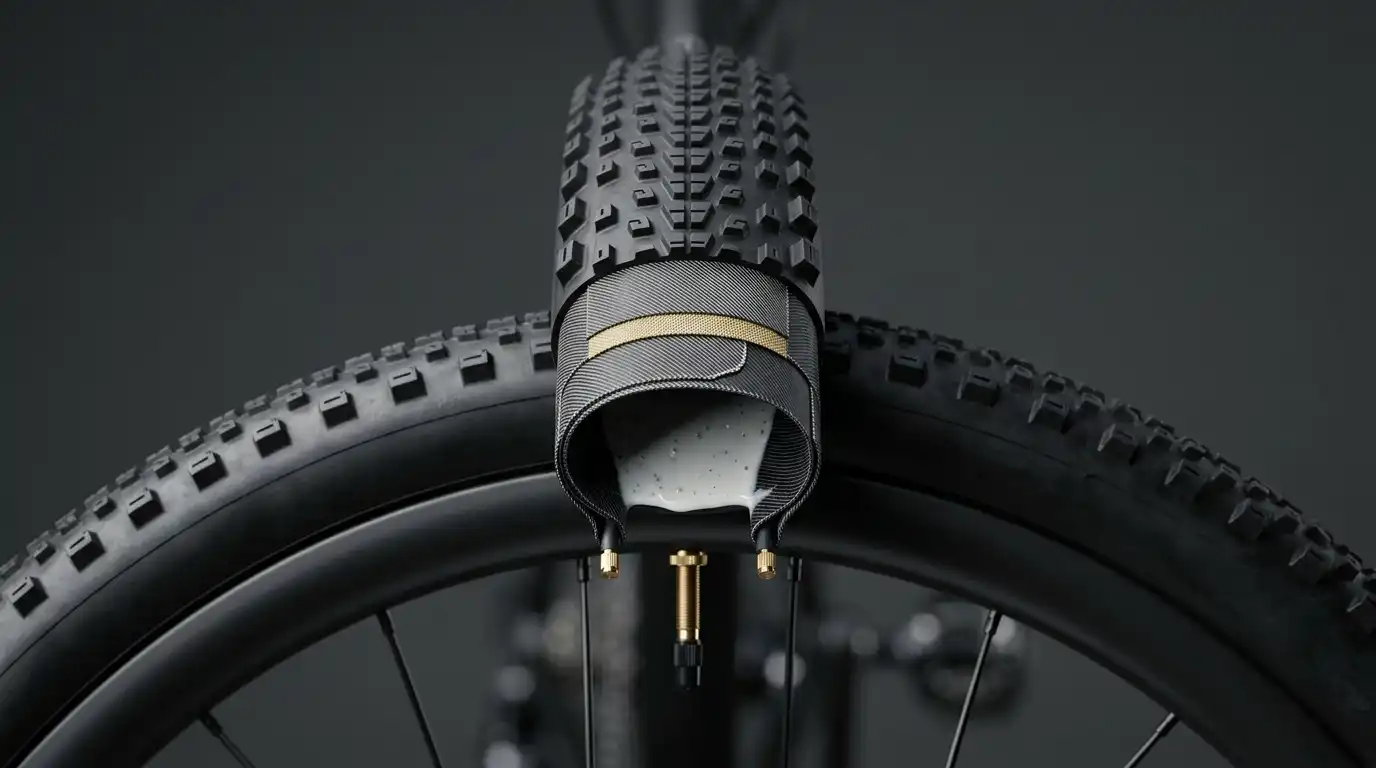
Bicycle tires rely on lightweight internal woven belts, reinforced sidewall grids, and liquid sealant to prevent flat tires. Car tires rely on heavy steel belts, thick undertread rubber, and reinforced radial plies to resist punctures.
BICYCLE PUNCTURE PROTECTION TECH
┌─────────────────────────────────────────────────────────────┐
│ Woven Aramid/Kevlar Breaker Belts (Under the center tread) │
│ Woven Sidewall Mesh (e.g., Maxxis EXO, Continental Protection)│
│ Tubeless Liquid Sealant (Seals thorns/cuts automatically) │
└─────────────────────────────────────────────────────────────┘
How Bicycle Puncture Protection Works
Cycling tire manufacturers integrate high-density woven breaker sheets (such as Kevlar or Aramid) directly beneath the outer rubber tread cap. These flexible sheets catch sharp glass, wire, and thorns before they can pierce the inner tube or casing.
Heavy-duty commuter tires also embed thick elastic sub-tread rubber layers (up to 5 mm thick) to physically block debris from reaching the inner chamber.
How Car Tire Puncture Protection Works
Car tires feature internal networks of high-tensile steel belts beneath the tread area, combined with thick rubber construction. Certain performance vehicles utilize “run-flat” tire designs with heavily reinforced sidewalls that can support vehicle weight for short distances even after a complete loss of air pressure.
Tubeless Bike Tires vs. Car Tires
Tubeless technology eliminates the traditional inner tube entirely, replacing it with an airtight seal formed directly between the tire bead and the wheel rim bed.
TUBELESS BICYCLE SYSTEM ANATOMY
┌─────────────────────────────────────────────────────────────┐
│ [ Airtight Rim Tape ] ─▶ Seals spoke holes in rim channel │
│ [ Tubeless Valve ] ─▶ Fits tightly into rim bed │
│ [ TLR Tire Bead ] ─▶ Locks into rim hooks under air │
│ [ Liquid Sealant ] ─▶ Coats inside, seals active leaks │
└─────────────────────────────────────────────────────────────┘
While virtually all modern passenger car tires operate without inner tubes, bicycle tubeless systems operate differently by incorporating liquid sealant.
How Bicycle Tubeless Systems Work
- Apply Rim Tape: Wrap specialized tubeless tape across the internal rim channel to seal all spoke holes.
- Install Tubeless Valve: Insert a tubeless valve stem through the rim valve hole and lock it down securely.
- Mount Tubeless Tire: Push the tire beads over the rim edge using a compatible tubeless-ready (TLR) tire and rim combination.
- Add Liquid Sealant: Inject liquid sealant (typically 2–4 oz depending on tire width) directly into the tire casing.
- Seat the Bead: Use a rapid blast of air from a floor pump or air compressor to seat the tire beads securely against the rim shelf.
Why Tubeless Sealant Is Different From a Car Tire
Automotive tires utilize thick, rigid rubber beads that lock airtight against heavy steel or alloy car wheels without requiring liquid sealant.
Bicycle tubeless systems rely on liquid latex sealant floating inside the lightweight, flexible tire casing. When a thorn or sharp debris pierces the tire tread, the escaping air forces liquid sealant into the hole, where suspended fibers clot rapidly to seal the puncture without stopping the ride.
Rim Compatibility: Bike Wheels vs. Car Wheels
Bicycle tires and rims must match precise ISO/ETRTO bead-seat diameters and internal rim width specifications to ensure safe operation.
ISO / ETRTO MATCHING GUIDE
┌─────────────────────────────────────────────────────────────┐
│ Tire Label Example: 28-622 (700x28c) │
│ – 28 mm = Inflated Casing Width │
│ – 622 mm = Exact Rim Bead-Seat Diameter (BSD) │
└─────────────────────────────────────────────────────────────┘
Automotive wheel standards use different bolt patterns, wheel offsets, bead profiles, and structural load ratings that are incompatible with bicycle equipment.
Why Rim Width Matters on a Bike
Internal rim width alters the overall shape and volume profile of an inflated bicycle tire. Mounting a wide 2.4-inch mountain bike tire on a very narrow rim can cause the tire to squirm and fold over during hard cornering.
Always consult your wheel manufacturer’s recommended tire width compatibility chart before installing new rubber.
Can You Put a Car Tire on a Bike Rim?
No. Bicycle rims and automotive wheels utilize different dimensions, bead profiles, and mechanical retention systems. Automotive tires cannot be safely seated onto bicycle rims under any circumstances.
Bike Tire vs. Car Tire Durability
Car tires are engineered to deliver tens of thousands of miles under multi-ton vehicle loads. Bicycle tire durability varies depending on whether the tire is designed for racing, daily commuting, or technical off-road riding.
AVERAGE SERVICE LIFE
┌─────────────────────────────────────────────────────────────┐
│ Race Bike Tires: 1,000 – 2,500 miles │
│ Commuter Bike Tires: 3,000 – 6,000 miles │
│ Passenger Car Tires: 40,000 – 70,000 miles │
└─────────────────────────────────────────────────────────────┘
Signs a Bike Tire Needs Replacing
- Worn Center Tread: The center of the tread cap is worn down flat, creating a squared-off profile.
- Visible Casing Threads: The outer rubber layer has worn through, exposing the underlying fabric casing threads.
- Sidewall Cuts & Cracks: Sharp rocks have cut into the sidewall, or age-related dry rot cracking has appeared.
- Frequent Punctures: The internal puncture belt has degraded, resulting in repeated flat tires from minor debris.
Signs a Car Tire Needs Replacing
- Low Tread Depth: Tread depth has worn down to the internal tread wear indicator bars (or below 2/32 of an inch).
- Sidewall Bulges: Internal structural cords have failed, causing a noticeable bulge in the sidewall rubber.
- Uneven Wear: Improper wheel alignment or suspension wear has worn down one edge of the tire prematurely.
Bike Tires vs. Car Tires for Different Riding Conditions
Matching tire choice to specific riding conditions ensures safety, efficiency, and performance.
CYCLING DISCIPLINE FOCUS
┌─────────────────────────────────────────────────────────────┐
│ Road: Slick tread, low weight, high suppleness │
│ Gravel: Semi-slick, tubeless-ready, puncture protection │
│ MTB: Aggressive knobs, reinforced sidewall casing │
│ E-Bike: E-50 certified, heavy-duty casing, hard rubber │
│ Commute: Thick puncture belt, long mileage, reflective │
└─────────────────────────────────────────────────────────────┘
Road Cycling
Prioritizes rolling efficiency, lightweight construction, and wet-pavement grip. Smooth slicks in widths from 28 mm to 32 mm inflated to optimal pressures balance speed with vibration damping.
Gravel Cycling
Demands extra air volume (38 mm to 45 mm), tubeless capabilities, and puncture belts to handle sharp crushed stone and dirt roads without pinch-flatting.
Mountain Biking
Requires wide casings (2.3 to 2.6 inches), aggressive tread knobs for cornering support, soft rubber compounds for traction over wet roots, and reinforced sidewall armoring.
E-Bikes
Electric bicycles subject tires to continuous motor torque and higher total vehicle weights. Look for tires stamped with an E-25 or E-50 / ECE-R75 rating, indicating certification for high-torque electric bike usage.
Daily Commuting
Prioritizes long service life, cut resistance, and thick protective belts. Supple weight is traded for durability and reliable daily operation.
Why You Should Never Use a Car Tire on a Bicycle
Automotive tires are built for completely different loads, rim profiles, bead dimensions, and mechanical operating conditions. Attempting to modify or force an automotive tire onto a bicycle wheel is dangerous and physically incompatible.
Bicycle tires must always be selected according to wheel diameter, internal rim width, frame clearance, inflation limits, and your intended riding discipline.
Featured Snippet Target: Can you use a car tire on a bike?
No. Car tires cannot be used on a bicycle. Automotive tires are engineered for heavy automotive wheels, specific bead seating standards, and vehicle load ratings. They are physically incompatible with bicycle wheels and frame clearances.
How to Choose the Right Bike Tire
Follow this step-by-step selection workflow when buying a replacement tire:
TIRE SELECTION WORKFLOW
┌─────────────────────────────────────────────────────────────┐
│ Step 1: Identify ISO Wheel Size (e.g., 622 mm / 700c) │
│ Step 2: Measure Frame Clearance & Rim Width │
│ Step 3: Match Tread Pattern to Terrain (Road vs Dirt) │
│ Step 4: Choose Casing Tech (TPI, Tubeless, Puncture Belts) │
│ Step 5: Calculate & Set Target PSI Based on System Weight │
└─────────────────────────────────────────────────────────────┘
Step 1 — Identify Your Wheel Size
Locate the primary size printed on your current tire sidewall. Always refer to the ISO/ETRTO standard millimeter rating (such as 28-622 or 58-622) to ensure an exact bead-seat diameter match with your wheel rim.
Step 2 — Choose the Tire Width
Measure your frame, fork, and brake caliper clearances. Ensure you maintain at least 4 to 6 mm of open space between the inflated tire and your frame to prevent rubbing when the frame flexes.
Step 3 — Select the Tread
Choose smooth tread caps for paved road riding, micro-knobs or semi-slicks for mixed gravel paths, and aggressive block knobs for off-road trails.
Step 4 — Compare Construction Features
Balance weight against durability. High-TPI supple casings roll faster and feel smoother, whereas lower-TPI casings with heavy puncture belts offer increased durability for commuting.
Step 5 — Set the Correct PSI
Start with the manufacturer’s suggested baseline range, factor in your combined system weight and internal rim width, and adjust by 2–3 PSI to strike your ideal balance between comfort, speed, and cornering grip.
Common Misconceptions About Bike and Car Tires
- “Higher PSI is always faster.” — False. Over-inflating a bike tire on real-world roads causes the casing to bounce over small bumps, wasting forward energy through vibration.
- “Wider bike tires always roll slower.” — False. At equal pressures, a wider tire has a shorter, wider contact patch that experiences less casing deformation, often rolling faster than a narrow tire on rough surfaces.
- “Deeper tread always yields more grip.” — False. Smooth slick rubber offers superior traction on dry, clean pavement by maximizing rubber-to-road contact.
- “All tubeless tires work on all rims.” — False. Tubeless tires require compatible tubeless-ready (TLR) rim channels and proper sealing components.
- “Higher TPI always means a better tire.” — False. While high TPI casings offer a smooth, supple ride, lower TPI tires are more cut-resistant for commuting or rugged trail use.
How Tire Testing Differs Between Bicycles and Cars
Tire testing evaluates performance under controlled laboratory and field conditions.
TESTING METHODOLOGIES
┌─────────────────────────────────────────────────────────────┐
│ BICYCLE TESTING │ AUTOMOTIVE TESTING │
│ – Rotational drum wattage │ – High-speed dynamic load │
│ – Steel pin puncture force │ – Hydroplaning speed thresholds│
│ – Casing weight in grams │ – Thermal breakdown & wear │
│ – Cornering coefficient │ – Braking distances in wet/dry│
└─────────────────────────────────────────────────────────────┘
What Makes a Bicycle Tire Test Useful?
High-quality bicycle tire tests isolate rolling resistance measured in Watts on steel drums, casing suppleness under load, needle-penetration puncture resistance, and actual weight in grams. Combining lab drum data with field testing across varied terrain delivers an accurate picture of real-world speed and handling.
Frequently Asked Questions
What is the main difference between bike tires and car tires?
Bike tires are lightweight, narrow, and feature curved profiles designed to lean into corners. Car tires are heavy, wide, flat-profile structures built with steel belts to support vehicle loads and heavy lateral forces.
Why do bike tires have higher PSI than car tires?
Bicycle tires have a small internal air volume and footprint. Higher pressure per square inch is necessary to support the rider’s weight and prevent the casing from collapsing onto the wheel rim.
Can I use car tire pressure settings on a bicycle?
No. Bicycle tires must be inflated according to their specific volume, casing ratings, and total rider system weight. Never apply automotive pressure standards to a bicycle.
Are bike tires more likely to get punctures than car tires?
Bicycle tires use lighter, thinner casings that are more vulnerable to sharp debris like glass and thorns. However, modern woven puncture belts and tubeless liquid sealants significantly reduce flat risks.
Are wider bike tires better?
Wider tires allow you to run lower inflation pressures, improving rider comfort, bump absorption, and traction on rough ground. The optimal width depends on your bike frame clearance, rim dimensions, and surface conditions.
Are tubeless bike tires better than tires with inner tubes?
Tubeless systems eliminate pinch flats, lower rolling resistance, and allow for lower pressures that improve grip. They also seal small punctures automatically, though they require tubeless-compatible rims and periodic sealant refreshes.
How often should bike tires be replaced?
Replace bicycle tires when the center tread wears flat, internal casing cords become visible, rubber dry rot cracking appears, or you experience frequent punctures. Service life ranges from 1,000 miles for race tires to over 4,000 miles for commuter tires.
Can I put a wider tire on my current bike?
You can install a wider tire if your current wheel rim’s internal width safely supports it and your bicycle frame, fork, and brakes maintain at least 4 to 6 mm of tire clearance.
Final Verdict: Bike Tires and Car Tires Are Built for Different Jobs
Bicycle tires and car tires share fundamental raw materials, but their underlying engineering serves completely different physical demands. Bicycle tires prioritize low weight, casing suppleness, responsive handling, and low rolling resistance under light system loads. Car tires prioritize high load capacity, dimensional stability, braking power, heat management, and high-mileage durability.
For cyclists, optimizing tire performance comes down to choosing the correct size for your wheel, verifying frame clearance, selecting an appropriate tread pattern, and setting your pressure based on total system weight.
Ready to Find Your Perfect Tire Setup?
Stop guessing your tire pressure! Use our Free Bike Tire Pressure Calculator & Tire Finder Tool at TheBikeTires.com to calculate your custom target PSI based on your exact body weight, bike type, tire width, and surface terrain.

Mohidul Islam is a leading cycling technology specialist and bike tire consultant with over 15 years of hands-on experience in the bicycle industry. He holds a Bachelor of Science in Mechanical Engineering from Penn State University, where he focused heavily on material science, tread mechanics, and rubber compound performance. Over the past decade and a half, Alex has conducted extensive field testing, tubeless setup evaluations, and tire pressure modeling for road, mountain, and e-bikes. His practical insights and data-driven approach help cyclists of all levels optimize grip, speed, and durability on every ride.