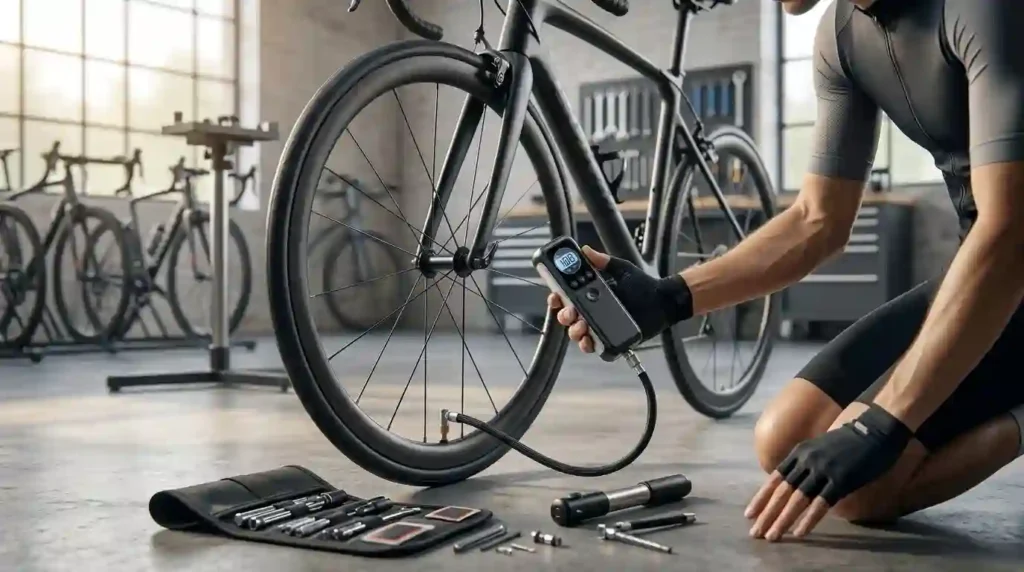
Flats, vague cornering grip, a buzzy ride, and tires that wear out early often share one cause. The pressure was off. A good bike tyre pressure gauge for road cycling turns a guess into a number you can repeat.
What is a bike tire pressure gauge? A bike tire pressure gauge measures the air pressure inside a bicycle tire in PSI or bar. Road cyclists use it to set consistent pressure, improve handling, and avoid underinflation or overinflation.
Pressure changes how a tire behaves in four big ways:
- Rolling resistance: The tire flexes and loses energy at the wrong pressure.
- Comfort: Too much air turns every crack in the road into a jolt.
- Cornering grip: The tire shape and contact patch shift with PSI.
- Puncture risk: Low pressure invites pinch flats, and high pressure makes the tire skip over debris.
Squeezing a tire tells you very little. A road tire at 40 PSI can feel almost as hard as one at 80 PSI. That is why thumb tests fail, especially on high-pressure tires.
This guide covers the main options: digital gauges, analog gauges, and pump-mounted gauges. You will also learn how to set the right PSI. For a wider view, read our guide on how to find the correct bike tire pressure.
What Is the Best Bike Tyre Pressure Gauge for Road Cycling?
The best gauge covers your normal pressure range and offers suitable accuracy. Look for a secure valve connection, an easy-to-read display, and compatibility with Presta valves.
Pick a compact standalone gauge for portability. Pick a pump-mounted gauge for regular home use. Many riders own one of each, and use the standalone gauge to double-check the pump.
Your tire sidewall also helps. Learn to read it with our guide on what the numbers on bike tyres mean.
Quick Comparison of Road Bike Pressure Gauges
| Gauge type | Best for | Main advantage | Main drawback |
|---|---|---|---|
| Digital gauge | Precise pressure checks | Clear numerical display | Needs a battery |
| Analog gauge | Simple home maintenance | No battery required | May be harder to read |
| Pump-mounted gauge | Routine inflation | Measures pressure while pumping | Accuracy varies by model |
| Standalone gauge | Checking pressure on rides | Compact and portable | May require a separate pump |
| Tubeless-compatible gauge | Tubeless road setups | Useful for low-pressure checks | Must suit the required PSI range |
How to Pick the Right Gauge for Your Riding
Start with where you check pressure most often. If you mostly ride from your garage, a pump-mounted or analog gauge may be enough. If you ride long distances or race, a small digital gauge in your saddle bag is worth the weight.
Then match the gauge range to your tires. A gauge that tops out at 60 PSI cannot serve a road bike. A gauge built for 250 PSI may be too coarse for a 28 mm tire at 65 PSI.
Finally, think about your other bikes. If you also own gravel tires or an e-bike, choose a gauge with fine low-pressure steps. One tool can then serve every bike in the garage.
How a Bike Tire Pressure Gauge Works
A gauge senses the air pushing against a sensor or a spring-loaded element. It then shows the result as a number or a needle position. The details below explain how to read it and how far to trust it.
Understanding PSI, Bar, and Pressure Readings
PSI means pounds per square inch. It is the standard unit for US cyclists. Bar is another pressure unit, and 1 bar is approximately 14.5 PSI.
Always compare readings in the same unit. Also check that the gauge covers your target range. Many tires and wheels list limits in both units.
| Bar | Approximate PSI |
|---|---|
| 4 | 58 |
| 5 | 72.5 |
| 6 | 87 |
| 7 | 101.5 |
| 8 | 116 |
How Accurate Is a Bike Tire Pressure Gauge?
Accuracy depends on sensor quality, calibration, pressure range, and valve sealing. A gauge may be less accurate at very low pressures or near the end of its scale.
Spec sheets vary. Some list a percentage of the reading, and others list a fixed error in PSI. Compare readings against a suitable reference gauge when accuracy matters.
Why Road Cycling Needs Careful Pressure Checks
Narrow road tires can feel firm even when pressure is not ideal. Small pressure changes can affect comfort, grip, and handling.
Wider road tires may use lower pressures than older narrow-tire setups. Many riders now run 28 mm (1.1 in) or wider. Our guide on the best tyre width for road and city riding explains the shift.
Do Temperature and Altitude Change Gauge Readings?
Temperature changes the air pressure inside the tire. A cold garage in Minnesota and a hot driveway in Arizona can differ by several PSI on the same tire. Check pressure at the temperature where you will ride.
Altitude matters less for a gauge, because most bike gauges show pressure above the air outside. Still, a ride from Denver down to a lower valley can shift your tire feel. Recheck after a big climb or descent.
Cold batteries can also slow digital displays. Keep a digital gauge in a pocket on winter rides so it stays warm.
Digital vs. Analog Bike Tire Pressure Gauges
Both types can work well. The best choice depends on how you ride and how you like to read numbers.
Benefits of a Digital Tire Pressure Gauge
Digital numbers are easy to read in low light and during quick checks. Some models offer multiple units, backlit displays, or pressure-release buttons.
Check battery life, sensor accuracy, and whether the gauge supports Presta valves. A dead battery in the middle of a ride is a real nuisance.
Benefits of an Analog Tire Pressure Gauge
Analog gauges work without batteries and are simple to maintain. A clear scale can be reliable for regular home use.
Check the scale spacing and display size to ensure you can read small pressure changes. A cramped dial hides a 3 PSI difference.
Which Gauge Is Best for Road Cycling?
Choose digital if you want clear readings and easy pressure comparisons. Choose analog if you prefer a simple tool that needs no battery.
Focus on verified accuracy and valve compatibility rather than the display type alone. A good analog gauge beats a poor digital one.
Key Features to Check Before Buying
Five specs separate a helpful gauge from a frustrating one. Check each before you buy.
Pressure Range and Resolution
Choose a gauge that covers your tire’s normal operating range. Road tires often sit between 60 and 100 PSI.
Resolution describes the smallest displayed increment. It does not guarantee accuracy. A gauge with fine increments helps you make small pressure changes, provided its accuracy is suitable.
Presta Valve Compatibility
Presta valves are common on road bikes and many performance wheels. Check whether the gauge fits Presta valves directly or needs an adapter.
A secure connection helps prevent air loss and inconsistent readings. Some gauges list Presta support but seal poorly in practice.
Gauge Accuracy and Calibration
Look for clear manufacturer accuracy specifications. Check whether the device can be tested against a reference gauge.
Avoid assuming that a higher price automatically means better accuracy. Read the specs, not the price tag.
Air Bleed Button and Pressure Adjustment
Some gauges let you release small amounts of air while checking pressure. This makes it easier to fine-tune PSI without repeatedly removing the gauge.
Release air slowly and stay within tire and rim pressure limits. Our guide explains what happens if bike tire pressure is too high.
Build Quality and Portability
A compact gauge is useful for road trips and long-distance rides. A durable housing and secure valve head can improve long-term use.
Consider display readability, protective covers, and replacement batteries. A gauge in a jersey pocket takes a beating.
How to Check Road Bike Tire Pressure Correctly
A quick routine gives the most reliable results. Follow these steps.
How do you use a bike tire pressure gauge?
- Check the tire and rim manufacturer’s pressure limits.
- Attach the gauge securely to the valve.
- Read the pressure in PSI or bar.
- Add air or release a small amount as needed.
- Recheck the pressure and close the valve.
For a longer walkthrough, see how to check bike tire pressure.
Measuring Pressure With a Presta Valve
Remove the valve cap and loosen the small valve nut. Press the gauge onto the valve head firmly without bending the stem.
Read the result, remove the gauge carefully, and retighten the valve nut. If you also need to add air, follow how to inflate a bike tire correctly.
How to Avoid Incorrect Pressure Readings
Ensure the gauge head seals properly around the valve. A hiss means air is escaping and the number will be low.
Check the reading more than once if it seems unusual. Use the same gauge for regular checks to reduce variation between tools.
When Should You Check Tire Pressure?
Check pressure before important rides, races, and long commutes. Recheck after major temperature changes or when a tire seems soft.
Tubed and tubeless tires may lose air at different rates, so follow a regular check routine. Our guides on how often to check bike tyres and how often to inflate bike tires give clear schedules.
Best Time to Check Pressure Before a Ride
Check pressure when the tires are cool and before you roll out. Tires warm up during a ride, and the air inside expands slightly. A reading taken right after a hard descent may look higher than your starting number.
Set your target PSI at home, then carry a small gauge to confirm it at the trailhead or start line. Use the same gauge each time. This keeps your numbers consistent, so you can tell what each change really did.
How to Find the Correct Road Bike Tire Pressure
The right PSI balances grip, comfort, and speed. It depends on your total weight, your tire, your rim, and the road. Use the sections below to build a starting number.
For a fast estimate, try the Free Bike Tire Pressure Calculator at TheBikeTires.com. Then fine-tune it with your gauge.
Does Rider Weight Affect Road Bike PSI?
Yes. Heavier total system weight often requires more pressure, all else being equal. Front and rear tires may need different pressures because wheel loads differ.
Rider weight is only one factor. Tire width, rim width, casing, and terrain also matter.
| System weight (lb) | 25 mm tire (PSI) | 28 mm tire (PSI) | 32 mm tire (PSI) |
|---|---|---|---|
| 150 | 68 | 62 | 55 |
| 175 | 74 | 68 | 60 |
| 200 | 80 | 74 | 66 |
| 225 | 86 | 80 | 71 |
| 250 | 92 | 86 | 76 |
Note: These are rear-tire starting points for tubeless setups on smooth pavement. They are estimates, not rules. Always stay under the tire and rim maximums.
Simple PSI Formula and Worked Example
Use this four-step method to set pressure from total system weight.
- Add rider weight, bike weight, and gear weight. This is your system weight.
- Find your tire width in the table above and read the rear PSI. Interpolate between rows if needed.
- Multiply the rear PSI by 0.93 for a front PSI estimate.
- Subtract 5 to 10 percent for wet or rough roads. Add 5 to 10 percent if you ride tubes instead of tubeless.
Example: A 170 lb rider has a 20 lb bike and 5 lb of gear. System weight is 195 lb. On a 28 mm tire, the table gives about 73 PSI rear. Front is about 68 PSI. On a wet day, drop each by 7 percent, to roughly 68 rear and 63 front.
Starting Pressure Adjustments for Road Conditions
Use these quick changes after you find your base PSI. Test each one on a short loop before you commit.
| Condition | Typical change from base PSI | Why |
|---|---|---|
| Dry, smooth asphalt | None | Base setting applies |
| Wet pavement | Down 5 to 10 percent | More contact patch and grip |
| Chip seal or rough road | Down 5 to 10 percent | Less vibration and better puncture resistance |
| Light gravel sections | Down 10 to 15 percent | Better traction on loose surfaces |
| Tubes instead of tubeless | Up 5 to 10 percent | Helps avoid pinch flats |
Tread pattern matters less on smooth road tires. Pressure does most of the work.
How Tire Width Affects Pressure
Wider tires often support lower pressures for similar loads. Narrow tires may require higher pressure, depending on the tire’s design and load.
Check actual inflated tire width, since rim width can change the tire’s shape. Our guide on bike tire width explained shows how to read it. If you plan to go wider, see how much wider a tire you can fit.
How Rim Width Affects Tire Pressure
Rim width influences tire shape and compatibility. A compatible wider rim may change the tire’s measured width and handling. Follow the rim maker’s approved tire-size and pressure limits.
| Inner rim width | Typical road tire width range |
|---|---|
| 17 to 19 mm | 25 to 32 mm (1.0 to 1.25 in) |
| 21 to 23 mm | 28 to 42 mm (1.1 to 1.65 in) |
| 25 mm and up | 32 mm and wider (1.25 in and wider) |
These are common ranges only. Read bike tire size compatibility explained before you change sizes.
Plain-English Tire Terms That Change Your PSI
| Term | What it means | Why it matters for PSI |
|---|---|---|
| Casing TPI | Threads per inch in the tire fabric | Higher TPI is thinner and more supple. See what a bike tire casing is. |
| Durometer | Rubber hardness rating | Softer rubber grips better but wears faster. See bike tire rubber compound. |
| Rolling resistance | Energy lost as the tire flexes | Both very low and very high PSI can raise it. |
| Hooked vs. hookless rims | Hooked rims have a lip that holds the bead. Hookless rims do not. | Many hookless rims have lower maximum PSI limits. |
| Tubeless sealant | Liquid latex that seals small holes | Allows lower pressure with fewer flats. |
| Puncture belt | A protective layer under the tread | Adds cut resistance. See best bike tyres for puncture protection. |
Does Tubeless Setup Change the Ideal PSI?
Tubeless tires can often run at lower pressures than comparable tubed setups, depending on the tire and conditions. Too little pressure can increase the risk of tire burping, rim strikes, or unstable handling.
Maintain tubeless sealant and inspect the bead and tire casing regularly. Learn more in how to choose puncture resistant bike tyres.
Does Road Surface Affect Tire Pressure?
Smooth pavement and rough pavement can favor different pressure choices. Excessive pressure on rough roads may reduce comfort and traction.
Make small adjustments and test handling rather than following a fixed PSI for every ride. Chip-seal roads in the Southwest and wet streets in the Pacific Northwest both reward a slightly lower setting. See how to choose bike tires for rough roads and bike tires for wet weather.
Common Tire Pressure Gauge Problems and Fixes
Most gauge issues come from poor sealing, a wrong valve fit, or a worn part. Work through the simple checks first.
Why Does My Gauge Give Different Readings?
Small differences can result from gauge accuracy, connection leaks, or changes in temperature. Air pressure rises about 2 percent for every 10°F of warming.
Different gauge designs may release slightly different amounts of air during attachment. Compare tools using a consistent procedure and a suitable reference gauge.
Why Won’t My Gauge Fit a Presta Valve?
The gauge may support Schrader valves only. Check whether the manufacturer supplies a Presta adapter or a convertible head.
Never force the gauge onto a valve, as this can damage the stem or valve core.
Can a Tire Pressure Gauge Release Air?
Some models include a bleed button for controlled pressure reduction. Others only measure pressure and cannot release air deliberately.
Check the product specification before buying if fine pressure adjustment is important.
How to Test a Bike Tire Pressure Gauge
A simple home test shows whether your gauge deserves your trust. Use the steps below to check it.
Transparency note: This guide explains testing methods and does not claim that specific gauges were independently lab tested. Read our testing process and editorial policy to see how we handle evidence.
Gauge Accuracy Testing
Compare the gauge with a calibrated reference device across the pressures cyclists commonly use. Test more than one pressure point to check whether the difference remains consistent.
Record the gauge reading, the reference reading, and the difference in PSI.
Repeatability and Valve Seal Testing
Take repeated readings at the same pressure under similar conditions. Check whether readings change after reconnecting the gauge.
Inspect the valve head for air leaks and inconsistent sealing.
Real-World Usability Testing
Assess readability outdoors and in low light. Test attachment and removal on common Presta valve designs.
Record battery use, portability, and ease of adjustment where relevant.
Common Road Cycling Tire Pressure Mistakes
Three errors cause most pressure problems. Each one is easy to avoid with a gauge and a little care.
Using Too Much Pressure
Overinflation can reduce comfort and may reduce grip on rough surfaces. Never exceed the lower applicable limit set by the tire and rim manufacturers.
Use a gauge instead of relying on how firm the tire feels. Read more in our guide on overinflating a bike tire and on how much bike tires affect comfort.
Using Too Little Pressure
Underinflation can increase tire flex, rolling losses in some conditions, and puncture risk. Tubeless tires may burp or strike the rim if pressure is too low for the load and terrain.
Recheck pressure after suspected leaks or sudden handling changes. Our guide explains why bike tyres lose air.
Ignoring Tire Condition
Worn tread, cuts, exposed casing, or damaged sidewalls can affect safety. A pressure gauge cannot detect every tire defect.
Inspect the tire and rim before inflating and riding. Know when to swap tires with how often bike tyres should be replaced.
Trusting a Pump Gauge Without a Cross-Check
Pump-mounted gauges are handy, but they read while air is moving. They can also drift over time. A quick check with a standalone gauge catches the difference.
If the two gauges disagree by more than a few PSI, find out why before your next ride. Pick one gauge as your reference and stick with it. E-bike riders with heavy bikes and strong e-bike torque should be extra careful, since a soft tire hurts grip and handling fast.
Frequently Asked Questions
What Is the Best Bike Tire Pressure Gauge for Road Cycling?
The best gauge is one that covers your normal PSI range, provides suitable accuracy, and fits your valve type. Digital gauges are easy to read, while analog models do not need batteries.
How Many PSI Should a Road Bike Tire Have?
There is no single PSI for every road bike. The correct pressure depends on tire width, rider and bike weight, rim limits, casing design, and road conditions. See how much air to put in bike tires.
Are Digital Bike Tire Pressure Gauges More Accurate?
Not necessarily. Digital gauges are often easier to read, but accuracy depends on the sensor, calibration, and pressure range. Check the manufacturer’s specifications.
Can I Use a Car Tire Pressure Gauge on a Road Bike?
Sometimes, but check the pressure range, valve compatibility, and accuracy at your target PSI. Some automotive gauges may be less useful for the fine adjustments needed on road bikes. See how bike tyres differ from car tyres.
Should Front and Rear Road Bike Tires Have the Same PSI?
Not always. The rear wheel often carries more weight, so it may need higher pressure. Use a calculator or pressure guide that accounts for wheel loads and tire dimensions.
Does Tubeless Road Cycling Need a Special Pressure Gauge?
Not always. A standard gauge can work if it fits the valve and reads accurately at the required pressure. A gauge with good low-pressure resolution can be useful for some wider tubeless setups.
How Often Should I Check Road Bike Tire Pressure?
Check before key rides and at regular intervals during daily use. The ideal frequency depends on tire volume, tube or tubeless setup, and how quickly the tire loses air.
Can Tire Pressure Affect Rolling Resistance and Cornering Grip?
Yes. Pressure affects tire deformation, comfort, grip, and rolling losses. The best setting balances these factors for your tire, rider load, and road surface. Explore how bike tires affect grip and how they affect speed.
Conclusion: Choose a Gauge That Helps You Ride Better
A good bike tyre pressure gauge supports consistent PSI, better pressure control, and more predictable handling. It is a small tool that pays off on every ride.
Prioritize accuracy, a suitable pressure range, Presta compatibility, and a clear display. Match pressure to tire width, rider weight, rim limits, and road conditions instead of using a universal PSI. If speed and comfort both matter, compare bike tires for speed vs comfort.
Here are the key takeaways:
- Squeezing a tire cannot tell you the real pressure.
- Digital and analog gauges both work when accuracy and valve fit are right.
- Cross-check any pump gauge against a standalone gauge.
- Adjust pressure for width, weight, tubeless setup, and road surface.
Ready to dial in your setup? Use the Free Bike Tire Pressure Calculator / Tire Finder Tool at TheBikeTires.com. Enter your weight, tire width, and road type, and get a starting pressure you can trust. Test your exact setup today, then confirm it with your gauge.

Mohidul Islam is a leading cycling technology specialist and bike tire consultant with over 15 years of hands-on experience in the bicycle industry. He holds a Bachelor of Science in Mechanical Engineering from Penn State University, where he focused heavily on material science, tread mechanics, and rubber compound performance. Over the past decade and a half, Alex has conducted extensive field testing, tubeless setup evaluations, and tire pressure modeling for road, mountain, and e-bikes. His practical insights and data-driven approach help cyclists of all levels optimize grip, speed, and durability on every ride.