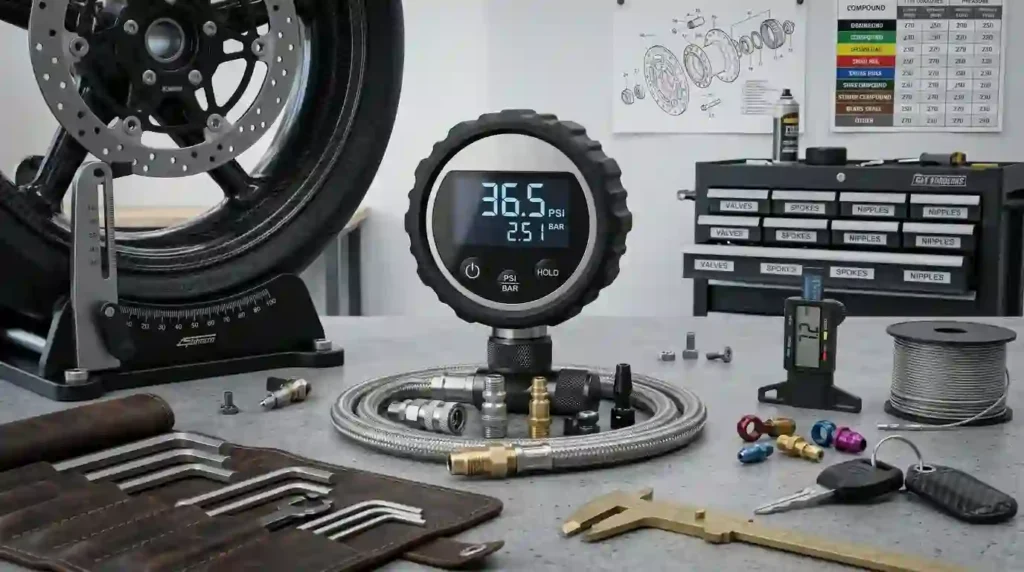
You squeeze the tire with your thumb and call it good. Then the ride feels harsh, the bike slides in a corner, or a pinch flat ends your day early. Sound familiar?
Many US riders guess at air pressure. Others trust the dial on a floor pump. Yet riders often report that pump gauges can differ from a separate gauge by several PSI. That gap is big enough to change comfort, grip, and flat risk.
The best bike tyre pressure gauge gives you repeatable readings you can trust. It fits your valve, covers your normal PSI range, and is easy to use before every ride. That one tool supports safety, speed, and comfort.
This guide covers gauge types, buying factors, and how to use one. It also shows how to test a gauge yourself. We do not name brands or invent specs, because the best pick depends on your tires and your habits.
You can read how we vet advice in our editorial policy.
What Is a Bike Tire Pressure Gauge?
A bike tire pressure gauge measures the air pressure inside a tire in pounds per square inch (PSI). Many also show bar or kPa. One bar equals about 14.5 PSI, and one PSI equals about 6.9 kPa.
Accurate readings help you avoid underinflation and overinflation. You will see three common styles: digital, analog, and pump-mounted.
Quick answer: A bike tire pressure gauge is a tool that measures the air pressure inside a tire, usually in pounds per square inch (PSI). It helps you avoid underinflation and overinflation. The three main types are digital gauges, analog dial gauges, and pump-mounted gauges built into floor pumps.
Why Is an Accurate Tire Pressure Gauge Important?
Correct PSI balances rolling resistance, comfort, traction, and tire protection. Low pressure raises pinch flat risk. Too much pressure cuts grip and can exceed equipment limits.
A reliable gauge also lets you repeat the same setting before every ride. That makes it easy to learn what works for you. It also helps you avoid overinflating a bike tire.
The thumb squeeze test is not a substitute. Two riders can press the same tire and guess pressures 10 PSI apart. See our guide on finding the correct bike tire pressure for target numbers.
How Does a Bike Tire Pressure Gauge Work?
The gauge reads air pressure through a valve connection. Digital models show a number on a screen. Analog models move a needle across a dial.
The head must fit the valve and seal well. A poor seal can give a false reading or waste air. Read how to check bike tire pressure for a full walkthrough.
Best Types of Bike Tire Pressure Gauges
Digital, analog, and pump-integrated gauges differ in accuracy, ease of use, and portability. A useful PSI range matters more than a long feature list. Pick a gauge that suits your tire type and pressure needs.
| Type | Strengths | Watch For |
|---|---|---|
| Digital | Easy to read, shows PSI or bar | Battery life, fine digits that look precise |
| Analog | No battery, simple | Small dial markings |
| Pump-mounted | Always on hand | Readings can drift from a separate gauge |
| Compact | Fits a saddlebag | Smaller display |
Digital Bike Tire Pressure Gauges
Digital displays are easy to read and often show PSI, bar, or kPa. Some add backlit screens, compact bodies, and pressure-release buttons.
Check battery life, valve fit, pressure range, and published accuracy. A digital screen looks precise, but it does not guarantee a precise reading.
Analog Bike Tire Pressure Gauges
Analog gauges use a dial or mechanical needle. They need no batteries. Large dials can be easy to read in a home workshop.
Look for clear markings, a suitable low-pressure range, and a secure valve connection. Many quality analog gauges use a spring-based tube inside to move the needle.
Pump-Mounted Tire Pressure Gauges
Many floor pumps include a built-in gauge for routine inflation. It is handy and always in reach.
A separate gauge can verify the pump’s reading, especially if the dial is hard to read. Check the gauge’s useful range and how easily you can read it at your normal PSI. Our guide on how to inflate a bike tire correctly explains the pump steps.
Compact and High-Pressure Gauges
Compact gauges suit road rides and emergency kits. High-pressure road tires need a gauge that covers their range with fine steps.
Mountain bike and gravel riders should also check accuracy at lower pressures. Many riders carry one small gauge for trail-side changes. Keep it in a pocket or pack where it will not get crushed or dirty.
What to Look for in the Best Bike Tire Pressure Gauge
Put accuracy, repeatability, valve fit, and a useful range first. Then weigh display quality, portability, durability, and ease of use.
Choose features that match your riding. Skip extras you will never use. A simple gauge that reads the same every time beats a fancy one that does not.
Accuracy and Measurement Resolution
Accuracy is how close a reading is to the true pressure. Resolution is the smallest step the gauge shows.
| Term | Meaning | Example |
|---|---|---|
| Accuracy | Closeness to true pressure | Reads 60 when true is 60 |
| Resolution | Smallest displayed step | Shows 0.1 PSI steps |
| Repeatability | Same result each time | Three reads, same number |
A display with fine steps does not prove the gauge is accurate to that level. Look for stated tolerances.
Riders often report that a pump gauge and a separate gauge disagree by several PSI. Neither may be exactly right. That is why one consistent gauge matters more than a perfect one.
PSI Range and Low-Pressure Performance
Choose a range that covers your recommended pressures. Your normal PSI should sit in the middle of the scale, not at the very edge.
| Bike Type | Typical Starting PSI | Range Tip |
|---|---|---|
| Road (28 to 32 mm) | 55 to 75 | Needs a higher range |
| Gravel (40 mm) | 28 to 45 | Mid range works |
| Mountain (2.2 to 2.6 in) | 18 to 28 | Needs clear low readings |
| Commuter or e-bike | Check the load rating | Match the tire label |
Hookless rims often cap pressure near 72.5 PSI (5 bar). Always follow your rim label. The tire sidewall also lists a maximum pressure, and our guide on how to read bike tire size helps you decode the markings.
Presta and Schrader Valve Compatibility
Presta valves are common on road, gravel, and many mountain bikes. Schrader valves show up on commuter bikes and some other types.
| Valve | Common On | Gauge Tip |
|---|---|---|
| Presta | Road, gravel, many MTBs | Loosen the tip first |
| Schrader | Commuters, some MTBs | Press on for a tight seal |
Check whether the gauge fits both directly or needs an adapter.
Bleed Buttons and Pressure Adjustment
A bleed button lets out small bursts of air so you can fine-tune PSI. It helps when you set pressure for grip or comfort.
Recheck the reading after you release air. Many riders pump a bit high, then bleed down to the exact target. That avoids pump error.
Digital vs. Analog Bike Tire Pressure Gauges
Compare ease of reading, power needs, durability, and typical use. Display type alone does not set accuracy.
Look at stated accuracy and repeatability instead of marketing claims. Our guide on how much air to put in bike tires helps you pick a target first.
Which Gauge Is More Accurate?
Both types can give useful readings if they are well designed and cared for. Digital gauges can drift with a weak battery. Analog gauges can drift after drops and wear.
Compare stated tolerances and independent tests when you can find them. Use the same gauge for every adjustment. That cuts variation between readings.
What Gauge Works Best for Beginners?
Digital gauges are easy to read at a glance. Analog gauges are simple and need no battery.
Pick a clear display, a secure valve fit, and easy instructions. Pair it with our guide on how often to check bike tires. New to tire setup? Start with how to choose bike tires.
Which Gauge Is Best for Professional or Workshop Use?
Look for repeatable readings, durable build, and a useful range. Pick a gauge you can check against a trusted reference.
Keep notes when you verify or calibrate. Records matter when you need precise numbers for many customers or many bikes.
A shop might check its main gauge every few months against a reference. A home rider can simply compare two gauges now and then and note any gap.
Best Bike Tire Pressure Gauge Features for Different Cyclists
Match the gauge to your tires, usual PSI, and riding conditions. Think about where the tool will live: workshop, backpack, or saddlebag.
| Rider | Top Priority | Helpful Extra |
|---|---|---|
| Road | High range, fine steps | Presta head |
| Mountain | Low-pressure accuracy | Bleed button |
| Gravel | Repeatable mid range | Compact body |
| Commuter or e-bike | Durable and quick | Schrader fit |
Best Gauge for Road Cyclists
Choose a gauge that reads your higher range clearly. Fine steps help with small changes, if the gauge is accurate enough.
Check that the head fits your road tire’s Presta valve. Our guide to bike tires for speed vs comfort shows why small PSI changes matter.
Ideal Gauge for Mountain Bikers
Put useful low-pressure readings first, along with a tight valve fit. A bleed button helps you fine-tune grip and tire support on the trail.
A compact body helps when you change PSI between trail conditions. Southwestern loose rocks and Pacific Northwest mud ask for different pressures. See bike tires for rough roads.
Gauge Features for Gravel Riders
Look for repeatable readings across the PSI range of your gravel tires. A compact gauge helps when you move from hard-packed roads to loose gravel.
Choose a head that works with your valve type and tubeless setup. If your rides mix pavement and dirt, see how to choose tires for mixed surfaces. Read our guide to bike tires for gravel roads.
Best Gauge for Commuters and E-Bike Riders
A durable gauge helps with regular checks and heavier loads. E-bike torque and extra weight make steady pressure and sound tires more important.
Pick a simple gauge that is quick to use before daily rides. A heavy bike with panniers can lose air unnoticed, so a ten-second check pays off. See how to choose tires for a commuter bike.
How to Use a Bike Tire Pressure Gauge Correctly
Use a gauge that fits the valve securely. Check the tire maker’s guidance and the rim limits. Use the same method every time.
First, find a target. Here is a simple formula for tubeless tires:
- System weight (lb) = rider + bike + clothing + cargo.
- Rear load = system weight x 0.55.
- Rear PSI = (rear load x K) divided by tire width in mm.
- Front PSI = rear PSI minus 3 to 5.
Use K = 20 on smooth pavement, 18 on rough pavement, 16 on hard-packed gravel, and 14 on loose gravel or trail. Add 5 PSI for tubes.
Example: A 175 lb rider on a 25 lb bike is 200 lb. Rear load is 110 lb. On 32 mm (1.26 in) tires over smooth pavement: 110 x 20 divided by 32 is about 69 PSI (4.8 bar). Front is about 65 PSI.
Step-by-Step Guide to Checking Tire PSI
- Find your range. Use the tire and wheel system guidance.
- Prepare the valve. Remove the cap and follow the valve design.
- Attach the gauge. Press on firmly without forcing the valve.
- Read PSI. Compare it with your target.
- Adjust. Add air or release a little as needed.
- Measure again. Then replace the valve cap.
Checking Presta and Schrader Valves
On a Presta valve, remove the cap and loosen the small tip before you measure. On a Schrader valve, press the gauge over the opening and make sure it seals.
Follow the gauge’s instructions. That avoids extra air loss and valve damage.
How Often Should You Check Bike Tire Pressure?
Check before long rides and demanding sessions. Check more often with high-pressure tires or if you notice air loss. Big temperature swings, like a cold Midwest morning, can shift pressure by a few PSI.
If pressure drops again and again, inspect the tire, valve, and tubeless sealant. Read how often to inflate bike tires and learn why bike tires lose air.
How Tire Pressure Accuracy Affects Bike Performance
The right PSI supports rolling efficiency, grip, and comfort. Tire width, casing, system weight, and surface change your target. A gauge measures pressure but does not choose the correct PSI.
| Total System Weight | 28 mm Road (PSI) | 32 mm Road (PSI) | 40 mm Gravel (PSI) |
|---|---|---|---|
| 140 lb (64 kg) | 58 front / 62 rear | 48 / 52 | 32 / 35 |
| 160 lb (73 kg) | 64 / 68 | 53 / 57 | 36 / 39 |
| 180 lb (82 kg) | 70 / 74 | 58 / 62 | 40 / 43 |
| 200 lb (91 kg) | 76 / 80 | 63 / 67 | 44 / 47 |
| 220 lb (100 kg) | 82 / 86 | 68 / 72 | 47 / 50 |
| 240 lb (109 kg) | 88 / 92 | 73 / 77 | 51 / 54 |
Note: These are starting estimates for tubeless tires on 19 to 21 mm inner rim width. Add about 5 PSI with tubes. Stay within all limits.
PSI and Rolling Resistance
Suitable pressure cuts needless tire deformation on a given surface. Excess pressure can raise vibration losses on rough roads.
Compare settings on the same route in similar conditions. Browse the best bike tires for speed if you want a faster casing too. Casing flex, TPI, and durometer also affect speed. See how much bike tires affect speed.
PSI, Comfort, and Cornering Grip
Correct pressure helps the tire follow the ground while it supports you. Too much pressure cuts compliance. Too little causes tire squirm.
Change pressure in small steps and check stability before you ride hard. For rough, long days, see how to choose comfortable bike tires. In rain, many riders drop 3 to 5 PSI for cornering traction. See how to choose bike tires for wet weather. Read how much bike tires affect grip.
PSI and Puncture Risk
Underinflation can raise pinch flat risk in tubed tires. Tubeless tires can still suffer rim strikes, air loss, and casing damage.
Correct pressure reduces some risks but cannot stop every puncture from sharp debris. Learn how to choose puncture-resistant bike tires.
How to Choose a Gauge for Tubeless and Inner-Tube Tires
Both systems need accurate pressure checks. Riders often run different pressures on different tire types and surfaces. Valve and gauge fit should be a key part of your choice.
| Setup | Gauge Priority | Pressure Habit |
|---|---|---|
| Tubeless | Clear low-range reading | Run lower, check often |
| Inner tube | Range that covers tire limits | Run a bit higher |
Does a Tubeless Setup Need a Special Gauge?
Most tubeless tires work with a suitable gauge that fits the valve. Low-pressure riding benefits from clear, repeatable low-range readings.
Check fit with your tubeless valve and any stem add-ons. Our bike tire casing guide explains why low pressure needs a sturdy casing.
How Does Tubeless Sealant Affect Pressure Checks?
Sealant closes many small punctures, but it does not replace pressure checks.
Repeated loss may point to a leak, poor bead seating, or a valve issue. Check sealant as the product maker advises. Hot, dry climates like the Southwest can dry it faster.
Do Inner-Tube Tires Need a Different Gauge?
No special gauge is needed just because a tire uses a tube. Pick a gauge that covers the tire’s range and fits its valve.
Check pressure before rides to help reduce pinch flat risk. See what happens if bike tire pressure is too high for the other side of the story.
How to Test Bike Tire Pressure Gauges Like an Expert
Compare readings with a suitable reference gauge or a calibrated pressure source. Test repeated readings at several points in your range. Report test conditions and separate maker claims from measured results.
Learn how we run comparisons on our testing process page.
How to Compare Gauge Accuracy
- Pick one tire. Inflate it to a steady pressure.
- Measure with each gauge. Take three readings per gauge.
- Note the spread. Write down how much each gauge varies.
- Compare to a reference. Use a trusted gauge at low, medium, and higher PSI.
- Repeat later. Check again after a few weeks.
Do not treat display resolution as proof of accuracy.
Which Testing Standards and Specifications Matter?
Review the maker’s stated accuracy and operating range. Use suitable calibration or verification methods where you can.
Do not claim compliance with a standard unless product documents back it up. For tire and rim fit, see our guide to ETRTO bike tire sizes and our bike tire size compatibility guide.
What Should a Trustworthy Gauge Review Include?
A good review reports valve fit, pressure range, readability, build quality, and ease of use. It explains the test method and the reference used.
It also lists pros and cons for road, gravel, mountain, and commuter riders. If a review gives no method, treat its claims with caution. Be wary of any review that names a winner without showing how it measured accuracy.
Common Bike Tire Pressure Gauge Mistakes to Avoid
A poor valve seal can waste air or give false readings. Check pressure with a steady method. Handle your gauge with care and verify it from time to time.
| Mistake | What Happens | Better Move |
|---|---|---|
| Wrong range | Hard to read | Match range to your PSI |
| Bad valve seal | Reading drops | Reseat and repeat |
| Rough handling | Drifting readings | Store it safely |
| Mixing gauges | Inconsistent PSI | Use one gauge |
Choosing a Gauge With the Wrong Pressure Range
A gauge is hard to use if your normal PSI sits near the bottom or top of its scale. Pick a range that suits your tire type and riding style.
Check the maker’s stated accuracy across that range. Also confirm the gauge reads in the unit you use, PSI in the US. A low-range gauge cannot safely read road tire pressure, and the reverse is also true.
Pressing the Gauge Onto the Valve Incorrectly
A poor seal can make the reading drop or jump. Forcing a gauge onto a valve can damage the valve or gauge head.
Follow the instructions. If a reading looks odd, try again.
Ignoring Gauge Accuracy Over Time
Drops, wear, and valve damage can hurt reliability. Compare your gauge with a trusted reference now and then if accuracy matters.
Replace or service a gauge that gives inconsistent readings. Tires wear too, so see how often bike tires should be replaced.
Frequently Asked Questions About Bike Tire Pressure Gauges
1. What Is the Best Bike Tire Pressure Gauge?
The best gauge gives repeatable readings across your normal PSI range. Choose one with the right valve fit, clear markings, and documented accuracy.
2. Are Digital Bike Tire Pressure Gauges More Accurate?
Not always. Accuracy depends on design and specs, not just the display. Compare stated tolerances and test results before you buy.
3. Can I Use a Car Tire Pressure Gauge on a Bike?
Some car gauges can read bike tires if the range and valve fit are right. A gauge made for bike PSI is often easier to read and use. Car gauges may not suit Presta valves without an adapter.
4. Do I Need a Special Gauge for Presta Valves?
You need a gauge that fits a Presta valve directly or works with a suitable adapter. Check fit before you buy.
5. How Often Should I Check My Bike Tire Pressure?
Check before long rides and whenever tires look or feel low. Frequent checks help with high-pressure tires and setups that lose air quickly.
6. What PSI Should My Bike Tires Be?
It depends on tire width, system weight, surface, and tire setup. As a rough start, a 200 lb rider on a 25 lb bike (225 lb total) might try 80 to 90 PSI on 28 mm road tires or 45 to 55 PSI on 40 mm gravel tires. Use maker guidance and our bike tire width guide to refine it.
7. Can a Tire Pressure Gauge Prevent Flat Tires?
A gauge helps you keep pressure that reduces some pinch flat and impact risks. It cannot stop every puncture from glass, thorns, or sharp objects.
8. Should I Check Tubeless Tire Pressure Before Every Ride?
Yes, it is a good habit. It helps you catch pressure loss and keep handling steady. If pressure keeps dropping, inspect sealant, valves, and tire condition.
Conclusion: Choose the Best Bike Tire Pressure Gauge
A reliable gauge makes it easier to hold the right PSI for comfort, grip, and tire protection. The key buying factors are accuracy, pressure range, valve fit, readability, and durability.
Key takeaways:
- Pick a gauge whose range puts your normal PSI near the middle.
- Match the head to your Presta or Schrader valve.
- Use one gauge for every adjustment, and verify it from time to time.
- Check pressure before rides and change it in small steps.
For more help, read what makes a good bike tire or compare bike tires for long-distance cycling.
Ready to dial in your exact setup? Use the Free Bike Tire Pressure Calculator and Tire Finder Tool at TheBikeTires.com to get a PSI built for your weight, tire width, and terrain. Then check it with your new gauge on your next ride.

Mohidul Islam is a leading cycling technology specialist and bike tire consultant with over 15 years of hands-on experience in the bicycle industry. He holds a Bachelor of Science in Mechanical Engineering from Penn State University, where he focused heavily on material science, tread mechanics, and rubber compound performance. Over the past decade and a half, Alex has conducted extensive field testing, tubeless setup evaluations, and tire pressure modeling for road, mountain, and e-bikes. His practical insights and data-driven approach help cyclists of all levels optimize grip, speed, and durability on every ride.